Journal of Korean Society of Dental Hygiene Open access, Peer Reviewed
pISSN 2287-1705, eISSN 2288-2294
Weeks in Review
Weeks to Publication
Journal of Korean Society of Dental Hygiene Open access, Peer Reviewed
pISSN 2287-1705, eISSN 2288-2294
Ji-Young Lee1 , Da-Jeong Kim2, Yu-Rin Kim2
1Department of Dental Hygiene, Daedong University
2Department of Dental Hygiene, Silla University
Correspondence to Yu-Rin Kim, Department of Dental Hygiene, Silla University, 140 Baegyang-daero 700beon-gil, Sasang-gu, Busan, 46958, Korea. E-mail: ttakjjung@gmail.com
Volume 26, Number 4, Pages 523–31, August 2026.
J Korean Soc Dent Hyg 2026;26(4):523–31. https://doi.org/10.13065/jksdh.2026.26.4.11
Received on July 06, 2026, Revised on July 16, 2026, Accepted on July 24, 2026, Published on August 30, 2026.
Copyright © 2026 Journal of Korean Society of Dental Hygiene.
This is an Open Access article distributed under the terms of the Creative Commons Attribution Non-Commercial License(http://creativecommons.org/licenses/by-nc/4.0).

Korea, Older adults living alone, Oral health, Water intake
우리나라는 세계적으로 가장 빠른 속도로 인구 고령화가 진행됨에 따라 독거노인 가구가 지속적으로 증가하고 있다[1]. 독거노인은 가족과 함께 거주하는 비독거노인에 비해 사회적 고립, 경제적 취약성 및 건강관리의 어려움을 경험할 가능성이 높으며, 이러한 환경적 요인들은 영양 상태와 전반적인 건강 수준에 부정적인 영향을 미친다. 특히 식사 준비의 어려움, 식욕 저하, 동반 만성질환의 증가 등은 충분한 영양과 수분을 적절히 공급받지 못하게 만드는 원인이 되며, 이로 인해 독거노인은 탈수 위험에 상대적으로 더 쉽게 노출되는 건강취약계층으로 알려져 있다[2].
노인은 생리적 노화 과정에서 체수분 항상성을 유지하는 능력이 감소하며, 특히 갈증을 인지하는 감각이 둔화되고 신장의 농축 기능이 저하되는 특징을 보인다[2,3]. 이로 인해 젊은 성인에 비해 체내 수분 부족 상태에 빠지기 쉬우며, 이러한 만성적인 수분 부족 상태는 심혈관 질환, 신장 기능 및 인지 기능 저하뿐만 아니라 노년기 삶의 질을 저하시킬 수 있다[2]. 더욱이 독거노인의 경우 일상적인 수분 섭취 행동을 모니터링하고 지지해 줄 보호자가 부재하여 탈수 위험성이 더욱 가중될 수 있다.
국민건강영양조사 자료를 활용한 선행연구에서는 가족 동거노인에 비해 독거노인의 구강기능 제한 및 저작 불편감 호소율이 상대적으로 높음이 확인된 바 있다[4]. 이는 독거 여부라는 사회환경적 요인이 노인의 실제 구강건강 및 삶의 질에 중요한 영향을 미칠 수 있음을 시사한다. 노년기의 자연치아 상실과 저작 기능 저하는 부드러운 음식 위주의 편중된 식사를 유발하여 식품 선택을 제한하고 영양 섭취 감소를 초래할 수 있으며, 결과적으로 적절한 영양 및 수분 섭취를 제한할 가능성이 있다[2,5]. 특히 식품을 통한 수분 섭취량은 식사를 통해 공급되는 수분을 반영하며, 식품 선택 및 저작 기능과 밀접한 관련이 있어 구강건강과의 관련성을 평가하는 데 적합한 지표로 활용될 수 있다. 따라서 독거노인 집단에서 식품을 통한 수분 섭취량과 구강건강의 연관성을 규명하는 것은 독거노인의 건강 특성을 이해하고 구강건강 증진을 위한 근거를 마련하는 데 중요한 의미가 있다.
체내 수분이 부족해지면 타액선의 기능이 저하되어 타액 분비량이 감소하고 구강건조증(Xerostomia)이 발생하기 쉽다[6,7]. 타액은 구강 내 윤활 작용뿐만 아니라 자정 작용 및 항균 작용을 담당하는 핵심 방어기전이기 때문에, 분비량 감소는 치아우식증과 치주질환의 발생 위험을 증가시키는 것으로 알려져 있다[7]. 나아가 이러한 구강 질환의 누적은 장기적으로 자연치아 상실의 위험 요인이 될 수 있으며, 저작, 연하 및 발음 기능의 저하를 유발하여 노인의 삶의 질을 저하시킬 수 있다[5,6]. 이러한 생리학적 기전을 고려하여 본 연구에서는 현존 자연치아 수, 저작기능 및 발음기능을 수분 섭취와의 관련성이 비교적 명확하게 보고된 구강건강 지표로 선정하였다.
최근 연구에서는 노인의 수분 섭취 수준이 구강건조 증상 및 구강 미생물과 관련이 있는 것으로 보고되었다[8]. 그러나 기존 연구들은 대부분 노인 전체를 대상으로 수행되어 독거 여부에 따른 차이를 충분히 고려하지 못하였으며, 식품을 통한 수분 섭취량과 객관적인 구강건강 지표 간의 관련성을 독거노인 집단에서 분석한 연구는 부족한 실정이다. 독거노인은 비독거노인보다 식생활 및 영양 상태가 상대적으로 취약할 가능성이 있으며, 이러한 특성은 식품을 통한 수분 섭취와 구강건강 간의 관계에도 영향을 미칠 가능성이 있다. 따라서 독거노인을 대상으로 식품을 통한 수분 섭취량과 구강건강의 연관성을 규명하는 것은 독거노인의 건강 특성을 이해하고 효과적인 건강관리 전략을 마련하기 위한 근거를 제공할 수 있을 것으로 기대된다.
이에 본 연구는 국가 단위 대표성 자료인 2020–2024년도 국민건강영양조사 자료를 활용하여 한국 독거노인과 비독거노인의 식품을 통한 수분 섭취량 및 구강건강 관련 지표를 비교하고, 독거노인 집단에서 식품을 통한 수분 섭취량과 구강건강 지표 간의 연관성을 분석하고자 하였다. 또한 2020–2024년 자료를 통합하여 상대적으로 표본 수가 제한적인 독거노인 하위집단에서도 통계적으로 안정적인 추정치를 확보하고, 독거노인의 구강건강 증진을 위한 영양관리 및 건강증진 전략 수립에 필요한 기초자료를 제공하고자 하였다.
본 연구는 국민건강영양조사 중 5개년도(2020–2024)의 자료를 사용하였으며 인체유래물 수집, 원시자료 제3자 제공 등을 고려하여 질병관리청 연구 윤리 심의위원회 승인(2018-01-03-2C-A, 2018-01-03-5C-A, 2018-01-03-4C-A, 2022-11-16-R-A, 2022-11-16-R-03)을 받았다. 국민건강영양조사는 2단계 층화 집락표본 추출법을 사용하여 시도, 동·읍면, 주택 유형(일반 주택, 아파트)을 기준으로 추출 틀을 층화하고, 주거면적 비율, 가구주 나이, 1인 가구 비율 등을 내재적 층화 기준으로 사용하였다. 건강행태 조사(자기기입 조사)에서 주요한 변수인 구강건강 관련 설문과 식습관 설문에 대한 결측값을 제외한 8,164명이 최종 분석대상이 되었다. 독립변수로 독거노인(Single-person older households; SG) 2,158명과 비독거노인(Multi-person older households; MG) 6,006명으로 구분하여 식품을 통한 수분 섭취량(사분위수)과 구강건강 관련 지표 차이를 확인하였고, 이후 독거노인 2,158명만 추출하여 식품을 통한 수분 섭취량(사분위수)과 구강건강 관련 지표의 연관성을 확인하였다<Fig. 1>.
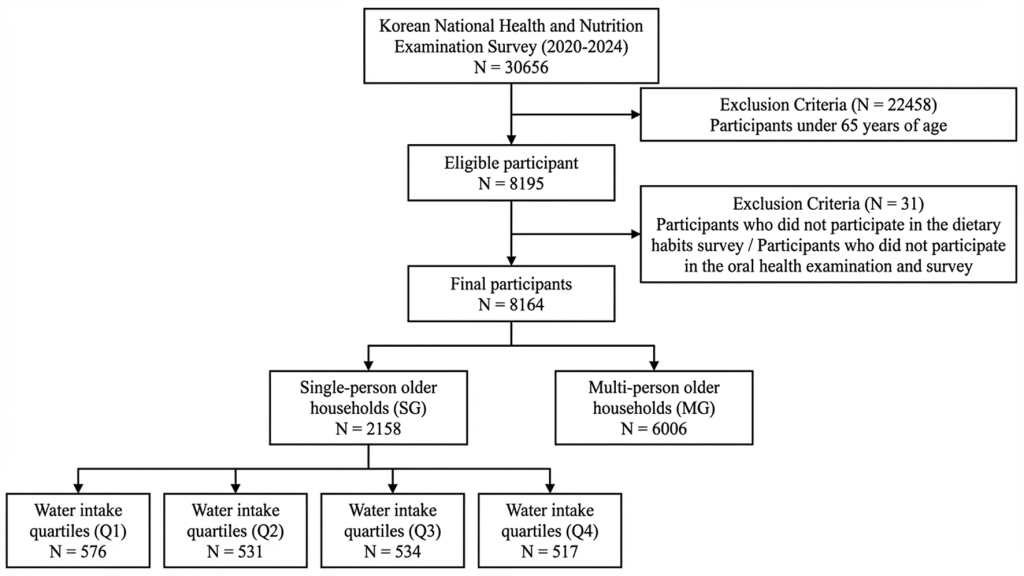
Fig. 1. Flow of study
1) 인구사회학적 특성 및 동반질환 조사
국민건강영양조사의 건강 설문조사를 통해 성별, 연령, 결혼상태, 교육수준, 수입수준, 흡연상태, 음주상태를 확인하였다. 결혼상태는 기혼과 미혼으로, 교육수준은 ‘초등 미만’, ‘중학교’, ‘고등학교’, ‘대학 이상’으로 구분하였다. 수입수준은 5분위 수인 ‘하’, ‘중하’, ‘중’, ‘중상’, ‘상’으로 구분하였다. 흡연상태는 ‘피운 적 없음 또는 과거흡연’, ‘가끔흡연’, ‘매일흡연’으로 구분하였고, 음주상태는 ‘평생 비음주 또는 월 1잔 미만’과 ‘월 1잔 이상’으로 확인하였다. 동반질환은 고혈압, 당뇨병, 이상지질혈증, 뇌졸중을 의사진단 유무로 확인하였다.
2) 식품을 통한 수분 섭취량
식품섭취조사(개인별 24시간 회상조사) 자료를 통하여 1일 수분 섭취량(g)을 확인하였으며 식품에 포함된 수분 섭취량의 합으로 물 섭취량과 음식 조리 시 추가된 조리수 섭취량은 미포함되었다. 본 연구에서는 식품을 통한 수분 섭취량(g)을 사분위수로 구분하여, 하위 25% 미만을Q1, 25% 이상 50% 미만을 Q2, 50% 이상 75% 미만을 Q3, 75% 이상을 Q4로 분류하였다.
3) 구강건강 관련 지표
구강건강 관련 지표로 구강 내 현존하는 자연치아 수와 구강건강 문제를 확인하였다. 구강건강 문제 중 씹는 기능에 대한 문제는 ‘현재 치아나 틀니, 잇몸 등 입안의 문제로, 음식을 씹는 데에 불편감을 느끼십니까?’로 조사되었고, 말하는 기능에 대한 문제는 ‘현재 치아나 틀니, 잇몸 등 입안의 문제로, 명확히 발음을 하는 데에 어려움이나 불편감을 느끼십니까?’로 조사되었다. 1점은 매우 불편함, 2점은 불편함, 3점은 그저 그러함, 4점은 불편하지 않음, 5점은 전혀 불편하지 않음으로 조사되었다. 본 연구에서는 역코딩하여 1점(불편감 없음)부터 5점(매우 불편함)까지의 범위를 가지며, 점수가 높을수록 구강기능의 불편감이 큰 것을 의미한다.
자료의 분석은 층화변수, 집락변수, 가중치를 부여한 복합표본설계 분석법(Complex sampling analysis)을 적용하였고, SPSS (ver. 21.0; IBM Corp., Armonk, NY, USA)로 분석하였다. 65세 이상 노인 8,164명 중 독거 여부에 따라 식품을 통한 수분 섭취량(사분위수)과 구강건강 관련 지표의 차이를 확인하였고, 이어 독거노인만 추출하여 식품을 통한 수분 섭취량(사분위수)에 따른 인구사회학적 특성 및 동반질환, 구강건강 관련 지표의 비교는 Complex sample Rao–Scott χ² test와 Complex-sample t-tests를 시행하였다. 식품을 통한 수분 섭취량(사분위수)에 따른 구강건강 관련 지표의 연관성은 Complex sample linear regression analysis를 시행하였다. Model 1은 아무런 보정을 하지 않았고, Model 2는 인구사회학적 특성과 동반질환을 보정하여 제시하였고, 자료의 결측값은 모두 제외하였다. 대상자 수는 가중되지 않은 빈도로 제시하였으며 통계적 검정의 유의수준은 0.05로 하였다.
독거노인과 비독거노인의 식품을 통한 수분 섭취량(사분위수) 차이를 확인한 결과는 <Table 1>에 제시하였다. 독거노인은 식품을 통한 수분 섭취량 사분위수 중에서 Q1의 비중이 25.1%로 가장 높았고, 비독거노인은 식품을 통한 수분 섭취량 사분위수 중에서 Q4의 비중이 32.2%로 가장 높았다(p<0.001).
Table 1. Difference in food-derived water intake (quartiles) between elderly living alone and elderly not living alone [Unit: unweighted n(%)]
| Characteristics | SG (n=2,158) | MG (n=6,006) | p* | |
|---|---|---|---|---|
| Food-derived water intake | Q1 | 576(25.1) | 1012(16.5) | <0.001 |
| Q2 | 531(24.9) | 1288(20.6) | ||
| Q3 | 534(25.0) | 1822(30.7) | ||
| Q4 | 517(25.0) | 1884(32.2) | ||
*by complex sample Rao–Scott χ² test.
SG: Single-person older households; MG: Multi-person older households; Q1: 1st quartile; Q2: 2nd quartile; Q3: 3rd quartile; Q4: 4th quartile.
독거노인과 비독거노인의 구강건강 관련 지표 차이를 확인한 결과는 <Table 2>에 제시하였다. 현존하는 자연치아의 수의 경우 독거노인은 평균 17.03개였고, 비독거노인은 평균 18.84개로 더 많았다. 씹는 기능에 대한 문제의 경우 독거노인은 평균 2.71점이었고, 비독거노인은 평균 2.56점으로 더 낮았다. 말하는 기능에 대한 문제의 경우 독거노인은 평균 1.99점이었고, 비독거노인은 평균 1.87점으로 더 낮았다. 씹는 기능과 말하는 기능에 대한 문제를 합한 경우 독거노인은 평균 4.69점이었고, 비독거노인은 평균 4.43점으로 더 낮았다(p<0.001).
Table 2. Differences in oral health related indicators between elderly people living alone and those not living alone (Mean±SE)
| Characteristics | SG (n=2,158) | MG (n=6,006) | p* |
|---|---|---|---|
| Number of natural teeth | 17.03±0.25 | 18.84±0.23 | <0.001 |
| Problems with chewing function | 2.71±0.03 | 2.56±0.02 | <0.001 |
| Problems with speaking function | 1.99±0.03 | 1.87±0.02 | <0.001 |
| Oral health problems (chewing+speaking) | 4.69±0.05 | 4.43±0.04 | <0.001 |
*by complex-sample t-tests.
SG: Single-person older households; MG: Multi-person older households.
독거노인의 식품을 통한 수분 섭취량(사분위수)에 따른 인구사회학적 특성 및 동반질환 차이를 확인한 결과는 <Table 3>에 제시하였다. 성별의 경우 식품을 통한 수분 섭취량 사분위 중에서 Q1에서 여성의 비중이 79.3%로 가장 높았고, Q4에서 남성의 비중이 34.6%로 가장 높았다. 연령의 경우 Q1은 평균 73.45세로 가장 많았고, Q4는 평균 71.51세로 가장 적었다. 결혼상태의 경우 모든 집단에서 기혼자의 비중이 높았으며, 교육수준의 경우 Q1은 초졸 이하가 79.5%였고, Q4는 42.4%였다. 수입수준의 경우 Q1은 ‘하’가 76.7%였고, Q4는 43.0%였다. 흡연상태의 경우 Q1은 ‘매일 흡연’이 39.2%였고, Q4는 25.1%였다. 음주상태의 경우 Q1은 ‘월 1잔 이상’이 19.4%였고, Q4는 29.4%였다. 동반질환의 경우 고혈압과 뇌졸중은 Q1에서 가장 높은 비중을 보였고, 당뇨는 Q2, 이상지질혈증은 Q3에서 높은 비중을 보였다. 고혈압과 당뇨를 제외하고 모든 변수에서 유의한 차이가 있었다(p<0.001).
Table 3. Sociodemographic characteristics and comorbidities of elderly people living alone according to food-derived water intake (quartiles) [Unit: unweighted N(%)]
| Characteristics | Division | Q1 (n=576) | Q2 (n=531) | Q3 (n=534) | Q4 (n=517) | p* |
|---|---|---|---|---|---|---|
| Sex | Male | 102(20.7) | 119(23.9) | 132(26.5) | 177(34.6) | <0.001 |
| Female | 474(79.3) | 412(76.1) | 402(73.5) | 340(65.4) | ||
| **Age | 73.45±0.15 | 73.36±0.14 | 72.29±0.12 | 71.51±0.11 | <0.001 | |
| Marital status | Single | 12(2.2) | 9(1.6) | 23(4.4) | 21(4.3) | <0.001 |
| Married | 564(97.8) | 522(98.4) | 511(95.6) | 496(95.7) | ||
| Education level | ≤Elementary school | 377(79.5) | 324(67.5) | 283(57.8) | 215(42.4) | <0.001 |
| Middle school | 42(9.4) | 72(15.0) | 80(18.1) | 85(17.0) | ||
| High school | 33(9.1) | 50(12.2) | 74(15.7) | 122(27.3) | ||
| ≥University | 8(1.9) | 24(5.3) | 34(8.4) | 64(13.2) | ||
| Income level | Low | 445(76.7) | 354(64.1) | 295(54.3) | 224(43.0) | <0.001 |
| Low-middle | 88(17.0) | 124(25.5) | 155(30.2) | 169(32.4) | ||
| Middle | 21(4.8) | 28(6.1) | 54(10.5) | 58(11.3) | ||
| Middle-high | 7(1.3) | 12(2.4) | 16(3.4) | 47(10.1) | ||
| High | 2(0.3) | 10(1.9) | 9(1.6) | 15(3.2) | ||
| Smoking status | Non-smoker/ex-smoker | 64(55.5) | 68(59.4) | 82(70.4) | 116(74.8) | <0.001 |
| Occasional smoker | 5(5.3) | 4(5.2) | 4(3.4) | 1(0.1) | ||
| Daily smoker | 48(39.2) | 40(35.5) | 33(26.2) | 43(25.1) | ||
| Alcohol status | <1 drink/month | 425(80.6) | 380(75.6) | 387(75.5) | 359(70.6) | <0.001 |
| ≥1 drink/month | 93(19.4) | 120(24.4) | 123(24.5) | 149(29.4) | ||
| Comorbidities | Hypertension | 353(61.1) | 332(62.1) | 315(59.1) | 298(57.3) | 0.243 |
| Diabetes | 153(26.5) | 143(27.4) | 131(23.9) | 134(25.9) | 0.376 | |
| Dyslipidemia | 230(40.4) | 227(42.8) | 269(51.0) | 248(50.6) | <0.001 | |
| Stroke | 28(10.6) | 15(6.0) | 22(7.6) | 13(4.5) | <0.001 |
*by complex-sample Rao–Scott χ² test, **by complex sample t-tests.
Q1: 1st quartile; Q2: 2nd quartile; Q3: 3rd quartile; Q4: 4th quartile.
Missing values were excluded from each variable.
독거노인의 식품을 통한 수분 섭취량(사분위수)에 따른 구강건강 관련 지표 차이를 확인한 결과는 <Table 4>에 제시하였다. 구강 내 현존하는 자연치아 수의 경우 Q1은 평균 14.97개였고, Q4는 19.02개로 더 많았다. 씹는 기능에 대한 문제의 경우 Q1은 평균 2.83점이었고, Q4는 평균 2.66점이었다. 말하는 기능에 대한 문제의 경우 Q1은 평균 2.14점이었고, Q4는 평균 1.84점이었다. 씹는 기능과 말하는 기능에 대한 문제를 합한 구강건강 문제의 경우 Q1은 4.97점으로 가장 높은 반면, Q4는 4.49점으로 가장 낮았다. 씹는 기능에 대한 문제를 제외하고 모든 변수에서 유의한 차이가 있었다(p<0.01).
Table 4. Differences in oral health indicators according to food-derived water intake (quartiles) of elderly living alone (Mean±SE)
| Characteristics | Q1 (n=576) | Q2 (n=531) | Q3 (n=534) | Q4 (n=517) | p* |
|---|---|---|---|---|---|
| Number of natural teeth | 14.97±0.41 | 17.10±0.49 | 17.09±0.37 | 19.02±0.31 | <0.001 |
| Problems with chewing function | 2.83±0.06 | 2.71±0.06 | 2.65±0.05 | 2.66±0.05 | 0.057 |
| Problems with speaking function | 2.14±0.06 | 1.99±0.05 | 1.99±0.05 | 1.84±0.04 | <0.001 |
| Oral health problems (chewing+speaking) | 4.97±0.10 | 4.70±0.10 | 4.64±0.08 | 4.49±0.08 | 0.002 |
*by complex-sample t-tests.
Q1: 1st quartile; Q2: 2nd quartile; Q3: 3rd quartile; Q4: 4th quartile.
독거노인의 식품을 통한 수분 섭취량과 구강건강 관련 지표의 연관성을 확인한 결과는 <Table 5>에 제시하였다. 아무런 보정을 하지 않은 Model 1의 경우 모든 구강건강 관련 지표에서 유의미한 연관성이 있었다. 현존하는 자연치아의 수의 경우 Q4를 기준으로 Q3은 1.174개, Q2는 2.843개, Q1은 4.075개 감소하였다. 씹는 기능에 대한 문제의 경우 Q4를 기준으로 Q3은 0.163점, Q2는 0.343점, Q1은 0.363점 높았다. 말하는 기능에 대한 문제의 경우 Q4를 기준으로 Q3은 0.112점, Q2는 0.229점, Q1은 0.314점 높았다. 구강건강 문제의 경우 Q4를 기준으로 Q3은 0.274점, Q2는 0.571점, Q1은 0.675점 높았다(p<0.001).
인구사회학적 특성 및 동반질환을 보정한 Model 2의 경우 현존하는 자연치아의 수의 경우 Q4를 기준으로 Q2는 2.560개, Q1은 2.158개 감소하였다. 씹는 기능에 대한 문제의 경우 Q4를 기준으로 Q3은 0.100점, Q1은 0.273점 높았다. 말하는 기능에 대한 문제의 경우 Q4를 기준으로 Q2는 0.156점, Q1은 0.159점 높았다. 구강건강 문제의 경우 Q4를 기준으로 Q2는 0.266점, Q1은 0.432점 높았다(p<0.05).
Table 5. Association between water intake (quartiles) and oral health indicators in elderly people living alone
| Characteristics | Model 1 | Model 2 | |||
|---|---|---|---|---|---|
| β (95% CI) | p(R2) | β (95% CI) | p(R2) | ||
| Number of natural teeth | Q1 | −4.075 (−4.759 to −3.391) | <0.001 | −2.158 (−3.575 to −0.741) | 0.003 |
| Q2 | −2.843 (−3.550 to −2.136) | <0.001 | −2.560 (−3.668 to −1.452) | <0.001 | |
| Q3 | −1.174 (−1.730 to −0.618) | <0.001 | −0.012 (−0.846 to 0.821) | 0.977 | |
| Q4 | Reference | (0.026) | Reference | (0.163) | |
| Problems with chewing function | Q1 | 0.363 (0.276 to 0.450) | <0.001 | 0.273 (0.132 to 0.414) | <0.001 |
| Q2 | 0.343 (0.252 to 0.434) | <0.001 | 0.110 (−0.044 to 0.263) | 0.160 | |
| Q3 | 0.163 (0.099 to 0.228) | <0.001 | 0.100 (0.002 to 0.197) | 0.045 | |
| Q4 | Reference | (0.013) | Reference | (0.045) | |
| Problems with speaking function | Q1 | 0.314 (0.245 to 0.382) | <0.001 | 0.159 (0.029 to 0.290) | 0.017 |
| Q2 | 0.229 (0.152 to 0.306) | <0.001 | 0.156 (0.039 to 0.273) | 0.009 | |
| Q3 | 0.112 (0.062 to 0.161) | <0.001 | 0.044 (−0.049 to 0.138) | 0.350 | |
| Q4 | Reference | (0.011) | Reference | (0.061) | |
| Oral health problems (chewing+speaking) | Q1 | 0.675 (0.535 to 0.815) | <0.001 | 0.432 (0.186 to 0.679) | <0.001 |
| Q2 | 0.571 (0.421 to 0.721) | <0.001 | 0.266 (0.014 to 0.517) | 0.039 | |
| Q3 | 0.274 (0.172 to 0.377) | <0.001 | 0.144 (−0.021 to 0.309) | 0.086 | |
| Q4 | Reference | (0.015) | Reference | (0.060) | |
*by complex sample linear regression analysis.
Reference group: Q4; Model 1: crude model; Model 2: adjusted for sociodemographic characteristics and comorbidities.
CI: confidence interval; Q1: 1st quartile; Q2: 2nd quartile; Q3: 3rd quartile; Q4: 4th quartile.
본 연구는 국민건강영양조사 5개년도 자료(2020–2024)를 활용하여 한국의 독거노인과 비독거노인의 식품을 통한 수분 섭취량 및 구강건강 관련 지표의 차이를 분석하고, 독거노인을 대상으로 식품을 통한 수분 섭취량(사분위수)에 따른 구강건강 관련 지표와의 연관성을 분석하였다. 그 결과, 독거노인은 비독거노인에 비해 식품을 통한 수분 섭취량이 적고 구강건강 상태도 전반적으로 불량한 것으로 나타났으며, 독거노인 내에서도 식품을 통한 수분 섭취량이 낮을수록 자연치아 수 감소 및 구강기능 저하와 관련되는 것으로 나타났다. 이러한 결과는 노인의 수분 섭취와 구강건강 간의 관련성을 보고한 선행 연구들과 전반적으로 유사하게 나타났다[6–9].
노인은 생리적 노화에 따라 갈증 인지 능력이 감소하고 체수분 항상성 유지 능력이 저하되어 탈수 또는 저수분 상태에 쉽게 노출되는 것으로 알려져 있다[2,3]. Hooper et al. [3]은 고령자에서 탈수 위험이 증가하며 이는 전반적인 건강 악화와 관련될 수 있다고 보고하였고, Volkert et al. [2]은 노인의 수분 섭취 부족을 주요 영양 문제 중 하나로 제시하였다. Kim and Jin [10]은 독거노인이 가족과 함께 거주하는 노인보다 영양섭취 수준과 구강건강 상태가 더 취약한 것으로 보고하였다. 이러한 영양학적 취약성은 수분을 포함한 전반적인 영양소의 불충분한 섭취로 이어질 가능성이 있으며, 이는 독거노인의 수분 섭취 부족 위험을 증가시키는 요인으로 작용할 수 있다. 따라서 독거노인의 수분 섭취 부족은 노화에 따른 생리적 변화와 함께 독거노인의 영양학적 취약성이 복합적으로 작용한 결과로 생각된다.
구강건강 관련 지표에서도 식품을 통한 수분 섭취량이 낮은 군(Q1)의 자연치아 수가 평균 14.97개로 가장 적었고, 수분 섭취량이 높은 군(Q4)에서는 19.02개로 가장 많았다. 그러나 보정모형에서는 Q4 기준으로 자연치아 수의 감소폭이 Q1보다 Q2에서 다소 크게 나타났다. 이러한 결과는 Q1 집단에서 평균 연령이 가장 높고, 여성, 저학력 및 저소득층의 비율이 높았으며, 뇌졸중 유병률 또한 상대적으로 높았던 특성을 보정하는 과정에서 추정치가 변화한 결과로 해석될 수 있다. 연령, 사회경제적 수준 및 건강상태는 자연치아 상실과 밀접한 관련이 있는 요인으로 알려져 있으며[11], 이러한 교란요인을 통제한 후 Q1의 효과크기가 일부 감소한 것으로 판단된다. 다만 Q1과 Q2의 회귀계수 차이는 크지 않고 신뢰구간도 상당 부분 중첩되어 교란변수 보정에 따른 추정치의 변동으로 이해할 필요가 있다. 따라서 본 연구는 낮은 식품 유래 수분 섭취와 자연치아 수 감소 간의 연관성을 확인하였으나, 완전한 선형적 용량-반응 관계를 시사하는 것으로 해석하는 데에는 주의가 필요할 것이다. 말하기 기능 및 전반적인 구강건강 문제 점수 역시 식품을 통한 수분 섭취량이 낮을수록 높은 경향을 보였다. 이러한 결과는 구강 내 수분 환경과 구강건강 간의 연관성을 뒷받침하는 것으로 볼 수 있으며, 실제로 국내 연구에서도 노인의 수분 섭취 수준에 따라 구강건조증 및 구강미생물의 차이가 있는 것으로 확인되어[8] 본 연구 결과와 유사하게 나타났다. 또한 수분 및 주요 영양소 섭취 수준이 잔존치아 수와 유의한 관련이 있다는 선행연구도 보고된 바 있어[9], 본 연구에서 나타난 수분 섭취 수준에 따른 자연치아 수의 차이를 뒷받침하는 결과로 볼 수 있다.
노인에서 흔히 나타나는 구강건조(Xerostomia)는 타액 분비 감소와 밀접하게 관련되며, 이는 저작, 연하 및 발음 기능 저하뿐 아니라 치아우식증 및 치주질환 발생 위험 증가와도 연관되는 것으로 보고되고 있다[6,7]. Thomson[6]은 노인에서 구강건조가 삶의 질 저하와 구강기능 감소에 영향을 미친다고 보고하였으며, Turner and Ship [7] 또한 타액 감소가 구강 질환 발생의 주요 위험요인임을 제시하였다. 타액은 구강 내 윤활작용뿐 아니라 항균 작용과 pH 조절 등 중요한 방어기전을 담당하기 때문에, 체내 수분 부족은 구강건강 악화로 이어질 수 있다. 또한 수분 섭취와 구강건강 간의 관계는 생활습관 요인의 측면에서도 설명될 수 있다. Petersen and Yamamoto [12]는 노인의 구강건강이 생활습관 및 사회환경적 요인과 밀접하게 관련된다고 보고하였으며, 수분 섭취는 이러한 기본적인 건강행태 중 하나로 볼 수 있다. 국내 연구에서도 수분 관련 요인과 구강건강 관련 삶의 질 간의 유의한 연관성이 보고된 바 있으며[13], 본 연구에서도 식품을 통한 수분 섭취량이 높은 군에서 구강건강 지표가 양호하게 나타난 결과 역시 이러한 맥락에서 이해할 수 있다.
한편, 본 연구에서는 씹기 기능의 경우 보정모형에서 일부 유의성이 감소한 반면, 말하기 기능 및 종합적인 구강건강 문제는 유의한 연관성을 유지하였다. 이는 구강기능이 치아 수, 근육 기능, 보철물 상태 등 다양한 요인의 영향을 받기 때문으로 보이며, 수분 상태의 영향 또한 기능별로 다르게 나타날 수 있음을 시사한다[5,14].
이상의 결과를 종합하면, 수분 섭취는 단순한 영양 요소를 넘어 구강건강 유지 및 기능 보존과 관련된 중요한 요인으로 볼 수 있으며, 특히 독거노인과 같은 취약집단에서 그 중요성이 더욱 강조될 필요가 있다. 지역사회 기반 노인 건강관리에서는 통합적 접근의 필요성이 강조되고 있으며[12], 수분 섭취 증진을 포함한 구강건강 관리 전략이 함께 고려될 필요가 있다. 다만 본 연구는 단면연구 설계로 수행되어 인과관계를 명확히 규명하기 어렵고, 식품을 통한 수분 섭취량은 24시간 회상법을 이용하여 조사되었으므로 기억 오류(recall bias)가 발생할 가능성이 있다. 또한 음용수 및 조리 시 추가되는 수분과 구강위생관리 요인을 충분히 고려하지 못한 한계가 있다. 향후 연구에서는 이러한 요인을 함께 고려한 종단연구를 통해 수분 섭취와 구강건강 간의 관련성을 보다 명확하게 확인할 필요가 있다.
본 연구는 국민건강영양조사 5개년도 자료를 활용하여 한국의 독거노인과 비독거노인의 식품을 통한 수분 섭취량과 구강건강 관련 지표의 차이를 확인하고, 이어 독거노인의 식품을 통한 수분 섭취량(사분위수)에 따른 구강건강 관련 지표의 연관성을 분석하여 다음과 같은 결과를 얻었다.
1. 독거노인은 식품을 통한 수분 섭취량 사분위수 중에서 Q1의 비중이 25.1%로 가장 높았고, 비독거노인은 수분 섭취량 사분위수 중에서 Q4의 비중이 32.2%로 가장 높았다(p<0.001).
2. 현존하는 자연치아의 수의 경우 독거노인은 평균 17.03개였고, 비독거노인은 평균 18.84개로 더 많았다. 구강건강 문제는 독거노인은 평균 4.69점이었고, 비독거노인은 평균 4.43점으로 더 낮았다(p<0.001).
3. 현존하는 자연치아의 수의 경우 식품을 통한 수분 섭취량 사분위 중 Q4를 기준으로 Q2는 2.560개, Q1은 2.158개 감소하였다. 씹는 기능에 대한 문제의 경우 Q4를 기준으로 Q3은 0.100점, Q1은 0.273점 높았다. 말하는 기능에 대한 문제의 경우 Q4를 기준으로 Q2는 0.156점, Q1은 0.159점 높았다. 구강건강 문제의 경우 Q4를 기준으로 Q2는 0.266점, Q1은 0.432점 높았다.
이상의 결과를 종합하면 독거노인은 비독거노인에 비해 식품을 통한 수분 섭취량과 구강건강 관련 지표가 낮았고, 독거노인은 식품을 통한 수분 섭취량에 따라 구강건강 관련 지표와 유의미한 연관성이 있었다. 따라서 독거노인을 대상으로 수분 섭취 증진 프로그램을 지역사회 구강보건사업과 연계하여 체계적으로 운영함으로써 자연치아 보존 및 구강기능 저하 예방을 도모할 필요가 있다.
Conceptualization: YR Kim; Data collection: YR Kim; Formal analysis: YR Kim; Writing–original draft: YR Kim, JY Lee, and DJ Kim; Writing–review&editing: DJ Kim, YR Kim and JY Lee. All authors have read and approved the final manuscript.
The authors declared no conflicts of interest.
None.
This study was conducted according to the Strengthening the Reporting of Observational Studies in Epidemiology (STROBE) guidelines [15]. Additionally, this study involved human subjects and/or human data and adhered to the Declaration of Helsinki [16]. Considering the collection of human-derived materials and provision of raw data to third parties, the study received approval from the Research Ethics Review Committee of the Korea Disease Control and Prevention Agency (2018-01-03-2C-A, 2018-01-03-5C-A, 2018-01-03-4C-A, 2022-11-16-R-A, 2022-11-16-R-03).
The datasets analyzed during the current study are publicly available from the Korea National Health and Nutrition Examination Survey (KNHANES), conducted by the Korea Disease Control and Prevention Agency (KDCA), at https://knhanes.kdca.go.kr
None.
1. Statistics Korea. 2024 Statistics on the aged. Daejeon: Statistics Korea. 2024.
2. Volkert D, Beck AM, Cederholm T, Cruz-Jentoft A, Goisser S, Hooper L, et al. ESPEN guideline on clinical nutrition and hydration in geriatrics. Clin Nutr 2019;38(1):10-47. https://doi.org/10.1016/j.clnu.2018.05.024
[DOI][PMC]
3. Hooper L, Bunn D, Jimoh FO, Fairweather-Tait SJ. Water-loss dehydration and aging. Mech Ageing Dev 2014;136-7:50-8. https://doi.org/10.1016/j.mad.2013.11.009
[DOI]
4. Jung EJ. Effects of general and oral health on quality of life in the elderly living alone and with family. J Korean Soc Dent Hyg 2019;19:577-89. https://doi.org/10.13065/jksdh.20190040
[DOI]
5. Miura H, Kariyasu M, Yamasaki K, Arai Y, Sumi Y. Relationship between general health status and the change in chewing ability: a longitudinal study of the frail elderly in Japan over a 3-year period. Gerodontology 2005;22(4):200-5. https://doi.org/10.1111/j.1741-2358.2005.00074.x
[DOI][PubMed]
6. Thomson WM. Dry mouth and older people. Aust Dent J 2015;60(S1):54-63. https://doi.org/10.1111/adj.12284
[DOI][PubMed]
7. Turner MD, Ship JA. Dry mouth and its effects on the oral health of elderly people. J Am Dent Assoc 2007;138(S1):S15-20. https://doi.org/10.14219/jada.archive.2007.0358
[DOI][PubMed][PMC]
8. Joung HY, Choi Y, Choe HJ, Jung IH. A convergence study of water intake on relationship between xerostomia, halitosis, oral microorganisms in the elderly. J Korea Converg Soc 2019;10(6):309-16. https://doi.org/10.15207/JKCS.2019.10.6.309
[DOI][DOI]
9. An BS. Association of water and major nutrient intake with remaining teeth among older adults: using data from the 2022 Korea National Health and Nutrition Examination Survey. J Korean Soc Oral Health Sci 2025;13(5):129-35. https://doi.org/10.33615/jkohs.2025.13.5.129
[DOI]
10. Kim EJ, Jin BH. Comparison of oral health status and daily nutrient intake between elders who live alone and elders who live with family: based on the Korean National Health and Nutrition Examination Survey (KNHANES VI) (2013-2015). Gerodontology 2018;35(2):129-38. https://doi.org/10.1111/ger.12334
[DOI][PubMed]
11. Roberto LL, Crespo TS, Monteiro-Junior RS, Martins AMEBL, De Paula AMB, Ferreira EF, et al. Sociodemographic determinants of edentulism in the elderly population: a systematic review and meta-analysis. Gerodontology 2019;36(4):325-37. https://doi.org/10.1111/ger.12430
[DOI][PubMed]
12. Petersen PE, Yamamoto T. Improving the oral health of older people: the approach of the WHO Global Oral Health Programme. Community Dent Oral Epidemiol 2005;33(2):81-92. https://doi.org/10.1111/j.1600-0528.2004.00219.x
[DOI][PubMed]
13. Joung HY, Lee SB. Correlations between xerostomia, oral health quality of life and knowledge about water intake among community-dwelling older adults. Korean J Rehabil Nurs 2017;20(2):164-70. https://doi.org/10.7587/kjrehn.2017.164
[DOI]
14. Lee DS, Kim JY, Choi JS. Orofacial muscle strength and associated potential factors in healthy Korean community-dwelling older adults: a pilot cross-sectional study. Appl Sci 2024;14(22):10560. https://doi.org/10.3390/app142210560
[DOI]
15. von Elm E, Altman DG, Egger M, Pocock SJ, Gøtzsche PC, Vandenbroucke JP; STROBE Initiative. The strengthening the reporting of observational studies in epidemiology (STROBE) statement: guidelines for reporting observational studies. J Clin Epidemiol 2008;61:344-9. https://doi.org/10.1016/j.jclinepi.2007.11.008
[DOI][PubMed]
16. World Medical Association. WMA Declaration of Helsinki – ethical principles for medical research involving human participants [Internet]. World Medical Association [cited 2025 Nov 13]. Available from: https://www.wma.net/policies-post/wma-declaration-of-helsinki/