Journal of Korean Society of Dental Hygiene Open access, Peer Reviewed
pISSN 2287-1705, eISSN 2288-2294
Weeks in Review
Weeks to Publication
Journal of Korean Society of Dental Hygiene Open access, Peer Reviewed
pISSN 2287-1705, eISSN 2288-2294
Mi-Ae Sung1 , Joon Sakong2, Jin-Ju Kwon3
1Department of Dental Hygiene, Daegu Health College
2Department of Preventive Medicine and Public Health, College of Medicine, Yeungnam University
3Department of Dentistry, College of Medicine, Yeungnam University
Correspondence to Jin-Ju Kwon, Department of Dentistry, College of Medicine, Yeungnam University, 170, Hyeonchung-ro, Nam-gu, Daegu, 42415, Korea. Tel: +82-53-620-3282, Fax: +82-53-629-1772, E-mail: dspearl@yu.ac.kr
Volume 26, Number 3, Pages 361–70, June 2026.
J Korean Soc Dent Hyg 2026;26(3):361–70. https://doi.org/10.13065/jksdh.2026.26.3.9
Received on March 25, 2026, Revised on April 14, 2026, Accepted on April 27, 2026, Published on June 30, 2026.
Copyright © 2026 Journal of Korean Society of Dental Hygiene.
This is an Open Access article distributed under the terms of the Creative Commons Attribution Non-Commercial License(http://creativecommons.org/licenses/by-nc/4.0).

Follow-up studies; Health policy; Infection control, Dental; Medical waste
대한민국 의료폐기물 발생량은 최근 환경부 통계에 따르면 2024년 기준 연간 약 20만 톤 수준으로 보고되며, 이는 2015년과 비교할 때 약 20% 이상 증가한 수준으로 추정된다[1]. 치과 의료폐기물에는 치과 병의원을 포함한 다양한 의료기관에서 배출되는 의료폐기물이 포함되며, 치과에서도 감염성 및 화학성 폐기물의 발생과 관리가 중요한 문제로 지적되고 있다[2]. 그러나 국내 의료폐기물 관리 연구는 주로 종합병원 및 병원급 의료기관을 중심으로 이루어져 왔으며, 치과의원을 포함한 치과 의료기관의 폐기물 발생, 특성과 관리 수준에 관한 연구는 상대적으로 부족하다. 특히 2010년대 중반까지 치과 감염관리 연구는 손위생, 개인보호구 사용, 멸균 및 소독 절차 등 진료실 내부 감염예방 활동에 집중되어 있었으며, 의료폐기물 자체의 분리배출·보관·운반과 같은 관리 체계에 대한 정량적 분석은 제한적으로 이루어져 왔다[3].
2012년부터 2017년 사이는 「폐기물관리법」의 개정을 통해 의료폐기물의 분류와 위탁관리, 2008년 최초 전자정보 관리 체계(올바로시스템, Allbaro, RFID)가 구축된 이후 단계적으로 정착된 시기로, 치과의료기관의 관리 수준 변화를 살피기에 제도 도입 이후 현장 정착 이전 중요한 제도적 과도기 단계라 할 수 있다[4,5]. 당시 인증 방식(배출자 카드 방식)이 가졌던 한계를 극복하고자, 본 연구는 전국 단위 통계가 미비했던 해당 시기에 수행된 지역 기반 추적 조사 자료를 활용하였다. 이는 치과 의료기관의 실제 관리 행태와 제도적 기준 사이의 간극을 파악할 수 있는 기초 자료를 제공한다는 점에서 학술적 희소성으로서의 의미가 있으며, 분석 결과는 향후 의료폐기물 관리 시스템의 정착 수준과 감염관리 정책의 발전을 논의하고 평가하는 데 근거 자료로 사용될 수 있을 것이다.
최근 고령화 및 의료 이용 확대에 따라 치과 의료폐기물의 발생량 또한 증가세를 보이고 있다[1,6]. 국민건강보험 자료에 따르면, 2018년 이후 치과 외래 진료 환자 수는 약 6% 증가하였으며, 고령층(60세 이상)에서는 20% 이상의 증가가 관찰되는 등 치과 진료 수요가 전반적으로 확대되는 추세이다[6]. 그러나 다수의 치과 종사자가 정규 교육 및 보수교육을 통해 의료폐기물 관리 기준을 숙지하고 있음에도 불구하고, 임상 현장의 높은 업무 강도와 복잡한 배출 공정 등으로 인해 감염성 폐기물의 분리배출 등 실무 적용 과정에서 일부 미흡한 사례들이 보고되고 있다[2,7]. 예를 들어, 석션 폐기물이나 타구대에서 발생하는 고형 폐기물 등 일반의료폐기물이 일반 생활쓰레기와 동일한 방식으로 배출되는 사례가 보고된 바 있다[2]. 이러한 정황은 단순한 교육 제공만으로는 치과 의료폐기물 관리 행태 개선에 한계가 있으며, 현장의 실천을 유도할 수 있는 보다 정교한 정책 설계와 관리 전략이 필요함을 시사한다.
본 연구의 1차적 목적은 2012년부터 2017년까지 치과 의료기관을 대상으로 수행된 반복 추적 조사를 통해 치과 의료폐기물 관리 실태의 변화 양상과 주요 취약 지점을 규명하는 것이다. 이를 통해, 치과 의료폐기물 관리 행태와 제도적 기준 사이의 간극을 파악하고자 한다. 나아가 현재 RFID 기반 관리 체계 올바로 시스템에서 실효성 있는 정규 의무 교육에 대해 고찰하고, 이행 수준별 유인책(인증 가산점, 세금 감면 등)과 행정적 제재(지도·점검 강화) 방안을 제시하는 것을 연구의 목표로 한다.
본 연구는 2012년과 2017년에 동일 치과 의료기관을 대상으로 두 차례 추적 조사(Follow-up study)를 실시하였다. 1차 조사(2012년)는 대구광역시 내 대학·종합병원 6개소와 치과병원 13개소를 모두 포함하였다. 치과의원은 8개 구별 분포 비율에 따른 비례 층화표집(Proportional Stratified Sampling)으로 82개소를 선정하여 총 101개소를 방문 조사하였다. 2차 조사(2017년 6월부터 11월까지)는 재참여에 동의한 82개 기관이 포함되었으며, 탈락률(attrition rate)은 18.8%(19개소)였다<Table 1>. 탈락 기관은 종합병원 1개소, 치과병원 5개소, 치과의원 13개소로 확인되었으며, 특정 종별에 편중되지 않고 종별 분포가 1차 조사와 유사한 구성비를 유지하였다. 또한, 기관 분포는 두 시점 모두에서 치과의원이 다수를 차지하여, 치과 의료기관 종별 비교가 가능하도록 설계되었다. 조사의 객관성을 위해 사전에 교육받은 동일한 1인의 연구자가 표준 지침에 따라 조사를 수행하였다. 이 연구는 영남대학교 생명윤리위원회의 승인을 받았다(YU201703004001-UE002).
본 연구는 Kim과 Sakong[7]의 치과 의료기관의 의료폐기물 관리 실태 문항과 Bae와 Lee[8]의 의료폐기물 및 멸균 관리 관련 핵심 항목을 추출하여 구성하였다. 치위생 전문가 및 예방의학 전문가 자문을 거쳐 문항을 수정·보완하였으며, 치과 의료기관의 의료 폐기물·감염관리 실태를 반복적으로 평가하는 데 적합하도록 핵심 기준(Core standards)을 선별하였다[8].
조사항목은 응답자(연령, 학력, 직위, 의료폐기물 및 감염관리 교육 경험 등) 및 기관(개원연도, 종사자 수, 일일 내원 환자 수 등)의 일반적 특성과 의료폐기물(액상/고상), 감염관리(고위험 기구 소독), 수관 관리 등에 대한 처리 방법을 포함하는 관리실태로 구성하였다<Table 1>. 해당 도구는 연구 저자들이 선행 연구의 지표 구조와 전문가 자문을 토대로 문항을 확정하였으며, 이번 연구에서는 동일 문항을 두 시점에 걸쳐 사전 교육을 받은 동일한 연구자 1인이 각 기관을 직접 방문하여 담당자와의 면담 및 현장 관찰을 통해 반복 적용함으로써 측정의 일관성과 관찰자 간 변이를 최소화하고자 하였다.
Table 1. Study participants and assessment items for dental waste management
| Categories | Descriptions |
|---|---|
| Study participants | Baseline (2012): n=101 (General hospitals: 6, Dental hospitals: 13, Dental clinics: 82) Follow-up (2017): n=82 (General hospitals: 5, Dental hospitals: 8, Dental clinics: 69) |
| General characteristics | Individual: Age, education, position, career, duty, education experience in medical waste management Institutional: Opening year, number of employees, number of patients (2017: Added medical institution certification evaluation) |
| Assessment items | Criteria for appropriate management |
| Waste management1) | Appropriate: Disposed of as medical waste (Liquid/solid waste from spittoon/suction, etc.) Inappropriate: Disposed of as municipal (general) waste |
| Infection control (including high-risk instruments)2) | Appropriate: Sterilization of high-risk instruments (e.g., scaler tips) after every patient Inappropriate: Alcohol disinfection only, or sterilization less than once a week |
| Waterline management3) | Appropriate: Daily flushing for more than 3 minutes before starting treatment Inappropriate: No flushing performed |
| Other items (including linens and blood-contaminated samples)4) | Appropriate: Professional or in-house laundry for reusable linens Inappropriate: Laundry at home or general laundromats |
1)Waste management: Classified spittoon and suction wastewater as infectious medical waste (Enforcement Decree of the Wastes Control Act, Annex 2); disposal as general waste is prohibited [4].
2)Infection control: High-risk instruments must undergo steam sterilization after each use (Ministry of Health and Welfare, MOHW Notice No. 2017-101) [2,9].
3)Waterline management: Daily flushing for 2–3 minutes before treatment recommended (MOHW Dental Infection Control Manual, 2020) to prevent biofilm [10].
4)Other items: Blood-contaminated linens must be processed by professional or in-house laundry; home laundering is strictly prohibited (Medical Service Act) [9,11].
Note: Reasons for attrition at follow-up (n=19): General hospital (n=1): Refusal (1). Dental hospital (n=5): Closing (1), Refusal (3), Loss of questionnaire (1). Dental clinic (n=13): Closing (4), Relocation (3), Refusal (6).
수집한 자료의 분석에는 SPSS (ver. 20.0; IBM Corp., Armonk, NY, USA)를 이용하였다. 치과 의료기관의 의료폐기물 및 감염관리 실태의 변화를 파악하기 위해 주요 변수에 대하여 기술통계(빈도와 백분율)를 산출하였다. 본 연구는 동일 기관에 대한 반복 측정 자료이므로, 두 시점(2012년, 2017년)에 모두 참여한 82개 기관을 대상으로 분석을 수행하였다. 연속형 변수의 평균 차이 검증을 위해 대응표본 t-검정(paired t-test)을 실시하였으며, 관리 방법의 변화 양상(개선, 적절, 부적절, 악화) 및 관련 요인에 따른 분포 차이를 파악하기 위해 교차분석(χ²-test)을 수행하였다. 모든 통계적 유의수준(α)은 0.05로 설정하였다.
2017년 조사에는 총 82개 치과 의료기관(대학병원·종합병원 치과 5개소, 치과병원 8개소, 치과의원 69개소)이 참여하였다. 각 기관당 담당자 1인을 대상으로 응답을 수집하였으며, 이들 응답자의 연령은 39세 이하가 73명(89.0%)이었다. 최종 학력은 전문대 졸업이 74명(90.2%), 대졸 이상이 3명(3.7%)으로 전문대 이상이 77명(93.9%)을 차지하였다. 직위는 치과위생사가 71명(86.6%)이었으며, 의료폐기물 및 감염관리 교육 경험이 있다고 응답한 경우는 56개 기관(68.3%)의 담당자에서 관찰되었다<Table 2>.
| Characteristic | Dental clinic within a general hospital (n=5) | Dental hospital (n=8) | Dental clinic (n=69) | Total (n=82) | |
|---|---|---|---|---|---|
| Age(years) | ≤29 | 2(40.0) | 8(100.0) | 46(66.6) | 56(68.3) |
| 30-39 | 1(20.0) | – | 16(23.2) | 17(20.7) | |
| ≥40 | 2(40.0) | – | 7(10.2) | 9(11.0) | |
| Education | High school graduate or lower | – | – | 5(7.2) | 5(6.1) |
| College graduate | 3(60.0) | 8(100.0) | 63(91.3) | 74(90.2) | |
| University graduate or higher | 2(40.0) | – | 1(1.5) | 3(3.7) | |
| Position (Job title) | Dental hygienist | 5(100.0) | 8(100.0) | 58(84.1) | 71(86.6) |
| Nursing assistant | – | – | 7(10.1) | 7(8.5) | |
| Other1) | – | – | 4(5.8) | 4(4.9) | |
| Received education in medical waste management | Yes | 5(100.0) | 8(100.0) | 43(62.3) | 56(68.3) |
| No | – | – | 26(37.7) | 26(31.7) | |
1)Includes dental technicians and sterilization staff.
치과의사가 1명인 기관이 44개소(53.7%)이었으며, 개원 시기는 1995년 이전이 25개소(30.5%), 1996–2005년이 35개소(42.7%)로 2005년 이전 개원 기관이 총 60개소(73.2%)이었다. 일일 내원 환자수는 30–49명인 기관이 37개소(45.1%)로 가장 많았으며, 50명 이상인 기관은 24개소(29.3%)였다<Table 3>. 조사 기간 동안 일일 내원 환자 수는 증가한 기관이 31개소, 유지 41개소, 감소 10개소였다<Table 4>.
| Characteristics | Dental clinic within a general hospital(n=5) | Dental hospital(n=8) | Dental clinic(n=69) | Total(n=82) | |
|---|---|---|---|---|---|
| Number of dentists | 1 | 2(40.0) | – | 42(60.9) | 44(53.7) |
| ≥2 | 3(60.0) | 8(100.0) | 27(39.1) | 38(46.3) | |
| Number of dental chairs (units) | ≤5 | 2(40.0) | – | 37(53.6) | 39(47.6) |
| 6-19 | 3(60.0) | 4(50.0) | 31(44.9) | 38(46.3) | |
| ≥20 | – | 4(50.0) | 1(1.5) | 5(6.1) | |
| Year of opening | ≤1995 | 4(80.0) | 1(12.5) | 20(29.0) | 25(30.5) |
| 1996-2005 | – | 4(50.0) | 31(44.9) | 35(42.7) | |
| ≥2006 | 1(20.0) | 3(37.5) | 18(26.1) | 22(26.8) | |
| Daily number of patients | ≤29 | 2(40.0) | – | 19(27.5) | 21(25.6) |
| 30-49 | 2(40.0) | 1(12.5) | 34(49.3) | 37(45.1) | |
| ≥50 | 1(20.0) | 7(87.5) | 16(23.2) | 24(29.3) | |
| Medical institution accreditation evaluation | Yes | 4(80.0) | 3(37.5) | – | 7(8.5) |
| No | 1(20.0) | 5(62.5) | 69(100.0) | 75(91.5) | |
| Characteristics | Classification | N | Proper Managements1) | p2) |
|---|---|---|---|---|
| Endodontic files | Education (Yes/No) | 56/26 | 50 (89.4) / 22 (84.6) | 0.317 |
| Accreditation (Yes) | 7 | 7 (100.0) | 0.394 | |
| Accreditation (No) | 75 | 65 (86.7) | ||
| Dental hospital | 6 | 6 (100.0) | ||
| Dental clinic | 69 | 59 (85.5) | ||
| Changes in patient volume (Inc/Same/Dec) | 31/41/10 | 28(93.5) / 37(90.2) / 7(70.0) | 0.014* | |
| Tooth-preparation burs | Education (Yes/No) | 56/26 | 36 (64.3) / 11 (42.3) | 0.003* |
| Accreditation (Yes) | 7 | 7 (100.0) | 0.001** | |
| Accreditation (No) | 75 | 40 (53.3) | ||
| Dental hospital | 6 | 5 (83.3) | ||
| Dental clinic | 69 | 35 (50.7) | ||
| Number of dentists (1/‾2) | 45 / 37 | 20 (44.4) / 27 (73.0) | 0.045* | |
| Scaler tips | Education (Yes/No) | 56/26 | 23 (41.1) / 6 (23.1) | 0.328 |
| Accreditation (Yes) | 7 | 7 (100.0) | 0.003* | |
| Accreditation (No) | 75 | 22 (29.3) | ||
| Dental hospital | 6 | 4 (66.7) | ||
| Dental clinic | 69 | 18 (26.1) | ||
| Number of dentists (1/‾2) | 45 / 37 | 8 (17.7) / 21 (56.8) | 0.001** | |
| Dental unit waterline management | Education (Yes/No) | 56/26 | 12 (21.4) / 1 (3.8) | 0.164 |
| Accreditation (Yes) | 7 | 7 (100.0) | <0.001** | |
| Accreditation (No) | 75 | 6 (8.0) | ||
| Dental hospital | 6 | 1 (16.7) | ||
| Dental clinic | 69 | 5 (7.2) |
1)Proper management: Sum of ‘Improvement’ (changed from inadequate methods to sterilization after every patient) and ‘Appropriate’ (maintained proper sterilization) responses.
2)p-values are based on χ2-test for the four management categories (Improvement, Appropriate, Inappropriate, Worsening).
Note: Non-significant variables (p>0.05) such as patient volume (for burs, scaler tips, waterline) and number of dentists (for files, waterline) were excluded from the table. *p<0.05, **p<0.01
1) 고위험 기구 및 치과유닛 수관 관리
2012년 스케일러 팁을 매 환자 사용 후 멸균하는 기관은 9개소(11.0%)였으며, 2017년에는 29개소(35.4%)로 증가하였다. 2017년 조사에서 53개소(64.6%)는 알코올 소독 또는 주 1회 미만 멸균 등의 방법을 사용하고 있었다. 관리 수준의 전이를 분석한 결과, 2012년에 적절하게 관리하던 9개소(11.0%) 중 5개소(55.6%, 전체의 6.1%)가 2017년 조사에서 부적절 관리로 전환되었다<Fig. 1>. 한편, 치과유닛 수관의 경우 적절한 배수(진료 전 매일 3분 이상)[10]를 시행하지 않는 기관은 2012년과 2017년 모두 69개소(84.1%)였다<Fig. 1>.
2) 의료폐기물 및 재사용포
2017년 조사에서 타구대 및 흡입기 거름망 고상폐기물을 일반폐기물로 처리하는 기관은 65개소(79.3%)였으며, 혈액 오염 인상재와 디지털 센서 커버 비닐을 일반폐기물로 처리하는 기관은 각각 55개소(67.1%), 40개소(51.9%)였다. 이는 2012년의 67개소(81.7%), 68개소(82.9%), 54개소(70.1%)와 비교할 때 부적절 처리 기관 수는 감소한 수치였으나, 2017년에도 세 항목 모두에서 부적절 처리 비율이 50%를 상회하였다<Fig. 2>.
특히 관리 수준의 변화를 추적한 결과, 2012년에 타구대 및 흡입기 거름망 고상폐기물을 적절하게 처리하던 15개소 중 8개소(53.3%, 전체의 9.8%)가 2017년에 부적절 처리로 전환되었다. 디지털 센서 커버 비닐 역시 2012년 적절 처리 기관 23개소 중 11개소(47.8%, 전체의 14.2%)가 2017년에 부적절 처리로 전환되었다<Fig. 2>.
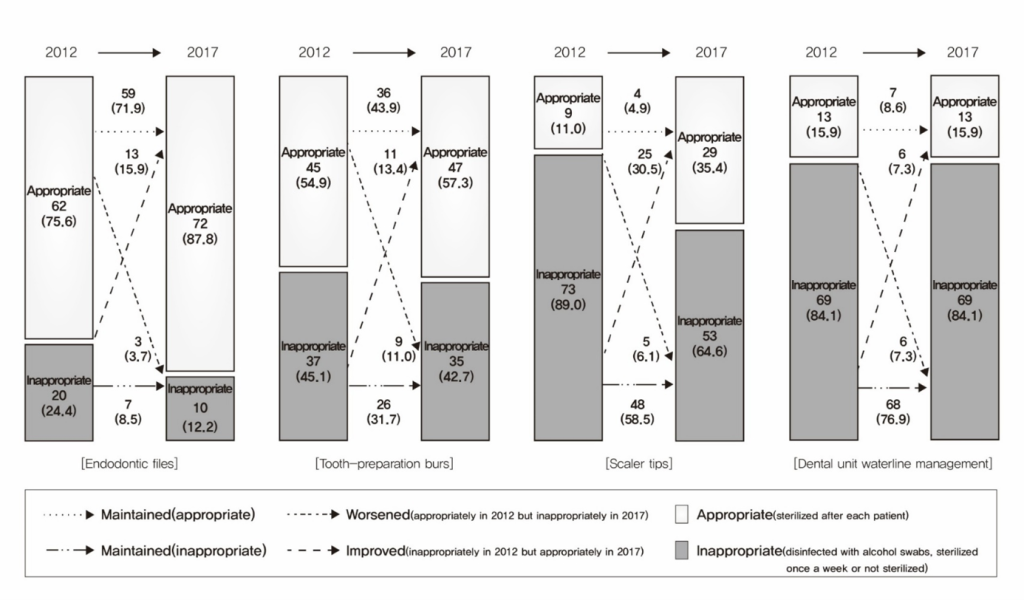
Fig. 1. Changes in management of high-risk instruments and dental unit waterlines in dental facilities. Appropriate and inappropriate indicate compliance and noncompliance with the recommended criteria, respectively; improvement and worsening indicate changes from inappropriate to appropriate and from appropriate to inappropriate, respectively. White and gray boxes indicate appropriate and inappropriate status, respectively.
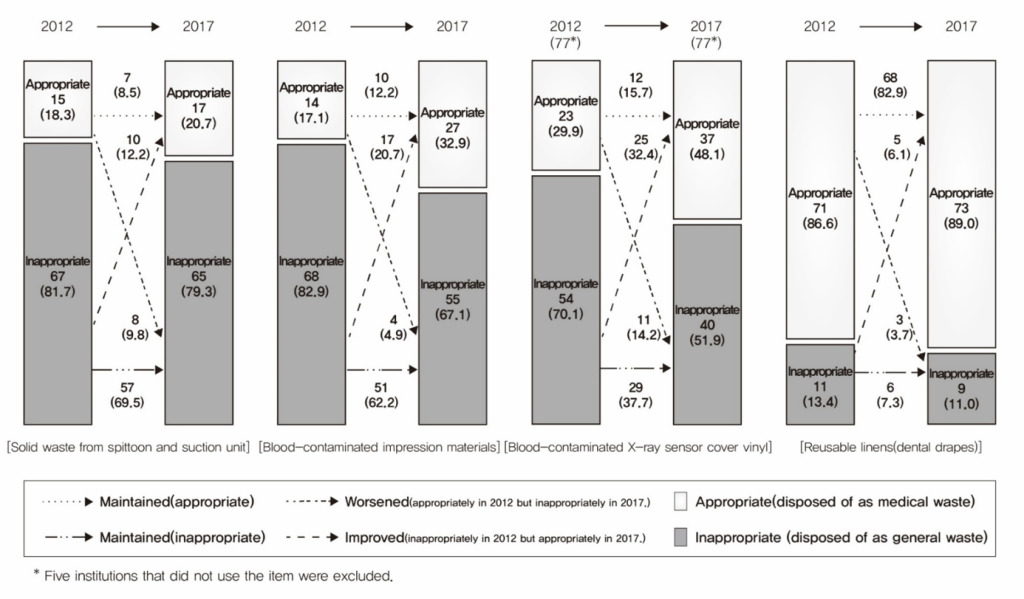
Fig. 2. Changes in medical waste and reusable linen management practices in dental care facilities. Appropriate and inappropriate indicate compliance and noncompliance with the recommended criteria, respectively; improvement and worsening indicate changes from inappropriate to appropriate and from appropriate to inappropriate, respectively. White and gray boxes indicate appropriate and inappropriate status, respectively.
본 연구의 Table 4와 Table 5에서는 2012년에 이미 적절하게 관리하던 기관과 2012–2017년 사이에 부적절에서 적절로 개선된 기관을 합산하여 ‘적절 관리(proper management)’로 정의하였다. 이 지표는 2017년 시점의 관리 수준과 더불어, 조사 기간 동안의 개선 효과가 함께 반영된 값이다.
1) 고위험 기구 및 수관 관리
고위험 기구의 관리 수준은 기관의 규모와 교육, 환자 수 등 다양한 요인에 따라 유의한 차이를 보였다<Table 4>. 치아 삭제용 버 및 스케일러 팁은 치과의사 수가 2명 이상인 경우와 감염관리 교육 경험이 있는 경우에 적절 관리율이 유의하게 높았다(p<0.05). 특히 스케일러 팁의 경우, 인증기관은 100% 적절하게 관리하고 있었으나 비인증 기관은 병원급(66.7%)과 의원급(7.0%) 만이 적절하게 관리하여 인증 여부에 따른 극명한 차이를 나타냈다(p=0.003). 수관 관리는 인증기관은 모든 기관(100%)이 적절하게 관리하고 있었으나, 비인증기관은 병원급(16.7%)과 의원급(7.2%) 모두 매우 낮은 관리율을 보였다.
2) 의료폐기물 및 재사용포 관리
의료폐기물의 세부 항목별 관리 실태를 분석한 결과, 치과 의료기관 인증기관은 타구대·흡입기 고상폐기물, 인상재, 센서 커버 비닐(미사용 1개소 제외) 모든 항목에서 2017년 조사시점에 100%의 적절 처리율을 보여 주었으며, 2012년에는 부적절하게 처리하던 일부 기관에서 관리 방법이 적절하게 개선된 양상이 관찰되었다<Fig. 2>. 반면, 비인증 기관은 기관 규모에 따라 차이를 보였다. 타구대 및 흡입기 고상폐기물의 경우, 비인증 병원급은 33.4%, 의원급은 11.6%만이 적절하게 관리하고 있었다(p<0.001). 오염 인상재 처리의 경우, 비인증 병원급은 50.0%, 의원급은 24.6%만이 적절하게 관리하고 있었으며, 비인증 의원급의 폐기물 분리배출 관리가 가장 취약하였다(p<0.01). 센서 커버 비닐 역시 비인증 병원급 83.3%, 의원급 40.0%에서 부적절 처리율이 나타나, 일부 항목에서는 통계적으로 유의하거나 유의한 경향을 보였다(p<0.05). 재사용포 세탁 방법의 경우, 교육 경험이 있는 기관(94.7%)이 없는 기관(77.0%)에 비해 적절 처리율이 더 높게 나타나는 경향을 보였다(p<0.05) <Table 5>.
Table 5. Proper management of medical waste and reusable linens by education and accreditation status (n=82) [Unit: N(%)]
| Characteristics | Classification | N | Proper Managements1) | p2) |
|---|---|---|---|---|
| Solid waste from spittoon and suction unit | Education (Yes/No) | 56/26 | 13 (23.2) / 4 (15.4) | 0.384 |
| Accreditation (Yes) | 7 | 7 (100.0) | <0.001** | |
| Accreditation (No) | 75 | 10 (13.3) | ||
| Dental hospital | 6 | 2 (33.4) | ||
| Dental clinic | 69 | 8 (11.6) | ||
| Blood‑contaminated impression materials | Education (Yes/No) | 56/26 | 22(39.3) / 5 (19.2) | 0.083 |
| Accreditation (Yes) | 7 | 7 (100.0) | 0.001** | |
| Accreditation (No) | 75 | 20 (26.7) | ||
| Dental hospital | 6 | 3 (50.0) | ||
| Dental clinic | 69 | 17 (24.6) | ||
| Blood‑contaminated X‑ray sensor cover vinyl (n=77)3) | Education (Yes/No) | 53/24 | 31 (58.5) / 6 (25.0) | 0.056 |
| Accreditation (Yes) | 6 | 6 (100.0) | 0.028* | |
| Accreditation (No) | 71 | 31 (43.7) | ||
| Dental hospital | 6 | 5 (83.3) | ||
| Dental clinic | 65 | 26 (40.0) | ||
| Reusable linens (dental drapes) | Education (Yes/No) | 56/26 | 53 (94.6) / 20 (77.0) | 0.014* |
| Accreditation (Yes) | 7 | 7 (100.0) | 0.665 | |
| Accreditation (No) | 75 | 66 (88.0) | ||
| Dental hospital | 6 | 6 (100.0) | ||
| Dental clinic | 69 | 60 (87.0) |
1)Proper management: Sum of ‘Improvement’ (changed from domestic to medical waste) and ‘Appropriate’ (maintained as medical waste) responses.
2)p-values are based on χ2-test for the four management categories (Improvement, Appropriate, Inappropriate, Worsening).
3)Five institutions that did not use digital X‑ray sensors cover vinyl were excluded.
Note: Patient volume and number of dentists were excluded as they showed no statistical significance (p>0.05, data not shown). *p< 0.05, **p< 0.01
본 연구는 2012년부터 2017년의 대구 지역 치과 의료기관의 의료폐기물 및 감염관리 실태 변화를 추적하여, 관리 체계의 장기적 취약성을 분석하였다. 우리나라는 2008년 8월 4일부터 의료폐기물 분야에 세계 최초로 RFID 시스템을 의무 도입하였으며[5], 2012년 이후 메르스 유행과 C형 간염 집단감염 사건을 거치며 의료기관 감염관리에 대한 사회적 규제가 강화되었다[2,8]. 그러나, 본 연구의 조사 결과에 따르면, 스케일러 팁(64.6%), 혈액 오염 인상재(67.1%), 수관 관리(84.1%) 등 핵심 지표의 5년 사이 치과 의료폐기물에 대한 부적절 관리 비율은 여전히 높게 나타났다. 특히 주목할 점은 고상폐기물(53.3%), 디지털 센서 커버 비닐(47.8%), 그리고 스케일러 팁(55.6%) 등의 관리 수준에 있어 적절하게 관리하던 기관의 약 절반이 5년 뒤 조사 시점에 부적절 관리로 전환된 양상을 보였다. 이는 제도적 관리 틀이 실제 임상 현장의 세부 실천으로 충분히 내재화되지 않았을 가능성을 시사한다.
본 연구에서 관찰된 관리의 취약성은, 2022년 이후 도입된 태그 기반 추적 시스템과 3년 주기 교육·평가 제도 변화[1,4]에도 불구하고, 일부 구조적 취약성이 여전히 지속되고 있을 가능성을 제기한다. 5년의 추적 동안 수관 관리나 고상폐기물 처리 항목이 많은 부분 개선되지 않았다[2]는 점은 현재의 치과 의료기관 감염관리 및 의료폐기물 관리체계에서도 여전히 해결해야 할 과제로 해석될 수 있다. 오랜 기간 치과 유닛 수관의 미생물 오염[10]과 아말감 파편에 의한 수은 노출 및 환경 영향[12]이 보고되고 있으며, 이러한 위험을 최소화하기 위해 폐기물 관리 지침과 아말감 분리기가 제시되어 왔다[13]. 향후에는 치과의 특수성을 반영하여 수관 관리 및 혼합 감염성 폐기물(아말감 혼입 등)에 대한 차별화된 분리·수거 기준을 구체화하고, 이를 평가할 수 있는 치과 맞춤형 관리 지표 개발의 필요성이 제기된다.
대한민국의 의료폐기물 정책은 기술 도입과 함께 배출자의 책임과 규제를 강화하는 방향으로 발전해 왔다. 그러나 이러한 규제 중심(Penalty)의 정책만으로는 지속적인 의료폐기물 발생량 증가와 감염관리의 질적 개선의 한계를 충분히 설명하기 어렵다. 상급 의료기관을 대상으로 한 선행 연구에서는 규제로 인한 현장 개선 효과가 보고되기도 하나[9], 국가 전체의 의료폐기물 발생량이 증가[1]해 왔다는 점은 규제 중심 접근의 한계를 시사한다. 특히 본 연구에서 확인된 의원급(Dental clinic) 치과 의료기관의 관리 실태는, 1차 의료 현장에서 이러한 규제 중심 정책의 효과가 여전히 제한적일 수 있음을 보여준다. 비록 본 분석은 반복 자료에 대한 제한된 통계적 접근을 사용한 한계가 있으나, 치과의료기관 인증평가를 받은 모든 기관에서는 의료폐기물 및 고위험 기구를 적절하게 처리하고 있음이 관찰되었다(p<0.05, <Table 5>). 또한, 인증 과정에서의 관리 방법 개선율도 높게 나타났다[9]. 이는 인증평가라는 제도적 틀이 실질적인 행태 변화를 이끄는 중요한 유인 요인이 될 수 있음을 시사한다[9]. 해외 선행 연구에서는 인센티브 기반 감염 제어와 금전적 패널티의 효과가 입증되었다[14,15]. 인증 여부뿐만 아니라 치과의사 수나 환자 수의 변동, 의료폐기물 및 감염관리 교육 경험(p=0.014) 등 본 연구에서 확인된 관리 실태 개선 요인들을 표준화된 정량적 핵심 이행 지표(KPI, Key Performance Indicator)로 전환하여 제도적 보상 체계(Incentive scheme)와 연계할 필요가 있다[8,14].
현재 환경부는 의료폐기물 배출·운반·처리 전 과정의 실시간 관찰 시스템을 고도화하고 있다[1,5,16]. 본 연구 범위 내 치과 영역에서도 이 시스템을 표준화된 정량적 핵심 이행 지표와 연계할 때 기관별 실태에 근거한 정밀한 피드백이 가능해질 것이다. 나아가 이를 감염관리 수가 가산제나 의료기관 인증평가와 연계된 인센티브 제도 등 정책적 보상 체계와 결합한다면, 1차 의료기관의 자발적인 관리 수준 향상에 기여할 수 있을 것이다. 치과의사·치과위생사의 공동 감염관리 리더십 강화와 치과위생사의 감염관리 코디네이터 역할 확립은 의료폐기물 및 감염관리 발전의 기반이 될 수 있음을 시사한다[3,11,17].
본 연구는 5년의 간격을 두고 수행된 추적 조사로서 국내 치과 의료기관의 의료폐기물 관리 실태변화를 포착했다는 점에서 차별성을 갖는다. 다만, 조사 시점별 응답 담당자 차이와 일부 항목의 응답 분류 차이로 인해 엄격한 의미에서의 대응 쌍(Matched pair)으로 보기에는 제한이 있다. 이에 따라 발생할 수 있는 변동성을 고려하여, 통계적 해석에 있어 보수적인 기준을 적용하고 경향성 파악에 집중하였다. 본 연구의 ‘적절 관리(proper management)’ 지표는 초기 관리 수준과 시간 경과에 따른 변화 효과(time effect)가 혼합되어 있는 혼합 지표로, 2017년 시점의 관리율을 다각도로 조명하는 데 유용하게 활용되었다. 대구 지역이라는 지리적 범위와 두 시점 간의 비교라는 정적 관찰 연구의 특성상 일반화에는 신중함이 요구된다.
이러한 통계적 분석 방법상의 한계에도 불구하고, 본 연구는 국내 치과 의료기관의 의료폐기물 관리 실태를 추적한 비교 자료라는 점에서 가치가 있다. 향후 연구에서는 동일 기관의 동일 응답자를 보다 정확히 추적할 수 있는 설계를 적용하고, 반복측정 구조를 반영한 통계 모형을 활용하여 관리 수준의 변화를 보다 정교하게 분석할 필요가 있다. 이를 통해 치과 의료기관의 의료폐기물 및 감염관리 실태를 정책 평가와 연계할 수 있는 표준화된 지표 개발이 요구된다. 이러한 점을 보완한 후속연구는 치위생학적 지식의 확장뿐 아니라 환자안전과 환경보건 증진, 그리고 의료폐기물 관리 정책의 실효성 있는 개선에 기여할 것으로 기대된다.
본 연구는 2012년과 2017년 대구 지역 82개 치과 의료기관을 대상으로 의료폐기물 및 감염관리 실태를 조사한 추적 연구이며, 주요 결론은 다음과 같다.
1. 감염관리 시스템 도입의 한계: 2008년 RFID 기반 올바로 시스템 도입에도 불구하고, 타구대 고상폐기물 및 혈액 오염 인상재 등 핵심 항목의 부적절 관리 비율은 여전히 50%를 상회하였다. 이는 행정 전산망 구축만으로는 임상 현장의 세부적인 감염관리 행태를 개선하는 데 한계가 있음을 시사한다.
2. 인증 여부에 따른 관리 수준의 양극화: 의료기관 인증을 받은 기관은 스케일러 팁, 수관 관리, 의료폐기물 처리 등 항목에서 적절 관리율을 보인 반면, 비인증 의원급 기관은 수관 관리 등에서 취약한 실태를 보였다. 따라서 소규모 비인증 의원급을 대상으로 한 맞춤형 지원과 관리 체계 마련이 필요함을 시사한다.
3. 감염관리 실천의 비지속성: 2012년에 적절하게 관리하던 기관 중 절반 이상이 2017년 조사에서 부적절 관리로 회귀하는 양상이 관찰되었다. 이는 감염관리 행위가 일시적인 실천에 그치지 않도록 상시적인 모니터링 체계와 내부적인 관리 구조 정착이 필요함을 의미한다.
4. 정책적 시사점: 제재 중심의 관리 체계보다 인증 기준과 같은 가이드라인이 내부 관리 구조와 결합될 때 관리 수준이 향상됨을 확인하였다. 향후 정책은 법정 교육 강화와 더불어 인증제도와 연계된 인센티브 중심의 접근을 통해 자발적 참여를 유도해야 한다.
This article is a revision of the first author’s doctoral dissertation\from Yeungnam University.\
Conceptualization, Data collection, Formal analysis: MA Sung; Writing-original draft: MA Sung, J Sakong; Writing-review&editing: MA Sung, JJ Kwon.
The authors declared no conflicts of interest.
None.
This study was approved by the Institutional Review Board (IRB) of Yeungnam University (IRB No.\YU201703004001-UE002).
Data can be obtained from the corresponding author.
The authors express their sincere gratitude to the dental hospitals, clinics, and dental hygienists who participated in this research. Their cooperation was essential for collecting high‑quality data and generating meaningful insights for this study.
1. Ministry of Climate, Energy and Environment. 2023 National status of waste generation and treatment [Internet]. Sejong: Ministry of Climate, Energy and Environment; 2025 [cited 2026 Mar 17]. Available from: https://www.index.go.kr/unity/potal/main/EachDtlPageDetail.do?idx_cd=1478
2. Seong MA, Park JH, Sakong J. Identifying medical waste management status by different types of dental institutions. J Environ Health Sci 2018;44(5):452-9. https://doi.org/10.5668/JEHS.2018.44.5.452
[DOI]
3. Sim EB, Noh HJ, Mun SJ, Jung WG, Choi ES. A study on the knowledge measurement of dental hygienists about dental waste. J Korean Soc Dent Hyg 2020;20(1):73-83. https://doi.org/10.13065/jksdh.20200008
[DOI]
4. Ministry of Government Legislation. Waste Control Act, Act No. 11690 [Internet]. Sejong: Ministry of Government Legislation; 2013 [cited 2026 Mar 17]. Available from: https://www.law.go.kr/%EB%B2%95%EB%A0%B9/%ED%8F%90%EA%B8%B0%EB%AC%BC%EA%B4%80%EB%A6%AC%EB%B2%95
5. Korea Environment Corporation. Guidelines for Allbaro electronic manifest system and RFID-based medical waste management [Internet]. Incheon: Korea Environment Corporation; 2008 [cited 2026 Mar 17]. Available from: https://www.allbaro.or.kr/04_wmedi/wmedi_manual.do?board_name=07&gubun=0703
6. Health Insurance Review and Assessment Service (HIRA), National Health Insurance Service. 2023 national health insurance statistical yearbook [Internet]. Wonju: HIRA; 2024 [cited 2026 Mar 17]. Available from: https://repository.hira.or.kr/handle/2019.oak/3432
7. Kim HJ, Sakong J. Dental waste management practices at dental offices in Gyeongsangnam-do. J Environ Health Sci 2012;38(4):332-9. https://doi.org/10.5668/JEHS.2012.38.4.332
[DOI]
8. Bae SS, Lee MS. Development of evaluation index for infection control and prevention at dental hospital and its validity verification. J Dent Hyg Sci 2013;13(3):254-63.
9. Lee YR, Han GS. Infection control by type of dental institution. J Korean Soc Dent Hyg 2020;20(6):875-88. https://doi.org/10.13065/jksdh.20200081
[DOI]
10. Walker JT, Bradshaw DJ, Bennett AM, Fulford MR, Martin MV, Marsh PD. Microbial biofilm formation and contamination of dental-unit water systems in general dental practice. Appl Environ Microbiol 2000;66:3363-7. https://doi.org/10.1128/AEM.66.8.3363-3367.2000
[DOI][PubMed][PMC]
11. Kang MK, Kim SK, Kim JH, Park BY, Choi MI, Yoo WS, et al. The main tasks of a dental infection-control coordinator and awareness about education. Korean J Clin Dent Hyg 2022;10:1-9. https://doi.org/10.12972/kjcdh.20220001
[DOI]
12. Bharti R, Wadhwani KK, Tikku AP, Chandra A. Dental amalgam: an update. J Conserv Dent 2010;13:204-8. https://doi.org/10.4103/0972-0707.73380
[DOI][PubMed][PMC]
13. American Dental Association. Amalgam separators and waste best management [Internet]. Chicago: American Dental Association; 2024 [cited 2026 Mar 17]. Available from: https://www.ada.org/resources/ada-library/oral-health-topics/amalgam-separators
14. Drohan SE, Levin SA, Grenfell BT, Laxminarayan R. Incentivizing hospital infection control. Proc Natl Acad Sci U S A 2019;116(13):6221-5. https://doi.org/10.1073/pnas.1812231116
[DOI][PubMed][PMC]
15. Wood DM, Beauvais B, Sturdivant RX, Kim FS. Evaluating the effect of financial penalty on hospital-acquired infections. Risk Manag Healthc Policy 2024;17:2181-90. https://doi.org/10.2147/RMHP.S469424
[DOI][PubMed][PMC]
16. Ministry of Climate, Energy and Environment. Blind spots in waste management solved by improving methods of transferring medical wastes [Internet]. Sejong: Ministry of Climate, Energy and Environment; 2022 [cited 2026 Mar 17]. Available from: https://www.me.go.kr/eng/web/board/read.do?menuId=461&boardId=1518600&boardMasterId=522
17. Wang L, Zhang D, Liu J, Tang Y, Zhou Q, Lai X, et al. The mediating role of incentives in association between leadership attention and self-perceived continuous improvement in infection prevention and control among medical staff: a cross-sectional survey. Front Public Health 2023;11:984847. https://doi.org/10.3389/fpubh.2023.984847
[DOI][PubMed][PMC]