Journal of Korean Society of Dental Hygiene Open access, Peer Reviewed
pISSN 2287-1705, eISSN 2288-2294
Weeks in Review
Weeks to Publication
Journal of Korean Society of Dental Hygiene Open access, Peer Reviewed
pISSN 2287-1705, eISSN 2288-2294
Jung-Hee Kang1 , Yoon-Young Choi2, Kyeong-Jin Lee2, Hyun-Young Moon2, Kyeong-Hee Lee2
1Enamel Co., Ltd.
2Department of Dental Hygiene, Shinhan University
Correspondence to Kyeong-Hee Lee, Department of Dental Hygiene, Shinhan University, 95 Hoam-ro, Uijeongbu-si, Gyeonggi-do 11644, Korea. Tel: +82-31-870-3452, Fax: +82-31-870-3459, E-mail: noh3898@hanmail.net
Volume 26, Number 4, Pages 473–82, August 2026.
J Korean Soc Dent Hyg 2026;26(4):473–82. https://doi.org/10.13065/jksdh.2026.26.4.6
Received on May 14, 2026, Revised on June 08, 2026, Accepted on July 24, 2026, Published on August 30, 2026.
Copyright © 2026 Journal of Korean Society of Dental Hygiene.
This is an Open Access article distributed under the terms of the Creative Commons Attribution Non-Commercial License(http://creativecommons.org/licenses/by-nc/4.0).

Aged, Augmented reality, Long-term intervention, Muscle strength, Virtual reality
구강 근육은 교합 유지와 구강운동 기능에 중요한 역할을 하며, 저작·발음·연하 기능 수행에 직접적으로 관여하므로 적절한 구강 기능 유지를 위해서는 충분한 구강 근육의 힘이 중요하다[1]. 노년기에 접어들면 골격근의 양과 질이 모두 감소하여 구강근력이 약화되며[2], 이러한 구강근력의 저하는 저작 시 불편감을 유발하고, 음식 섭취의 제한으로 인한 영양불균형을 초래하여 전신 건강에 부정적인 영향을 미친다[3]. 더 나아가 발음 및 연하 기능의 저하로 일상생활의 불편함이 증가하며, 심한 경우 흡인성 폐렴으로 이어질 수 있어, 노인의 건강 유지와 삶의 질 향상을 위해 구강근력 강화는 필수적이다.
이에 따라 최근에는 노인을 대상으로 한 구강근력 강화훈련이 활발히 이루어지고 있으며, 다수의 연구에서 훈련 후 구강근력의 유의미한 개선 효과가 보고되고 있다[4–6]. 그러나 대부분의 선행연구는 중재 기간이 6주 이내로 비교적 단기적인 적용에 그치고 있어, 중재 효과의 지속성에 대한 검증에는 한계가 있다. 선행연구에 따르면 구강근력 강화훈련을 통해 향상된 혀 근력은 훈련 종료 후 일정 기간이 지나면 감소하는 경향을 보이며, 훈련 중단 시 탈훈련(Detraining)에 따른 기능 저하가 관찰되었다[7,8]. 또한 허약 노인을 대상으로 한 연구에서도 구강근력 강화훈련은 충분한 중재 기간과 지속적인 적용이 동반될 때 연하 기능 및 구강기능 전반의 개선 효과가 보다 안정적으로 나타나는 것으로 보고되었다[9]. 노인은 근감소가 지속적으로 진행되는 집단으로, 단기간의 중재만으로는 기능 개선 효과를 장기적으로 유지하기 어렵다는 점을 고려할 때, 노인의 구강기능 유지 및 증진을 위해서는 단기 효과 확인을 넘어 장기간 적용 가능한 중재의 효과를 검증하는 연구가 필요하다.
한편, 인터넷과 스마트폰의 보급으로 정보통신기술은 일상생활 전반에 깊숙이 자리 잡고 있다. 이러한 디지털 기술의 발전은 삶의 만족도 향상에 긍정적인 영향을 미치며[10], 노인을 대상으로 한 연구에서도 정서적 안정, 사회적 관계 유지, 자기효능감 향상 등을 통해 삶의 만족도를 증진시키는 중요한 요인으로 작용하는 것으로 나타나고 있다[11,12]. 이에 따라 스마트 매체를 활용한 교육의 필요성과 요구도 또한 점차 높아지고 있다. 특히 스마트폰 기반 중재는 시간과 장소의 제약을 받지 않고 반복적으로 훈련을 실시할 수 있어 노인의 지속적인 건강관리 수단으로 주목받고 있다. 또한 시각·청각적 자극을 활용한 콘텐츠는 훈련에 대한 흥미를 유도하고 자기주도적 참여를 촉진함으로써 장기적인 중재 적용에 유리한 환경을 제공한다. 이러한 특성은 구강기능의 저하를 경험하는 노인에게 있어 일상생활 속에서 무리 없이 적용 가능한 효과적인 구강건강 관리 전략으로서 스마트폰 기반 구강근력 강화훈련의 필요성을 시사한다. 이에 본 연구는 스마트폰 앱 기반 구강근력 강화훈련 콘텐츠를 개발하고, 노인을 대상으로 스마트폰 앱 기반 구강근력 강화훈련을 12주간 장기 적용한 후 구강근력을 비롯한 건강 개선효과를 살펴보고자 하였다.
본 연구는 노인을 대상으로 스마트폰 앱 기반 구강근력 강화훈련의 장기 중재 효과를 검증하기 위한 탐색적 무작위 대조군 사전사후설계(Exploratory randomized control group pretest-posttest design) 연구이다. 연구대상자는 무작위 배정을 통해 실험군과 대조군으로 구분하였으며, 중재 전·후 평가를 실시하여 구강건강, 정신건강 및 발음 기능의 변화를 분석하였다.
대상자를 윤리적으로 보호하기 위해 신한대학교 생명윤리심의위원회(IRB승인번호: SHIRB-202503-HR-257-02)에서 연구의 승인을 받은 후 진행하였다. 연구대상자는 비확률 표집 방법(Non-probability sampling method)을 사용하여 수도권 소재 노인복지관에 협조를 요청한 후, 연구의 목적과 절차를 충분히 설명하고 참여에 자발적으로 동의한 65세 이상 노인을 최종적으로 선정하였다.
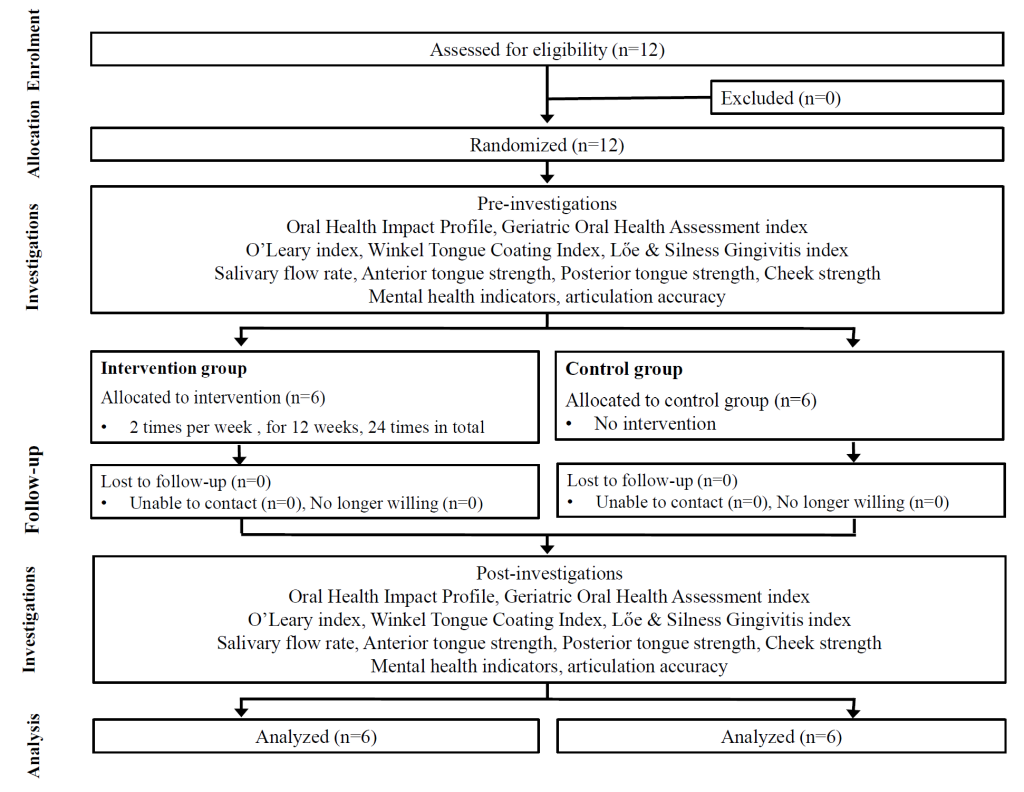
본 연구는 스마트폰 앱 기반 구강근력 강화훈련의 장기적 효과를 탐색하기 위한 연구로, 향후 본 연구 수행을 위한 연구 절차의 실행 가능성과 중재 효과크기(Effect size)를 추정하는 것을 목적으로 하였다. Whitehead 등[13]은 연속형 결과변수를 사용하는 예비 무작위 연구에서 효과크기 추정을 위해 집단당 약 5–10명의 표본이 적절할 수 있음을 제시하였다. 이에 본 연구에서는 실험군과 대조군 각각 5명씩 총 10명을 목표 표본 수로 산정하였으며, 연구기간 중 발생 가능한 탈락률을 고려하여 각 집단별로 6명씩 총 12명을 모집하였다. 연구기간 동안 탈락자는 발생하지 않았으며, 최종적으로 실험군 6명과 대조군 6명의 자료를 분석에 활용하였다<Fig. 1>.
본 연구에 사용된 스마트폰용 앱은 ‘구강운동 프로그램’으로, 연구자가 개발한 구강운동 콘텐츠를 기반으로 문화체육진흥원에서 제작·개발한 애플리케이션이다. 스마트폰 기반의 시청각 안내와 반복 훈련을 통해 구강 및 안면 근육의 기능 향상과 구강근력 강화를 지원하도록 개발되었다. 해당 앱은 2023년 9월 5일 출시되었으며, Google Play Store를 통해 무료로 제공되고 있다.
앱 콘텐츠는 발음훈련 및 혀 운동 게임과 혀 운동, 입 운동, 입술 운동, 식사 전 체조, 잇몸 마사지 및 침샘 마사지 등으로 구성된 6개의 동영상으로 구성되어 있다. 각 콘텐츠는 동영상 기반의 시청각 자료를 활용하여 사용자가 화면에 제시되는 구강운동 동작을 관찰하고 음성 및 영상 안내에 따라 반복 수행할 수 있도록 설계되었다. 또한 혀 운동 게임은 게임화(Gamification) 요소를 적용하여 훈련에 대한 흥미와 참여도를 높일 수 있도록 구성하였다.
본 연구에서는 스마트폰 앱 기반 구강근력 강화훈련의 장기적 효과를 확인하기 위하여 중재 기간을 12주로 설정하였다. 선행연구에 따르면 노인을 대상으로 한 운동중재 프로그램은 일반적으로 8주 이상 시행되며, 근력 및 신체기능 향상을 평가하기 위해 8–24주의 중재 기간이 적용되고 있다[14]. 또한 근력 향상은 초기 신경근 적응을 거쳐 기능적 변화로 이어지기 때문에 일정 기간 이상의 반복 훈련이 필요하다. 이에 본 연구에서는 단기 효과를 넘어 구강근력 강화훈련의 지속적인 효과를 확인하기 위하여 12주간의 중재를 실시하였다.
스마트폰 앱을 활용한 구강근력 강화훈련은 2025년 5월부터 8월까지 12주간 총 24회 실시하였다. 훈련은 연구의 일관성을 확보하기 위해 연구자가 지정한 동일한 실내 공간에서 진행되었으며, 회당 소요시간은 약 50분이었다. 프로그램 시작 전에 연구자가 대상자와 함께 스마트폰 앱을 다운로드 받은 후, 사용방법을 직접 교육하고, 대상자가 익숙하게 작동할 수 있을 때까지 교육하였다. 이후 중재 프로그램 시간 동안 대상자가 스스로 스마트폰 앱에 탑재된 구강운동 동영상과 게임 콘텐츠를 활용하여 학습할 수 있도록 하였다. 또한 정해진 훈련 시간 외에도 앱에 탑재된 콘텐츠를 자유롭게 이용하도록 안내하였다.
효과 판정을 위한 사전조사는 구강근력 강화훈련 시행 1주 전에 실시하였으며, 사후평가는 프로그램 종료 후 1주가 경과된 후에 실시하였다. 구강검사, 구강근력, 타액분비량 및 발음 측정은 동일한 연구자가 사전 및 사후 조사를 모두 직접 수행하였다<Fig. 2>.
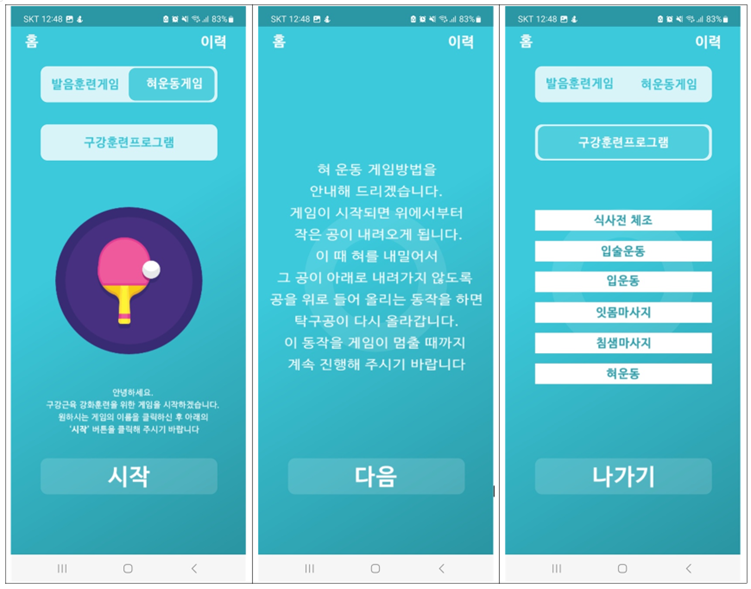
Fig. 2. Smartphone app content driving screen for oral muscle strength training.
구강근력 강화훈련의 효과 검증을 위해 연구대상자의 일반적인 특성으로 연령, 교육수준, 배우자 동거상태, 경제상태를 조사하였고, 구강건강관련행위 특성으로 칫솔질 횟수, 혀 세정, 잇몸 세정, 구강위생용품사용, 이쑤시개 사용, 최근 6개월 이내 스케일링 여부를 조사하였다.
구강건강 관련 삶의 질은 구강건강영향지수(Oral health impact profile, 이하 OHIP)[15]와 구강건강평가지수(Geriatric oral health assessment index, 이하 GOHAI)[16]를 이용하여 설문으로 측정하였다. OHIP는 점수가 높을수록 삶의 질이 낮음을 의미하며, GOHAI는 점수가 높을수록 삶의 질이 높음을 의미한다. 치면세균막은 O’Leary index[17]를 이용하여 측정하였으며, 점수가 낮을수록 치면세균막이 적은 것을 의미한다. 설태는 Winkel tongue coating index[18]로 구하였으며, 점수가 클수록 설태가 많은 것을 의미한다. 치은염은 Löe & Silness의 치은염 지수[19]로 구하였으며, 점수가 클수록 잇몸의 염증이 심한 것을 의미한다. 타액분비량(Salivary flow rate, SFR)의 변화를 확인하기 위해 무게(g)의 단위로 양을 측정하였으며(1 mL ≒ 1g), 비자극성 타액분비량(Salivary flow rate, SFR)을 측정하였다[20]. 구강근력은 Iowa oral performance instrument(IOPI; IOPI Medical LLC, Redmond, WA, USA) [21]를 사용하여, 혀의 전방부와 후방부, 볼의 근력을 측정하였다.
정신건강 관련 지표는 우울, 수면의 질, 졸림증을 측정하였다. 우울 수준은 미국 국립정신건강연구소(National institute of mental health)에서 개발한 Center for epidemiologic studies depression scale(CES-D) [22]을 기반으로, 노인 대상 연구에 적합하도록 국내에서 신뢰도와 타당도가 검증된 한글판 CES-D를 사용하여 측정하였다. 이 척도는 지난 일주일 동안 경험한 정서적·신체적 증상에 대해 4점 Likert 척도로 구분하며, 점수가 높을수록 우울 수준이 높음을 의미한다. 일반적으로 16점 이상은 임상적으로 의미 있는 우울 상태로 판정한다. 수면의 질은 Korean version of Pittsburgh sleep quality index(PSQI-K)를 사용하였다[23]. PSQI-K는 총 18개의 문항으로 구성되어 지난 한 달 동안 주관적인 수면의 질을 측정하는 도구로, 점수가 높을수록 수면의 질이 낮음을 의미하며, 5점 이상은 수면이 방해받고 있는 상태로 해석된다. 졸림 정도의 평가는 국내에서 신뢰도와 타당도가 검증된 한국어판 Epworth sleepiness scale(ESS)[24]을 사용하여 수행하였다. 이 척도는 일상생활에서 쉽게 졸음을 느낄 수 있는 8가지 상황에서의 졸림 정도를 평가하며, 총점이 높을수록 주간 졸림 정도가 심함을 의미한다. 일반적으로 10점 이상은 과도한 주간 졸림(Excessive daytime sleepiness)의 가능성이 있는 것으로 해석한다.
발음 변화 평가는 언어치료 자격을 갖춘 치과위생사 1인이 사전·사후 조사를 동일하게 실시하였다. 또한 언어치료사 연구자 외에 10년 경력의 1급 언어치료사가 녹음된 음성 자료를 함께 평가하여 신뢰도를 검증하였으며, 평가자 간 Cohen의 Kappa 상관계수는 .916으로 높은 신뢰도를 보였다. 음성 수집은 소음이 적은 공간에서 대상자가 편안한 자세로 앉은 상태에서 진행하였으며, 녹음기(PCM-A10; Sony Corp., Tokyo, Japan)는 대상자로부터 10 cm 거리에 두었다. 발음 측정을 위해 중재 전 선별검사로 Speech mechanism screening test(SMST)[25]을 사용하여 조음기관의 구조와 기능을 평가하였다. 기준점수는 검사도구의 최고단계인 50–59세 연령군을 적용하였으며, 연구대상자가 해당 기준에서 정상 범주(96.60점)에 속하는지 확인하였다. 단, 말 속도, 최대발성시간, 조음교대운동 항목은 대상자의 연령(65세 이상)을 고려하여 평가에서 제외하였다. 사후조사는 프로그램 종료 후 1주 이내에 실시하였다. 조음 정확도 평가는 Urimal test of articulation and phonology-2 (U-TAP 2)[26]을 사용하여 주어진 그림을 보고 30개 단어를 발음하게 한 뒤, 주요 음운 오류 패턴을 분석하였다.
본 연구의 수집된 자료는 SPSS(ver. 22.0; IBM Corp., Armonk, NY, USA)를 이용하여 분석하였으며, 통계적 유의수준은 0.05를 기준으로 하였다. 연구대상자의 일반적 특성과 구강건강행위 특성은 Fisher’s exact test를 시행하여 그룹 간의 사전 동질성을 확인하였다. 프로그램 전과 후의 차이는 Wilcoxon signed-rank test를 이용하여 확인하였고, 실험군과 대조군 간의 차이는 Mann–Whitney U test를 이용하였다.
연구대상자의 일반적인 특성은 연령, 교육수준, 배우자 동거 상태, 경제상태를 조사하였다. 두 집단 간 통계적으로 유의한 차이가 없어 집단 간 동질성이 확보되었다. 연령은 65–74세가 많았으며, 학력은 고등학교 졸업, 배우자와의 동거상태는 실험군은 동거 중, 대조군은 사별, 경제상태는 ‘중’이 가장 많았다<Table 1>.
Table 1. General characteristics of the participants [Unit: N(%)]
| Characteristic | Division | Intervention group (n=6) | Control group (n=6) | Total (N=12) | p* |
|---|---|---|---|---|---|
| Age, years | 65-74 | 4(66.7) | 2(33.3) | 6(50.0) | 0.567 |
| 75-84 | 2(33.3) | 4(66.7) | 6(50.0) | ||
| Education | ≤ Middle school | 1(16.7) | 2(33.3) | 3(25.0) | 1.000 |
| High school | 4(66.7) | 4(66.7) | 8(66.7) | ||
| ≥ College | 1(16.7) | 0(0.0) | 1(8.3) | ||
| Spouse | Widowed | 2(33.3) | 4(66.7) | 6(50.0) | 0.567 |
| Cohabitating | 4(66.7) | 2(33.3) | 6(50.0) | ||
| Economic status | Upper | 2(33.3) | 1(16.7) | 3(25.0) | 0.545 |
| Middle | 4(66.7) | 3(50.0) | 7(58.3) | ||
| Low | 0(0.0) | 2(33.3) | 2(16.7) |
*by Fisher’s exact test.
연구대상자의 구강건강 관련 행위 특성은 칫솔질 횟수, 잇몸 세정, 혀 세정, 구강위생용품 사용, 이쑤시개 사용, 최근 6개월 이내 스케일링 여부로 조사하였고, 두 집단 간 통계적으로 유의한 차이가 없어 집단 간 동질성이 확보되었다.
두 집단 모두에서 칫솔질은 실험군은 2회, 대조군은 3회 이상이 많았고, 잇몸과 혀 세정은 항상 닦는다가 가장 많았다. 구강위생용품의 사용은 실험군의 경우 예와 아니오가 동일하게 나타났고, 대조군은 아니오가 많았다. 이쑤시개의 사용은 실험군은 예가 많았고, 대조군의 경우 예와 아니오가 동일하게 나타났다. 최근 6개월 이내 스케일링 여부는 실험군의 경우 예와 아니오가 동일하게 나타났고, 대조군은 아니오가 많았다<Table 2>.
Table 2. Oral health-related behavior characteristics [Unit: N(%)]
| Characteristic | Division | Intervention group (n=6) | Control group (n=6) | Total (N=12) | p* |
|---|---|---|---|---|---|
| Daily toothbrushing frequency | 1 | 1(16.7) | 1(16.7) | 2(16.7) | 0.740 |
| 2 | 4(66.7) | 2(33.3) | 6(50.0) | ||
| ≥3 | 1(16.7) | 3(50.0) | 4(33.3) | ||
| Gum cleaning | Always | 5(83.3) | 3(50.0) | 8(66.7) | 0.697 |
| Sometimes | 1(16.7) | 1(16.7) | 2(16.7) | ||
| Never | 0(0.0) | 2(33.3) | 2(16.7) | ||
| Tongue cleaning | Always | 5(83.3) | 3(50.0) | 8(66.7) | 0.545 |
| Sometimes | 0(0.0) | 1(16.7) | 1(8.3) | ||
| Never | 1(16.7) | 2(33.3) | 3(25.0) | ||
| Use of oral hygiene products | Yes | 3(50.0) | 2(33.3) | 5(41.7) | 1.000 |
| No | 3(50.0) | 4(66.7) | 7(58.3) | ||
| Use a toothpick | Yes | 5(83.3) | 3(50.0) | 8(66.7) | 0.545 |
| No | 1(16.7) | 3(50.0) | 4(33.3) | ||
| Scaling within the past 6 months | Yes | 3(50.0) | 2(33.3) | 5(41.7) | 1.000 |
| No | 3(50.0) | 4(66.7) | 7(58.3) |
*by Fisher’s exact test.
구강근력 강화훈련 실시 전·후의 실험군의 변화를 확인한 결과, 노인구강건강평가지수(p<0.05), 치면세균막(p<0.05), 치은염(p<0.05), 전방부 혀 근력(p<0.05)에서 유의한 차이를 보였다. 프로그램 실시 전에 비해 노인구강건강평가지수는 9.17점 증가하였고, 치면세균막은 0.21 감소, 치은염은 0.49 감소하였으며, 전방부 혀 근력은 10.34 증가하였다. 사후 두 그룹간의 비교에서도 노인구강건강평가지수(p<0.05), 치은염(p<0.05), 전방부 혀 근력(p<0.01)은 유의한 차이를 보였다<Table 3>.
Table 3. Oral health improvement effect of a smartphone app-based oral health intervention
| Variables | Intervention group (n=6) | Control group (n=6) | p** | ||||
|---|---|---|---|---|---|---|---|
| Pre | Post | p* | Pre | Post | p* | ||
| OHIP-14 | 24.67±6.74 | 19.17±3.06 | 0.094 | 35.17±16.96 | 34.00±15.62 | 0.625 | 0.240 |
| GOHAI | 42.50±6.06 | 51.67±4.89 | 0.028 | 36.50±12.32 | 38.83±11.29 | 0.180 | 0.041 |
| O’Leary index | 0.51±0.27 | 0.30±0.14 | 0.043 | 0.49±0.30 | 0.35±0.14 | 0.465 | 0.240 |
| Löe & Silness index | 0.85±0.16 | 0.36±0.16 | 0.039 | 1.36±0.45 | 0.68±0.30 | 0.068 | 0.041 |
| Tongue coating index | 3.17±2.56 | 1.17±0.75 | 0.068 | 2.83±1.72 | 1.83±1.17 | 0.109 | 0.394 |
| Saliva flow rate (g) | 1.80±1.12 | 2.92±1.48 | 0.225 | 1.35±0.99 | 1.32±1.07 | 1.000 | 0.065 |
| Anterior tongue strength (kPa) | 47.33±4.32 | 57.67±7.50 | 0.046 | 29.50±12.72 | 38.17±6.05 | 0.109 | 0.002 |
| Posterior tongue strength (kPa) | 35.67±11.69 | 46.50±20.79 | 0.141 | 34.50±13.14 | 35.17±9.58 | 0.655 | 0.180 |
| Cheek strength (kPa) | 22.50±2.74 | 23.67±2.66 | 0.458 | 20.00±6.16 | 25.33±7.69 | 0.285 | 0.699 |
OHIP-14: Oral health impact profile; GOHAI: Geriatric oral health assessment index.
*by Wilcoxon signed-rank test, **by Mann–Whitney U test.
구강근력 강화훈련 실시 전·후의 정신건강에 대한 실험군의 변화를 확인한 결과, 수면의 질(p<0.05)에서 유의한 차이를 보였다. 수면의 질은 PSQI-K 점수가 1.28점 감소하여 향상된 것으로 나타났다. 그러나 사후 두 그룹간의 비교에서는 유의한 차이를 보이지 않았다<Table 4>.
Table 4. Mental health improvement effects of smartphone app-based oral health intervention
| Variables | Intervention group (n=6) | Control group (n=6) | p** | ||||
|---|---|---|---|---|---|---|---|
| Pre | Post | p* | Pre | Post | p* | ||
| Depression | 14.83±5.60 | 12.83±3.54 | 0.367 | 17.67±4.13 | 20.17±11.14 | 0.262 | 0.240 |
| Sleep quality | 5.09±2.61 | 3.81±3.04 | 0.026 | 6.46±3.36 | 7.11±2.95 | 0.498 | 0.485 |
| Drowsiness | 12.00±2.61 | 10.02±1.17 | 0.058 | 5.83±3.66 | 12.00±9.33 | 0.109 | 1.000 |
*by Wilcoxon signed-rank test, **by Mann–Whitney U test.
구강근력 강화훈련 실시 전·후의 발음 개선에 실험군의 변화를 확인한 결과, 훈련 전보다 훈련 후에 대부분 증가하는 것으로 나타났으나, 통계적으로 유의한 차이를 보이지 않았다. 사후 두 그룹간의 비교에서도 유의한 차이를 보이지 않았다.
사전조사의 주된 음운오류 패턴은 유음의 비음화(라면[나면], 로보트[노보트]) 9회, 모음변동(코끼리[코꾸리], 나무[냐무], 자동차[자동챠], 포크[포쿠]) 4회, 경음의 평음화(접씨[접시]) 3회, 어중종성생략(책상[채쌍]) 1회, 어말종성생략(짹짹[짹째]) 1회 순으로 빈번하게 나타났다. 사후조사의 주된 음운오류패턴은 유음의 비음화 7회, 경음의 평음화 4회, 연구개음의 전방화(냉장고[낸잔고]) 2회, 유음 생략(빨간색[빠간색]) 1회, 유음화 활음화(라면[야면]) 1회, 역행동화(토끼[또끼]) 1회 순으로 나타나, 사전조사 오류빈도의 18회보다 16회로 감소하였다<Table 5>.
Table 5. Pronunciation improvement effect of a smartphone app-based oral health intervention
| Variables | Intervention group (n=6) | Control group (n=6) | p** | ||||
|---|---|---|---|---|---|---|---|
| Pre | Post | p* | Pre | Post | p* | ||
| PCC | 96.81±0.95 | 97.18±1.46 | 0.345 | 96.80±0.94 | 97.52±1.10 | 0.144 | 1.000 |
| PWC | 0.87±0.05 | 0.92±0.03 | 0.131 | 0.88±0.04 | 0.91±0.05 | 0.257 | 0.699 |
| PMLU | 8.49±0.03 | 8.50±0.06 | 0.786 | 8.49±0.04 | 8.51±0.03 | 0.336 | 1.000 |
| PWP | 0.99±0.01 | 0.99±0.01 | 0.414 | 0.99±0.01 | 0.99±0.01 | 0.180 | 1.000 |
| PVC | 97.62±5.83 | 100.00a | 0.317 | 97.62▽5.83 | 100.00a | 0.317 | 1.000 |
PCC: Total percentage of correct consonant; PWC: Proportion of whole-word correctness; PMLU: Phonological mean length of utterance; PWP: Proportion of whole-word proximity; PVC: Percentage of correct vowel
aWhen the standard error of the difference is 0.
*by Wilcoxon signed-rank test , **by Mann–Whitney U test.
본 연구는 스마트폰 앱 콘텐츠를 이용한 12주간의 장기 구강근력 강화훈련이 노인의 구강건강, 정신건강 및 발음 기능에 미치는 효과를 확인하고, 6주 단기 중재를 적용한 선행연구와 비교하여 중재 기간에 따른 변화 양상을 분석하고자 수행되었다.
구강건강에서는 노인구강건강평가지수, 치면세균막, 치은염, 전방부 혀 근력에서 유의한 개선이 나타났으며, 일부 지표에서는 집단 간 차이도 확인되었다. 이는 구강근력 강화훈련이 단순한 기능 향상을 넘어 전반적인 구강건강 상태 개선으로 이어질 수 있음을 보여준다. 6주 중재를 적용한 선행연구[27]와 비교할 때, 두 연구 모두 치면세균막과 치은염 감소, 혀 근력 증가 등에서 일관된 개선 경향을 보였다. 특히 단기 중재에서는 구강위생 관련 지표의 빠른 개선이 두드러진 반면, 본 연구의 12주 중재에서는 노인구강건강평가지수와 같은 종합적 지표의 향상이 확인되었다. 이는 중재 기간이 연장됨에 따라 초기의 구강 내 환경 변화가 축적되어 보다 포괄적인 건강 상태 개선이 이루어졌을 가능성을 시사한다. 또한 혀 근력은 두 연구 모두에서 유의하게 증가하였으며, 장기 중재에서 그 증가 폭이 더 크게 나타나 근력 향상이 시간에 따라 누적될 수 있음을 보여준다. 한편, 구강위생 지표의 감소 폭이 단기 연구에서 더 크게 나타난 것은 중재 초기 단계에서 효과가 빠르게 나타난 이후 점차 변화 폭이 완만해지는 특성과 관련되며, 이는 구강위생 중재에서 초기 개선이 크고 이후 유지되는 경향을 보고한 선행연구와 일치한다[28].
정신건강에서는 수면의 질이 유의하게 개선되어 구강근력 강화훈련이 긍정적 변화를 유도했을 가능성을 시사한다. 또한 구강 인두 운동이 수면 무호흡 지수를 감소시키고 주간 졸림 및 주관적 수면 상태를 개선한다는 연구[29]와도 맥락을 같이 한다. 이러한 결과는 구강 근력 강화훈련을 통한 신체 기능 개선이 수면과 같은 정신건강 요소에 점진적으로 영향을 미쳤을 가능성을 뒷받침한다. 다만 집단 간 유의차가 나타나지 않은 것은 제한된 표본 수에 따른 검정력 부족과 개인별 수면 패턴 및 외부 환경 요인의 영향을 고려할 필요가 있다.
발음 측면에서는 전반적인 향상 경향이 나타났으나 통계적으로 유의한 차이는 확인되지 않았다. 그러나 음운 오류 패턴 분석에서는 오류 빈도 감소와 오류 유형 변화가 나타나 조음 기능의 질적 향상을 시사하였다. 또한 혀 압력 및 조음기관 기능 강화 훈련이 발음 정확도와 발화 명료도 향상에 기여한다는 선행연구[30]를 고려할 때, 본 연구에서 나타난 기초적 오류의 감소와 세밀한 조음 조정 단계로의 변화는 조음기관의 근력 및 운동 조절 능력 향상에 따른 결과로 해석될 수 있다. 특히 유음의 비음화 감소, 종성 생략 및 모음변동과 같은 기초적 오류의 축소는 이러한 기능적 개선을 뒷받침한다. 또한 발음 변화가 통계적으로 유의하지 않았던 것은 제한된 표본 수로 인한 검정력 부족, 중재에 따른 천장효과, 그리고 변화가 미세한 조음 조정과 같은 질적 형태로 나타나 정량적 평가 지표로 충분히 반영되지 못했을 가능성에 기인한 것으로 보인다.
종합하면, 구강근력 강화훈련은 단기적으로 구강위생 및 염증 지표 개선에 효과적이며, 장기적으로는 이러한 변화가 축적되어 보다 포괄적인 구강건강 향상으로 이어질 가능성을 확인하였다. 또한 혀 근력 증가와 발음 오류 감소 등의 변화는 조음 기능 향상 가능성을 시사하였으며, 수면의 질 개선과 같은 일부 정신건강 지표의 긍정적 변화도 관찰되었다. 그러나 발음 기능 및 정신건강 관련 결과의 경우 통계적으로 유의하지 않은 결과가 포함되어 있어 중재 효과를 확정적으로 입증하였다고 보기보다는 긍정적인 변화 가능성을 탐색적으로 확인한 것으로 해석할 필요가 있다. 따라서 스마트폰 앱 기반 구강근력 강화훈련은 노인의 구강건강 증진을 위한 유용한 중재로 활용될 가능성이 있으며, 발음 기능 및 정신건강에 대한 효과는 향후 대규모 연구를 통해 추가적으로 검증할 필요가 있다.
그러나 본 연구는 예비연구로 수행되어 실험군과 대조군 각각 6명으로 표본 수가 적어 통계적 검정력이 제한적이며, 연구 결과를 일반화하는 데 한계가 있다. 또한 수도권 소재 단일 노인복지관 이용 노인을 대상으로 실시한 단일 기관 연구로서 지역적·환경적 특성이 연구 결과에 영향을 미쳤을 가능성이 있으며, 다양한 지역 및 특성을 가진 노인 집단에 결과를 확대 해석하는 데 주의가 필요하다. 또한 본 연구는 스마트폰 앱을 활용한 구강근력 강화훈련의 효과를 검증하였다는 점에서 디지털 기반 중재의 활용 가능성을 제시하였으나, 실제 중재는 연구의 일관성을 확보하기 위해 연구자가 지정한 동일한 실내 공간에서 실시되었다. 따라서 참여자가 가정이나 지역사회 등 일상생활 환경에서 스마트폰 앱을 자율적으로 활용하는 완전한 의미의 비대면 모바일 헬스(mHealth) 중재와는 차이가 있으며, 실제 생활환경에서의 적용 가능성이나 사용 순응도를 충분히 반영하지 못한 한계가 있다. 아울러 스마트폰 활용 능력, 사용 빈도, 가정환경 등의 개인차가 연구 결과에 미치는 영향도 확인하지 못하였다.
발음 기능의 경우 정량적 평가뿐 아니라 오류 유형 분석을 통해 질적 변화를 확인하였으나, 사용된 평가도구가 미세한 조음 변화와 기능적 개선을 충분히 반영하지 못했을 가능성이 있다. 또한 중재 종료 후 추적관찰을 실시하지 않아 훈련 효과의 지속성을 확인하지 못하였다. 따라서 후속연구에서는 충분한 검정력을 확보할 수 있도록 표본 수를 확대하고, 다양한 지역 및 기관이 참여하는 다기관 연구를 수행하여 연구 결과의 일반화 가능성을 높일 필요가 있다. 또한 실제 생활환경에서 노인이 스마트폰 앱을 자율적으로 활용하는 방식의 중재를 적용하여 중재의 실효성, 사용 순응도 및 생태학적 타당도를 검증할 필요가 있다. 나아가 앱 사용 빈도와 사용자 만족도, 장기적 활용 가능성을 함께 분석하고, 중재 종료 후 추적조사를 실시하여 훈련 효과의 유지 기간을 확인할 필요가 있다. 또한 발음 및 조음 기능의 질적 변화를 보다 민감하게 측정할 수 있는 평가도구를 적용함으로써 장기적 효과를 보다 명확하게 검증할 필요가 있다.
본 연구는 노인 12명(실험군 6명, 대조군 6명)을 대상으로 스마트폰 기반 구강근력 강화훈련의 장기 중재 효과를 확인하고자 2025년 5월부터 8월까지 12주간 훈련을 실시하였으며, 그 결과 다음과 같은 결과를 얻었다.
1. 스마트폰 앱 기반 구강근력 강화훈련 후 실험군은 노인구강건강평가지수(p<0.05), 치면세균막(p<0.05), 치은염 (p<0.05)및 전방부 혀 근력(p<0.05)에서 유의한 개선을 보였다. 사후 집단 간 비교에서도 노인구강건강평가지수(p<0.05), 치은염(p<0.05), 전방부 혀 근력(p<0.01)에서 유의한 차이가 나타났다.
2. 정신건강에서는 수면의 질이 유의하게 향상되었으나(p<0.05), 집단 간 차이는 확인되지 않았다. 발음 정확도는 훈련 후 전반적으로 향상되고 음운오류 빈도가 감소하였으나 통계적으로 유의한 차이는 나타나지 않았다.
이상의 결과를 통해 스마트폰 앱 기반 12주 구강근력 강화훈련은 노인의 구강건강과 혀 근력 향상에 유의한 효과가 있으며, 일부 수면의 질과 조음 기능에도 긍정적인 변화를 유도하는 것으로 확인되었다. 특히 스마트폰 기반 중재는 시간과 장소의 제약 없이 지속적인 참여를 가능하게 하여 중재의 실천 가능성과 접근성을 높였다는 점에서 의의가 있다. 또한 장기간 중재를 통해 기능 향상이 점진적으로 축적되고, 이러한 변화가 건강과 삶의 질 향상으로 이어질 수 있음을 시사한다.
Conceptualization: KH Lee, YY Choi; Data collection: JH Kang, HY Moon, KJ Lee; Formal analysis: KH Lee; Writing-original draft: JH Kang; Writing-review&editing: KH Lee, JH Kang
The authors declared no conflicts of interest.
This work was supported by the National Research Foundation of Korea grant funded by the Korea government (Ministry of Science and ICT) (No. 2022R1A2C2010905).
This study was approved by the Institutional Review Board (IRB) of Shinhan University (IRB No.\SHIRB-202503-HR-257-02).
The datasets generated during the current study are available from the corresponding author upon request.
None.
1. Sagawa K, Furuya H, Ohara Y, Yoshida M, Hirano H, Iijima K, et al. Tongue function is important for masticatory performance in the healthy elderly: a cross-sectional survey of community-dwelling elderly. J Prosthodont Res 2019;63(1):31-4. https://doi.org/10.1016/j.jpor.2018.03.006
[DOI][PubMed]
2. Laguna L, Sarkar A, Artigas G, Chen J. A quantitative assessment of the eating capability in the elderly individuals. Physiol Behav 2015;147:274-81. https://doi.org/10.1016/j.physbeh.2015.04.052
[DOI][PubMed]
3. Marshall TA, Warren JJ, Hand JS, Xie XJ, Stumbo PJ. Oral health, nutrient intake and dietary quality in the very old. J Am Dent Assoc 2002;133(10):1369-79. https://doi.org/10.14219/jada.archive.2002.0052
[DOI][PubMed]
4. Kim BH, Chung EJ. Oropharyngeal dysphagia in the elderly. J Korean Dysphagia Soc 2016;6(2):49-53. https://doi.org/10.34160/jkds.2016.6.2.001
[DOI]
5. Choi YY, Jung ES, Lee KJ, Moon HY, Yoon MS, Lee KH. Effectiveness of virtual reality-based oral muscle strength training on oral function in older adults. J Korean Soc Dent Hyg 2024;24(2):121-30. https://doi.org/10.13065/jksdh.20240013
[DOI]
6. Robbins J, Gangnon RE, Theis SM, Kays SA, Hewitt AL, Hind JA. The effects of lingual exercise on swallowing in older adults. J Am Geriatr Soc 2005;53(9):1483-9. https://doi.org/10.1111/j.1532-5415.2005.53467.x
[DOI][PubMed]
7. Oh JC. Effects of tongue strength training and detraining on tongue pressures in healthy adults. Dysphagia 2015;30(3):315-20. https://doi.org/10.1007/s00455-015-9601-x
[DOI][PubMed]
8. Hsiao HL, Lou JH, Wang CC, Lai YJ, Wu SJ, Hwu YJ. Effects of tongue-strengthening exercise on tongue strength reserve and detraining effects among healthy adults: a randomized controlled trial. Int J Environ Res Public Health 2022;19(11):6878. https://doi.org/10.3390/ijerph19116878
[DOI][PubMed][PMC]
9. Kao SH, Chu H, Banda KJ, Sung CM, Chen R, Chang LF, et al. Effects of tongue resistance and strengthening exercises on tongue strength and oropharyngeal swallowing in frail older adults with mild cognitive impairment: a double-blind randomised controlled trial. J Oral Rehabil 2026;53(2):402-14. https://doi.org/10.1111/joor.70087
[DOI][PubMed]
10. Shin YJ, Koo MJ. An explorative study on computer education for the elderly and their life satisfaction. Andragogy Today Interdiscip J Adult Contin Educ 2010;13(4):119-47. https://doi.org/10.22955/ace.13.4.201011.119
[DOI]
11. Kwak MJ, Roh SE, Kwak YG. The effect of informatization education satisfaction of elderly welfare center on elderly information usage and life satisfaction. J Korea Contents Assoc 2017;17(3):486-95. https://doi.org/10.5392/JKCA.2017.17.03.486
[DOI]
12. Kim MY, Jun HJ. The effects of smartphone use on life satisfaction in older adults: the mediating role of participation in social activities. Korean J Gerontol Soc Welf 2017;72(3):343-70. http://doi.org/10.21194/kjgsw.72.3.201709.343
[DOI]
13. Whitehead AL, Julious SA, Cooper CL, Campbell MJ. Estimating the sample size for a pilot randomised trial to minimise the overall trial sample size for the external pilot and main trial for a continuous outcome variable. Stat Methods Med Res 2016;25(3):1057-73. https://doi.org/10.1177/0962280215588241
[DOI][PubMed]
14. González-Rocha A, Mendez-Sanchez L, Ortíz-Rodríguez MA, Denova-Gutiérrez E. Effect of exercise on muscle mass, fat mass, bone mass, muscular strength and physical performance in community dwelling older adults: systematic review and meta-analysis. Aging Dis 2022;13(5):1421-35. https://doi.org/10.14336/AD.2022.0215
[DOI][PubMed][PMC]
15. Locker D, Matear D, Stephens M, Lawrence H, Payne B. Comparison of the GOHAI and OHIP-14 as measures of the oral health-related quality of life of the elderly. Community Dent Oral Epidemiol 2001;29(5):373-81. https://doi.org/10.1111/j.1600-0528.2001.290507.x
[DOI][PubMed]
16. Atchison KA, Dolan TA. Development of the geriatric oral health assessment index. J Dent Educ 1990;54(11):680-7. https://doi.org/10.1002/j.0022-0337.1990.54.11.tb02481.x
[DOI][PubMed]
17. O’Leary TJ, Drake RB, Naylor JE. The plaque control record. J Periodontol 1972;43(1):38. https://doi.org/10.1902/jop.1972.43.1.38
[DOI][PubMed]
18. Winkel EG, Roldán S, Van Winkelhoff AJ, Herrera D, Sanz M. Clinical effects of a new mouthrinse containing chlorhexidine, cetylpyridinium chloride and zinc-lactate on oral halitosis: a dual-center, double-blind placebo-controlled study. J Clin Periodontol 2003;30(4):300-6. https://doi.org/10.1034/j.1600-051X.2003.00342.x
[DOI][PubMed]
19. Löe H, Silness J. Periodontal disease in pregnancy. I. Prevalence and severity. Acta Odontol Scand 1963;21(6):533-51. https://doi.org/10.3109/00016356309011240
[DOI][PubMed]
20. Navazesh M, Christensen CM. A comparison of whole mouth resting and stimulated salivary measurement procedures. J Dent Res 1982;61(10):1158-62. https://doi.org/10.1177/00220345820610100901
[DOI][PubMed]
21. Adams V, Mathisen B, Baines S, Lazarus C, Callister R. Reliability of measurements of tongue and hand strength and endurance using the Iowa Oral Performance Instrument with healthy adults. Dysphagia 2014;29(1):83-95. https://doi.org/10.1007/s00455-013-9486-5
[DOI][PubMed]
22. Radloff LS. The CES-D scale: a self-report depression scale for research in the general population. Appl Psychol Meas 1977;1(3):385-401. https://doi.org/10.1177/014662167700100306
[DOI]
23. Sohn SI, Kim DH, Lee MY, Cho YW. The reliability and validity of the Korean version of the Pittsburgh Sleep Quality Index. Sleep Breath 2012;16(3):803-12. https://doi.org/10.1007/s11325-011-0579-9
[DOI][PubMed]
24. Johns MW. A new method for measuring daytime sleepiness: the Epworth Sleepiness Scale. Sleep 1991;14(6):540-5. https://doi.org/10.1093/sleep/14.6.540
[DOI][PubMed]
25. Kim J, Shin M, Song YK. Speech mechanism screening test for children: an evaluation of performance in 3- to 12-year-old normal developing children. Commun Sci Disord 2018;23(1):180-97. https://doi.org/10.12963/csd.17451
[DOI]
26. Kim YT, Park H, Kang JK, Kim JA, Shin MJ, Kim SJ, et al. Validity and reliability analyses for the development of Urimal Test of Articulation and Phonology-2. Commun Sci Disord 2018;23(4):959-70. https://doi.org/10.12963/csd.18545
[DOI]
27. Lee KH, Choi YY, Jung ES, Moon HY, Yoon MS, Lee KJ. Effects of smartphone app-based oral muscle strength training on functional improvement in the elderly. J Korean Soc Dent Hyg 2024;24(3):209-18. https://doi.org/10.13065/jksdh.20240302
[DOI]
28. Zotti F, Dalessandri D, Salgarello S, Piancino MG, Bonetti S, Visconti L, et al. Usefulness of an app in improving oral hygiene compliance in adolescent orthodontic patients. Angle Orthod 2016;86(1):101-7. https://doi.org/10.2319/010915-19.1
[DOI][PubMed][PMC]
29. Guimarães KC, Drager LF, Genta PR, Marcondes BF, Lorenzi-Filho G. Effects of oropharyngeal exercises on patients with moderate obstructive sleep apnea syndrome. Am J Respir Crit Care Med 2009;179(10):962-6. https://doi.org/10.1164/rccm.200806-981OC
[DOI][PubMed]
30. Kim BJ, Ma SR. The effects of tongue pressure strength and accuracy training on tongue strength and speech function of chronic stroke patients. J Korea Contents Assoc 2017;17(11):156-66. https://doi.org/10.5392/JKCA.2017.17.11.156
[DOI]