Journal of Korean Society of Dental Hygiene Open access, Peer Reviewed
pISSN 2287-1705, eISSN 2288-2294
Weeks in Review
Weeks to Publication
Journal of Korean Society of Dental Hygiene Open access, Peer Reviewed
pISSN 2287-1705, eISSN 2288-2294
Hye-Sook Choi
Department of Dental Technology, Kyungdong University
Corresponding author: Hye-Sook Choi, Department of Dental Technology, Kyungdong University, 815 Gyeonhwon-ro, Munmak-eup, Wonju-si, Gangwon-do, 26495, Korea. Tel: +82-33-738-1304, Fax: +82-33-738-1209, E-mail: chs@kduniv.ac.kr
Volume 26, Number 5, Pages 661–72, October 2026.
J Korean Soc Dent Hyg 2026;26(5):661–72. https://doi.org/10.13065/jksdh.2026.26.5.10
Received on August 05, 2026, Revised on September 17, 2026, Accepted on September 26, 2026, Published on October 30, 2026.
Copyright © 2026 by Journal of Korean Society of Dental Hygiene.
This is an Open Access article distributed under the terms of the Creative Commons Attribution Non-Commercial License(http://creativecommons.org/licenses/by-nc/4.0/).

High-sensitivity C-reactive protein, Korea, Older adults, Remaining teeth, hs-CRP, Systemic inflammation
South Korea is experiencing one of the fastest rates of population aging in the world. Consequently, extending healthy life expectancy and improving the quality of life of older adults have become major public health priorities [1].
With advancing age, physical function declines and the prevalence of chronic diseases increases, both of which substantially affect overall health status and quality of life [2]. In particular, chronic low-grade inflammation in older adults has been recognized as an important contributor to various age-related conditions, including cardiovascular disease, diabetes mellitus, dyslipidemia, sarcopenia, and frailty [3].
High-sensitivity C-reactive protein (hs-CRP) is a well-established biomarker for assessing systemic inflammation [4]. Serum hs-CRP levels reflect the degree of inflammatory response in the body, and elevated hs-CRP has been associated with an increased risk of chronic diseases and all-cause mortality [5]. Therefore, identifying factors associated with systemic inflammation in older adults is essential for promoting healthy aging and preventing chronic diseases.
Oral health is closely associated with systemic health in older adults, and growing attention has been directed toward the relationship between oral diseases and systemic inflammation [6,7]. Tooth loss in older adults is often the consequence of long-standing periodontal disease and chronic oral inflammation, suggesting a potential association with systemic inflammatory status [8,9].
The number of remaining teeth is widely used as an objective indicator of oral health status in older adults. In addition, having 20 or more natural teeth, referred to as functional dentition, is generally regarded as the minimum requirement for maintaining adequate masticatory function, nutritional intake, communication, and quality of life [10]. Older adults with fewer than 20 remaining teeth are more likely to experience impaired chewing ability and poor nutritional status, which may adversely affect systemic health.
A lower number of remaining teeth has been associated with an increased risk of cardiovascular events, diabetes, and mortality [11].
Previous studies have reported an association between oral health indicators, such as periodontal disease and the number of remaining teeth, and systemic inflammatory markers like hs-CRP across broad adult populations or categorized age groups [12,13]. However, studies focusing specifically on older Korean adults—particularly evaluating the independent association of remaining teeth while adjusting for comprehensive covariates—remain limited.
Therefore, this study aimed to investigate the association between the number of remaining teeth and hs-CRP levels among Korean adults aged 65 years and older using data from the first year (2022) of the Ninth Korea National Health and Nutrition Examination Survey (KNHANES) [14]. The findings of this study may provide evidence regarding the relationship between oral health and systemic inflammatory status in older adults, serving as a foundational basis for developing strategies to promote oral health and healthy aging.
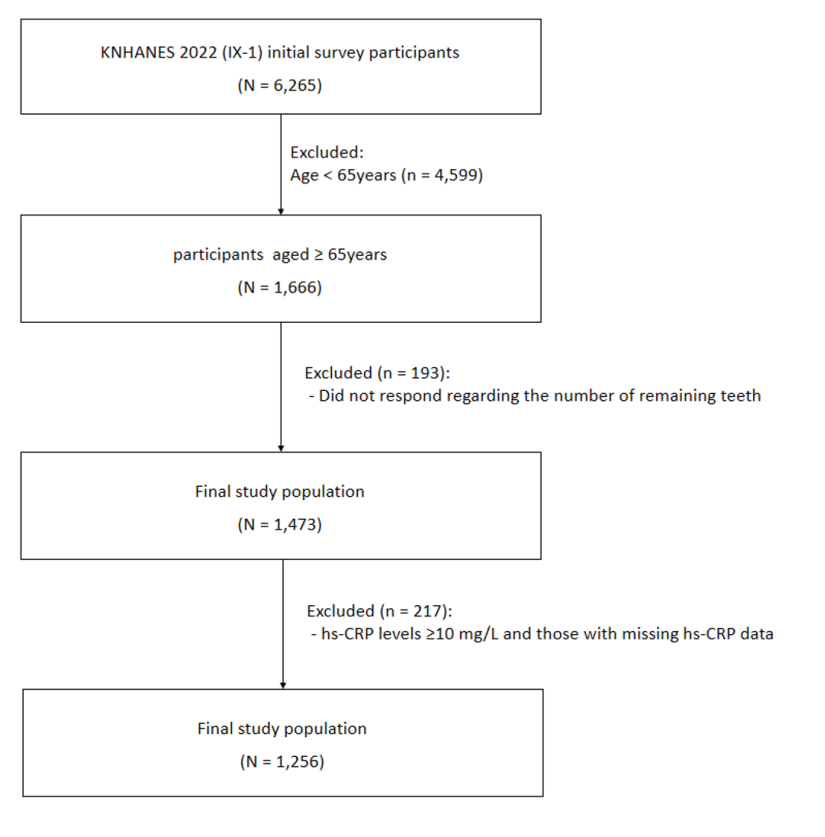
This study utilized data from the first year (2022) of the Ninth KNHANES [14], a nationally representative survey conducted by the Korea Disease Control and Prevention Agency. Among the 6,265 participants in the 2022 KNHANES, 1,666 adults aged 65 years and older were initially identified. Of these, 193 participants who did not provide information on the number of remaining teeth were excluded, leaving 1,473 participants. Subsequently, 217 participants with hs-CRP levels ≥10 mg/L or missing hs-CRP data were excluded. Thus, 1,256 participants were included in the final analytic sample for the regression analyses (Fig. 1). For the multivariable regression analyses, a complete-case analysis (listwise deletion) was performed separately for each hierarchical model. Participants with missing values for any variable included in a given model were excluded from that model. Consequently, the analytic sample size varied across the models: 1,143 participants were included in Model 1 (with 113 participants excluded due to missing data in the demographic variables), 1,124 in Model 2 (with an additional 19 participants excluded due to missing data in the health-related behavior variables), and 1,075 in Model 3 (with a further 49 participants excluded due to missing data in the health condition variables). The sample size remained unchanged in Model 4 because no additional participants were excluded due to missing data.
2.1. Dependent variable: hs-CRP
The dependent variable was the serum level of hs-CRP, a biomarker of chronic low-grade systemic inflammation. To minimize the potential influence of acute infection or acute inflammatory conditions, participants with hs-CRP levels ≥10 mg/L were excluded from the analysis. Because hs-CRP values typically exhibit a right-skewed distribution, natural logarithmic transformation was performed to satisfy the normality assumption of linear regression. Accordingly, the log-transformed hs-CRP value was used in all analyses.
2.2. Independent variables
The independent variables included demographic characteristics, health-related behaviors, health conditions, and oral health status.
demographic characteristics included age (continuous), sex (male or female), family composition (living alone, living with others), household income (low, low-middle, middle-high, high), and education level (elementary school or lower, middle school, high school, college or higher). Household income and education level were treated as ordinal variables based on their ordered categories.
Health-related behaviors included alcohol consumption (lifetime non-drinker or <1 drink/month, ≥1 drink/month), smoking status (non-current smoker, current smoker), and aerobic physical activity (yes, no).
Health conditions variables included diagnosed hypertension (yes, no), diagnosed diabetes (yes, no), diagnosed dyslipidemia (yes, no), and body mass index (BMI, kg/m²).
Oral health status was assessed using the number of remaining teeth. Based on the World Health Organization criterion for functional dentition, participants were categorized into two groups: fewer than 20 remaining teeth and 20 or more remaining teeth.
All statistical analyses were performed using SPSS (ver. 26.0; IBM Corp., Armonk, NY, USA). Following the KNHANES analytical guidelines, complex sample analyses were conducted by incorporating stratification, clustering, and sampling weights to account for the survey's multistage, stratified sampling design.
The distributions of demographic characteristics, health-related behaviors, health conditions, and oral health status were summarized using complex sample frequency analyses for categorical variables and descriptive statistics for continuous variables. The results are presented as weighted percentages (%) for categorical variables and weighted means ± standard errors (SE) for continuous variables.
To examine the univariate associations between log-transformed hs-CRP levels and each independent variable, complex sample simple linear regression analyses were performed.
To evaluate the independent association between oral health status and hs-CRP after controlling for potential confounding factors, hierarchical complex sample multiple linear regression analyses were conducted. Four hierarchical models were constructed. Model 1 included demographic characteristics (age, sex, family composition, household income, and education level). Model 2 additionally adjusted for health-related behaviors(alcohol consumption, smoking status, and aerobic physical activity). Model 3 further adjusted for health conditions variables, including hypertension, diabetes mellitus, dyslipidemia, and BMI. Finally, Model 4 included oral health status (number of remaining teeth) in addition to all variables included in the previous models to assess its independent association with hs-CRP levels. A significance level of 0.05 was used, and p-values < 0.05 were considered statistically significant.
The general characteristics of the study participants are presented in Table 1. A total of 1,256 older adults were included in the analysis, with a mean age of 72.90 ± 0.21 years. Of the participants, 571 (44.9%) were men and 685 (55.1%) were women. Regarding family composition, 296 (21.2%) lived alone, whereas 960 (78.8%) lived with others. The largest proportion of participants belonged to the low-income group (43.1%), followed by the low-middle-income group (27.1%). Nearly half of the participants had an education level of elementary school or lower (46.6%).
Regarding health-related behaviors, 804 participants (64.7%) were lifetime non-drinkers or consumed alcohol less than once per month, and 1,102 (90.0%) were non-current smokers. In addition, 778 participants (67.0%) did not engage in aerobic physical activity. With respect to health conditions, 720 participants (58.8%) had diagnosed hypertension, 275 (22.8%) had diabetes mellitus, and 513 (42.1%) had dyslipidemia. The mean BMI was 24.35 ± 0.11 kg/m².
Regarding oral health status, 548 participants(41.1%) had fewer than 20 remaining teeth, whereas 708 (58.9%) had 20 or more remaining teeth. The mean log-transformed hs-CRP level was −0.30 ± 0.03.
Table 1. General characteristics of the study participants
| Variables | n(%)* | Total(%) | |||||||||||||||||||
|---|---|---|---|---|---|---|---|---|---|---|---|---|---|---|---|---|---|---|---|---|---|
| Demographic | Age (Mean±SE) | 72.90±0.21 | 1,256 (100.0) | ||||||||||||||||||
| characteristics | Sex | Male | 571(44.9) | 1,256 (100.0) | |||||||||||||||||
| Female | 685(55.1) | ||||||||||||||||||||
| Family composition | Alone | 296(21.2) | 1,256 (100.0) | ||||||||||||||||||
| Living with others | 960(78.8) | ||||||||||||||||||||
| Household income | Low | 588(43.1) | 1,253 (100.0) | ||||||||||||||||||
| Low-middle | 353(27.1) | ||||||||||||||||||||
| Middle-high | 183(17.1) | ||||||||||||||||||||
| High | 129(12.7) | ||||||||||||||||||||
| Education level | Elementary school or lower | 581(46.6) | 1,144 (100.0) | ||||||||||||||||||
| Middle school | 190(16.3) | ||||||||||||||||||||
| High school | 226(20.8) | ||||||||||||||||||||
| College or higher | 147(16.4) | ||||||||||||||||||||
| Health-related | Alcohol consumption | Lifetime non-drinker or <1 drink/month | 804(64.7) | 1,238 (100.0) | |||||||||||||||||
| behaviors | ≥1 drink/month | 434(35.3) | |||||||||||||||||||
| Smoking status | Non-current smoker | 1,102(90.0) | 1,235 (100.0) | ||||||||||||||||||
| Current smoker | 133(10.0) | ||||||||||||||||||||
| Aerobic physical activity | No | 778(67.0) | 1,130 (100.0) | ||||||||||||||||||
| Yes | 352(33.0) | ||||||||||||||||||||
| Health conditions Diagnosed hypertension | No | 535(41.2) | 1,255 (100.0) | ||||||||||||||||||
| Yes | 720(58.8) | ||||||||||||||||||||
| Diagnosed diabetes | No | 980(77.3) | 1,255 (100.0) | ||||||||||||||||||
| Yes | 275(22.76) | ||||||||||||||||||||
| Diagnosed dyslipidemia | No | 742(57.9) | 1,255 (100.0) | ||||||||||||||||||
| Yes | 513(42.1) | ||||||||||||||||||||
| BMI (Mean±SE) | 24.35±0.11 | 1,256 (100.0) | |||||||||||||||||||
| Oral health status Remaining teeth | <20 | 548(41.1) | 1,256 (100.0) | ||||||||||||||||||
| ≥20 | 708(58.9) | ||||||||||||||||||||
| Log-transformed hs-CRP (Mean±SE) | −0.30±0.03 | 1,256 (100.0) | |||||||||||||||||||
SE: standard error; BMI: body mass index; hs-CRP: high-sensitivity C-reactive protein. *Data are presented as weighted percentages for categorical variables and weighted mean ± SE for continuous variables. Missing values were excluded from the analysis.
The results of the univariate analyses examining the associations between log-transformed hs-CRP levels and the independent variables are presented in Table 2.
Among the demographic characteristics, increasing age was significantly associated with higher log-transformed hs-CRP levels (B = 0.023, p < 0.001). Men had significantly higher log-transformed hs-CRP levels than women (B = 0.161, p = 0.011). Participants living alone had significantly lower log-transformed hs-CRP levels than those living with others (B = −0.153, p = 0.013). In addition, higher household income was significantly associated with lower log-transformed hs-CRP levels (B = −0.105, p = 0.001).
Regarding health-related behaviors and health conditions, non-current smokers had significantly lower log-transformed hs-CRP levels than current smokers (B = −0.217, p = 0.031). Participants without dyslipidemia had significantly higher log-transformed hs-CRP levels than those with dyslipidemia (B = 0.250, p < 0.001).
With respect to oral health status, participants with fewer than 20 remaining teeth had significantly higher log-transformed hs-CRP levels than those with 20 or more remaining teeth (B = 0.276, p < 0.001).
In contrast, education level, alcohol consumption, aerobic physical activity, hypertension, diabetes mellitus, and BMI were not significantly associated with log-transformed hs-CRP levels.
Table 2. Simple linear regression analysis of factors associated with log-transformed hs-CRP levels
| Variables | B | SE | p | ||||||
|---|---|---|---|---|---|---|---|---|---|
| Demographic characteristics | Age | 0.023 | 0.005 | <0.001 | |||||
| Sex | 0.161 | 0.063 | 0.011 | ||||||
| Family composition | −0.153 | 0.061 | 0.013 | ||||||
| Household income | −0.105 | 0.032 | 0.001 | ||||||
| Education level | −0.046 | 0.027 | 0.082 | ||||||
| Health-related behaviors | Alcohol consumption | −0.074 | 0.075 | 0.324 | |||||
| Smoking status | −0.217 | 0.100 | 0.031 | ||||||
| Aerobic physical activity | 0.079 | 0.071 | 0.270 | ||||||
| Health conditions | Diagnosed hypertension | −0.007 | 0.061 | 0.905 | |||||
| Diagnosed diabetes | 0.067 | 0.070 | 0.341 | ||||||
| Diagnosed dyslipidemia | 0.250 | 0.063 | <0.001 | ||||||
| BMI | 0.010 | 0.012 | 0.407 | ||||||
| Oral health status | Remaining teeth | 0.276 | 0.059 | <0.001 | |||||
B:unstandardized regression coefficient; SE: standard error; BMI: body mass index; hs-CRP: h igh-sensitivity C-reactive protein. By complex sample simple linear regression analysis. Reference groups: female, living with others, ≥1 drink/month, current smoker, aerobic physical activity (yes), diagnosed hypertension (yes), diagnosed diabetes (yes), diagnosed dyslipidemia (yes), and ≥20 remaining teeth.
Hierarchical multiple linear regression analyses were performed to examine the independent associations of demographic characteristics, health-related behaviors, health conditions, and oral health status with log-transformed hs-CRP levels. The results are presented in Table 3.
In Model 1, which included only demographic characteristics, age (B = 0.019, p = 0.006), sex (B = 0.171, p = 0.032), family composition (B = −0.209, p = 0.003), and household income (B = −0.085, p = 0.034) were significantly associated with log-transformed hs-CRP levels.
After additional adjustment for health-related behaviors (Model 2), age (B = 0.018, p = 0.013), family composition (B = −0.196, p = 0.005), and household income (B = −0.088, p = 0.032) remained significantly associated with log-transformed hs-CRP levels, whereas the association with sex was no longer statistically significant (B = 0.118, p = 0.133).
Following further adjustment for health conditions variables (Model 3), age (B = 0.020, p = 0.003), family composition (B = −0.185, p = 0.010), and household income (B = −0.084, p = 0.037) remained significantly associated with log-transformed hs-CRP levels. In addition, participants without diagnosed dyslipidemia had significantly higher log-transformed hs-CRP levels than those with diagnosed dyslipidemia (B = 0.249, p = 0.002).
In the fully adjusted model (Model 4), oral health status remained independently associated with log-transformed hs-CRP levels. Specifically, participants with fewer than 20 remaining teeth had significantly higher log-transformed hs-CRP levels than those with 20 or more remaining teeth (B = 0.176, SE = 0.060, p = 0.004).
Table 3. Multiple linear regression analysis of factors associated with log-transformed hs-CRP levels
| Model 1 | Model 2 | Model 3 | Model 4 | |||||||||||||||||||||||
|---|---|---|---|---|---|---|---|---|---|---|---|---|---|---|---|---|---|---|---|---|---|---|---|---|---|---|
| Variables | ||||||||||||||||||||||||||
| B (SE) | p | B (SE) | p | B (SE) | p | B (SE) | p | |||||||||||||||||||
| Demographic | Age | 0.019(0.007) 0.006 | 0.018(0.007) 0.013 | 0.020(0.007) 0.003 | 0.017(0.007) | 0.019 | ||||||||||||||||||||
| characteristics | Sex | 0.171(0.079) 0.032 | 0.118(0.078) 0.133 | 0.064(0.076) 0.400 | 0.060(0.075) | 0.425 | ||||||||||||||||||||
| Family composition | −0.209(0.069) 0.003 −0.196(0.069) 0.005 −0.185(0.071) | 0.010 −0.198(0.072) | 0.006 | |||||||||||||||||||||||
| Household income | −0.085(0.040) 0.034 −0.088(0.039) 0.032 −0.084(0.040) 0.037 −0.078(0.040) | 0.050 | ||||||||||||||||||||||||
| Education level | −0.021(0.030) 0.480 −0.010(0.030) 0.736 −0.001(0.031) 0.987 | 0.009(0.031) | 0.769 | |||||||||||||||||||||||
| Health-related | Alcohol consumption | −0.080(0.094) 0.395 −0.084(0.094) 0.373 −0.077(0.093) | 0.409 | |||||||||||||||||||||||
| behaviors | Smoking status | −0.163(0.130) 0.214 −0.169(0.128) | 0.189 −0.159(0.130) | 0.222 | ||||||||||||||||||||||
| Aerobic physical activity | 0.042(0.077) 0.587 | 0.041(0.077) 0.600 | 0.031(0.076) | 0.690 | ||||||||||||||||||||||
| Health | Diagnosed hypertension | −0.021(0.071) | 0.768 −0.016(0.072) | 0.819 | ||||||||||||||||||||||
| conditions | Diagnosed diabetes | 0.063(0.080) 0.437 | 0.070(0.080) | 0.382 | ||||||||||||||||||||||
| Diagnosed dyslipidemia | 0.249(0.081) 0.002 | 0.236(0.081) | 0.004 | |||||||||||||||||||||||
| BMI | 0.018(0.015) | 0.246 | 0.020(0.015) | 0.205 | ||||||||||||||||||||||
| Oral health | Remaining teeth | 0.176(0.060) | 0.004 | |||||||||||||||||||||||
| status | ||||||||||||||||||||||||||
B: unstandardized regression coefficient; SE: standard error; BMI: body mass index; hs-CRP: high-sensitivity C-reactive protein. By complex sample multiple linear regression analysis. Model 1: N = 1,143 , R² = 0.033, F = 7.644, p < 0.001; Model 2: N = 1,124, R² = 0.035, F = 3.976, p < 0.001; Model 3: N = 1,075 , R² = 0.053, F = 3.939, p < 0.001; Model 4: N = 1,075, R² = 0.060, F = 4.591, p < 0.001. Dependent variable: log-transformed hs-CRP. Reference groups: female, living with others, ≥1 drink/month, current smoker, aerobic physical activity (yes), diagnosed hypertension (yes), diagnosed diabetes (yes), diagnosed dyslipidemia (yes), and ≥20 remaining teeth. Model 1: Demographic characteristics (age, sex, family composition, household income, and education level). Model 2: Demographic characteristics + health-related behaviors (alcohol consumption, smoking status, and aerobic physical activity). Model 3: Demographic characteristics + health-related behaviors + health conditions (diagnosed hypertension, diagnosed diabetes, diagnosed dyslipidemia, and BMI). Model 4: Demographic characteristics + health-related behaviors + health conditions + Oral health status (remaining teeth).
This study investigated the association between the number of remaining teeth and hs-CRP, a marker of systemic inflammation, among Korean adults aged 65 years and older using data from the first year (2022) of the Ninth KNHANES. Hierarchical multiple linear regression analyses showed that age, family composition, diagnosed dyslipidemia, and the number of remaining teeth were significantly associated with log-transformed hs-CRP levels. In particular, older adults with fewer than 20 remaining teeth exhibited significantly higher log-transformed hs-CRP levels than those with 20 or more remaining teeth (B = 0.176, p = 0.004).
The present findings are consistent with previous Korean studies reporting an association between oral health and systemic inflammatory status. Son and Lee [12] reported that periodontal disease was significantly associated with moderate hs-CRP levels (1–3 mg/L) after adjustment for demographic and health-related factors. In addition, Cho [13] reported that individuals with 0–23 remaining teeth had higher odds of having an hs-CRP level ≥1.23 mg/L than those with 24 or more remaining teeth, which was consistent with the present finding that fewer remaining teeth were associated with higher log-transformed hs-CRP levels.
Although the present findings are consistent with previous Korean studies [12,13], they extend the existing evidence in several important ways. While previous studies included adults across a broader age range, this study focused exclusively on adults aged 65 years and older. This age group is of particular importance because cumulative tooth loss, an increased burden of chronic inflammation, and various age-related health conditions frequently coexist. Furthermore, the present study evaluated the association between the number of remaining teeth and hs-CRP levels after sequential adjustment for demographic characteristics, health-related behaviors, and health conditions. Consequently, these findings provide further evidence supporting an association between the number of remaining teeth and hs-CRP levels among older Korean adults.
These findings are also broadly supported by previous international studies conducted in diverse populations, although the strength and direction of the observed associations have varied. In older adults from the UK and USA, Kotronia et al. [15] reported that tooth loss was associated with higher levels of CRP. Similarly, Holmlund et al. [16] found an inverse association between the number of remaining teeth and inflammatory markers, including CRP, among elderly Swedish adults. More recently, Wu et al. [17] reported that hs-CRP partially mediated the association between tooth loss and mortality in a Chinese cohort, suggesting that systemic inflammation may partly contribute to the association between tooth loss and mortality. In addition, Berger et al. [18], using data from the UK Biobank, reported that higher hs-CRP levels were associated with several indicators of poor oral health, including tooth loss, dentures, bleeding gums, and loose teeth, and provided evidence suggesting that systemic inflammation may also contribute to poor oral health. Collectively, these findings support a close relationship between oral health and systemic low-grade inflammation across diverse populations and suggest that this relationship may be complex and potentially bidirectional.
Although tooth loss is partly a consequence of aging, it may also reflect the cumulative effects of long-standing periodontal disease and chronic oral inflammation [19,20]. Periodontal disease induces persistent inflammation of the periodontal tissues, and inflammatory mediators released locally may enter the systemic circulation, thereby contributing to systemic inflammatory responses [21]. Therefore, the number of remaining teeth may serve as a potential indicator of systemic inflammatory status in older adults. Importantly, however, the number of remaining teeth is not a direct measure of periodontal inflammation, and the observed association should not be interpreted as evidence that tooth loss itself directly causes systemic inflammation.
Older adults with fewer remaining teeth are also more likely to experience impaired masticatory function, which may restrict food choices. Reduced consumption of fruits, vegetables, and fiber-rich foods, together with increased reliance on soft or carbohydrate-rich foods, may contribute to nutritional imbalance and subsequently promote chronic systemic inflammation [22,23]. Thus, the association between tooth loss and hs-CRP may reflect not only the inflammatory consequences of oral disease but also pathways involving impaired mastication and dietary changes.
Age was positively associated with log-transformed hs-CRP levels, consistent with previous studies reporting that chronic low-grade inflammation increases with advancing age [3,24]. Age-related alterations in immune function are accompanied by increased production of pro-inflammatory cytokines, a phenomenon commonly referred to as inflammaging.
Family composition was significantly associated with log-transformed hs-CRP levels. Older adults living alone had significantly lower log-transformed hs-CRP levels than those living with others. This finding was unexpected because living alone has been associated with several adverse health and behavioral outcomes among older adults. Previous studies have reported that older adults living alone may be more likely to experience depression, malnutrition, physical inactivity, and difficulties in health management [25–27]. However, the mechanisms underlying the inverse association observed in the present study remain unclear. Differences in health behaviors, socioeconomic characteristics, health status, selection effects, or other unmeasured factors may have contributed to this finding. Further studies are needed to determine whether and how living arrangements influence systemic inflammation among older adults.
Dyslipidemia was significantly associated with hs-CRP levels. Dyslipidemia is a well-established risk factor for cardiovascular disease, and abnormal lipid metabolism has been linked to vascular inflammation [28]. However, in both the univariate and multivariable analyses, participants without diagnosed dyslipidemia exhibited significantly higher hs-CRP levels than those with dyslipidemia (Model 4: B = 0.236, p = 0.004). A possible explanation is that participants diagnosed with dyslipidemia may have been receiving lipid-lowering therapy, particularly statins. In addition to their cholesterol-lowering effects, statins exert anti-inflammatory effects by improving endothelial function and reducing circulating hs-CRP levels. Consequently, individuals receiving appropriate medical treatment may have lower inflammatory marker levels than those without a diagnosis. Nevertheless, medication use was not included in the present analysis, and treatment status, disease duration, and treatment adherence could not be evaluated. Therefore, the potential role of lipid-lowering therapy remains speculative. Further studies incorporating detailed medication data are warranted to clarify this association. The unexpected inverse association should therefore be interpreted cautiously rather than as evidence of a protective effect of dyslipidemia.
In contrast, BMI was not significantly associated with hs-CRP levels in this study. This finding differs from previous studies conducted in general adult populations that reported positive associations between BMI and hs-CRP [29,30]. One possible explanation is that the present study focused exclusively on older adults. Aging is accompanied by sarcopenia, changes in body composition, and alterations in fat distribution, which may limit the ability of BMI to accurately reflect adiposity and metabolic risk in older populations. Future studies should therefore consider additional measures, such as waist circumference, body fat percentage, and indicators of sarcopenia, to provide a more comprehensive assessment of body composition.
This study has several limitations. First, because the study employed a cross-sectional design using KNHANES data, causal relationships between the number of remaining teeth and hs-CRP levels cannot be established. Second, although hs-CRP is a widely used biomarker of systemic inflammation, its levels may be influenced by acute infection, medication use, dietary factors, and other chronic diseases, all of which could not be fully controlled in the present analysis. Third, although the number of remaining teeth is an objective measure of oral health, it does not fully capture other clinically relevant oral conditions, such as periodontal disease severity, denture use, or masticatory function. Fourth, the explanatory power of the final regression model was relatively low (R²=0.060), indicating that the included variables explained 6.0% of the variance in log-transformed hs-CRP levels. This may reflect the multifactorial nature of systemic inflammation and the presence of unmeasured factors.
Despite these limitations, this study has important strengths. By utilizing nationally representative KNHANES data, the findings are likely to be generalizable to the older Korean population. Furthermore, the study demonstrated that the number of remaining teeth was independently associated with systemic inflammatory status, highlighting the potential importance of oral health in promoting healthy aging. Future longitudinal studies incorporating additional relevant biological, behavioral, and oral health factors are needed to clarify the temporal and causal relationship between tooth loss and systemic inflammation and to determine whether interventions aimed at preventing tooth loss or improving oral health can reduce systemic inflammation.
This study examined the association between the number of remaining teeth and systemic inflammation, as measured by log-transformed hs-CRP, among Korean adults aged 65 years and older, using data from the first year (2022) of the Ninth KNHANES. The main findings were as follows.
1. In the univariate analysis, participants with fewer than 20 remaining teeth had significantly higher log-transformed hs-CRP levels than those with 20 or more remaining teeth (B = 0.276, p < 0.001).
2. After sequential adjustment for demographic characteristics, health-related behaviors, and health conditions, participants with fewer than 20 remaining teeth continued to have significantly higher log-transformed hs-CRP levels than those with 20 or more remaining teeth (B = 0.176, SE = 0.060, p = 0.004).
These findings highlight the potential importance of maintaining oral health and preventing tooth loss as part of healthy aging. Further longitudinal studies are needed to clarify the causal relationship between tooth loss and systemic inflammation and to determine whether oral health interventions can effectively reduce systemic inflammation.
The author fully participated in the work performed and documented truthfully.
The author declared no conflicts of interest.
This research was supported by Kyungdong University Research Fund, 2026.
This research was supported by the ANCHOR program through the Gangwon ANCHOR Center, funded by the Ministry of Education(MOE) and the Gangwon State(G.S.), Republic of Korea.(2026-ANCHOR-10-003)
The 2022 KNHANES was approved by the Institutional Review Board of the Korea Disease Control and Prevention Agency (IRB No. 2018-01-03-4C-A). This study analyzed publicly available, de-identified secondary data; therefore, additional Institutional Review Board review was not required.
The data analyzed in this study are publicly available from the Korea National Health and Nutrition Examination Survey website (https://knhanes.kdca.go.kr).
None.
The author did not use any artificial intelligence tools or software in the preparation of this manuscript.
1. OECD. Health at a glance 2023: OECD indicators [Internet]. OECD Publishing [cited 2026 Aug 4]. Available from:
[DOI]
2. Jaul E, Barron J. Age-related diseases and clinical and public health implications for the 85 years old and over population. Front Public Health 2017;5:335.
[DOI][PubMed][PMC]
3. Franceschi C, Garagnani P, Parini P, Giuliani C, Santoro A. Inflammaging: a new immune-metabolic viewpoint for age-related diseases. Nat Rev Endocrinol 2018;14:576–90.
[DOI][PubMed]
4. Pearson TA, Mensah GA, Alexander RW, Anderson JL, Cannon RO 3rd, Criqui M, et al. Markers of inflammation and cardiovascular disease: application to clinical and public health practice: a statement for healthcare professionals from the Centers for Disease Control and Prevention and the American Heart Association. Circulation 2003;107(3):499–511.
[DOI][PubMed]
5. Emerging Risk Factors Collaboration, Kaptoge S, Di Angelantonio E, Lowe G, Pepys MB, Thompson SG, et al. C-reactive protein concentration and risk of coronary heart disease, stroke, and mortality: an individual participant meta-analysis. Lancet 2010;375(9709):132–40.
[DOI][PubMed][PMC]
6. Sanz M, Marco Del Castillo A, Jepsen S, Gonzalez-Juanatey JR, D’Aiuto F, Bouchard P, et al. Periodontitis and cardiovascular diseases: consensus report. J Clin Periodontol 2020;47(3):268–88.
[DOI][PubMed][PMC]
7. Lamster IB, Pagan M. Periodontal disease and the metabolic syndrome. Int Dent J 2017;67(2):67–77.
[DOI][PubMed][PMC]
8. Yan GLK, Tan MN, Wong ML, Tay CM, Allen PF. Functional dentition, chronic periodontal disease and frailty in older adults: a narrative review. Int J Environ Res Public Health 2023;20(1):502.
[DOI][PubMed][PMC]
9. Hajishengallis G, Chavakis T. Local and systemic mechanisms linking periodontal disease and inflammatory comorbidities. Nat Rev Immunol 2021;21(7):426–40.
[DOI][PubMed][PMC]
10. World Health Organization. Global oral health status report: towards universal health coverage for oral health by 2030 [Internet]. World Health Organization [cited 2026 Aug 4]. Available from: https://www.who.int/publications/i/item/9789240061484
11. Liljestrand JM, Havulinna AS, Paju S, Männistö S, Salomaa V, Pussinen PJ. Missing teeth predict incident cardiovascular events, diabetes, and death. J Dent Res 2015;94(8):1055–62.
[DOI][PubMed]
12. Son SH, Lee ES. Relationship between periodontal disease and level of high-sensitivity C reactive protein in Korean adults. J Korean Soc Dent Hyg 2019;19(6):919–29.
[DOI]
13. Cho YY. Association between periodontal disease, number of remaining teeth and high-sensitivity C-reactive protein in Korean adults aged 40 and older: based on data from 2015 Korea National Health and Nutrition Examination Survey. J Korean Soc Dent Hyg 2020;20(3):303–12.
[DOI]
14. Korea Disease Control and Prevention Agency. Korea National Health and Nutrition Examination Survey (KNHANES): raw data and user guide [Internet]. Korea Disease Control and Prevention Agency [cited 2026 Aug 4]. Available from: https://knhanes.kdca.go.kr/knhanes/main.do
15. Kotronia E, Wannamethee SG, Papacosta AO, Whincup PH, Lennon LT, Visser M, et al. Poor oral health and inflammatory, hemostatic, and cardiac biomarkers in older age: results from two studies in the UK and USA. J Gerontol A Biol Sci Med Sci 2021;76(2):346–51.
[DOI][PubMed][PMC]
16. Holmlund A, Hulthe J, Lind L. Tooth loss is related to the presence of metabolic syndrome and inflammation in elderly subjects: a prospective study of the vasculature in Uppsala seniors (PIVUS). Oral Health Prev Dent 2007;5(2):125–30.
[DOI]
17. Wu D, Mao M, Wang W, Zheng H, You H, Chen W, et al. Tooth loss and mortality risk: the mediating role of hs-CRP in a Chinese cohort. Front Oral Health 2025;6:1542147.
[DOI][PubMed][PMC]
18. Berger M, Kern JS, Schulze-Späte U, Wolfart S, Jankowski J, Wolf M, et al. Systemic inflammation is a risk factor for oral health: an analysis of data from the UK Biobank. Front Immunol 2025;16:1651947.
[DOI][PubMed][PMC]
19. Tonetti MS, Greenwell H, Kornman KS. Staging and grading of periodontitis: framework and proposal of a new classification and case definition. J Periodontol 2018;89(Suppl 1):S159–72.
[DOI][PubMed]
20. Pihlstrom BL, Michalowicz BS, Johnson NW. Periodontal diseases. Lancet 2005;366(9499):1809–20.
[DOI][PubMed]
21. D’Aiuto F, Nibali L, Parkar M, Suvan J, Tonetti MS. Short-term effects of intensive periodontal therapy on serum inflammatory markers and cholesterol. J Dent Res 2005;84(3):269–73.
[DOI][PubMed]
22. Calder PC, Bosco N, Bourdet-Sicard R, Capuron L, Delzenne N, Doré J, et al. Health relevance of the modification of low grade inflammation in ageing (inflammageing) and the role of nutrition. Ageing Res Rev 2017;40:95–119.
[DOI][PubMed]
23. Soysal P, Stubbs B, Lucato P, Luchini C, Solmi M, Peluso R, et al. Inflammation and frailty in the elderly: a systematic review and meta-analysis. Ageing Res Rev 2016;31:1–8.
[DOI][PubMed]
24. Kang MG, Jung HW, Kim BJ. A link between systemic low-grade inflammation and frailty in older adults: clinical evidence from a nationwide population-based study. Korean J Intern Med 2024;39(6):1011–20.
[DOI][PubMed][PMC]
25. Yun H. A study on relationship between physical activity, diet pattern and mental health of Korean elderly. J Korea Converg Soc 2018;9(12):313–9.
[DOI]
26. Suh SR, Kim M. Influencing factors on the health-related quality of life of older adults living alone. J Korean Gerontol Soc 2014;34(4):705–16.
27. Nam SI, See J, Jung YE, Chae J. Meaning in life, depression, and suicidal ideation in old age: a comparative study of living alone and not living alone older adults. Korean J Gerontol Soc Welf 2019;74(2):163–92.
[DOI]
28. Kim HC, Oh SM. Noncommunicable diseases: current status of major modifiable risk factors in Korea. J Prev Med Public Health 2013;46(4):165–72.
[DOI][PubMed][PMC]
29. Lee YJ, Lee JH, Shin YH, Kim JK, Lee HR, Lee DC. Gender difference and determinants of C-reactive protein level in Korean adults. Clin Chem Lab Med 2009;47(7):863–9.
[DOI][PubMed]
30. Choi J, Joseph L, Pilote L. Obesity and C-reactive protein in various populations: a systematic review and meta-analysis. Obes Rev
목적: 본 연구는 국민건강영양조사 제9기 1차년도(2022) 자료를 활용하여 65세 이상 노인을 대상으로 잔존치아 수와 전신 염증 지표인 고감도 C반응단백(high-sensitivity C-reactive protein, hs-CRP) 간의 관련성을 규명하고자 수행되었다. 방법: 연구대상은 제 9기 국민건강영양조사에 참여한 대상자 중 65세 이상 노인 1,256명이었다. 종속변수는 로그 변환한 hs-CRP 수치(log-transformed hs-CRP)로 설정하였으며, 주요 독립변수는 잔존치아 수(20개 미만, 20개 이상)로 분류하였다. 대상자의 일반적 특성은 복합표본 빈도분석과 기술통계를 실시하였다. 잔존치아 수와 hs-CRP의 관련성을 확인하기 위해 복합표본 단순선형회귀분석과 다중선형회귀분석을 실시하였다. 결과: 단순선형회귀분석 결과 연령, 성별, 가족구성, 가구소득, 흡연, 이상지질혈증, 잔존치아 수가 log-transformed hs-CRP와 유의한 관련성을 보였다. 다중선형회귀분석 결과, 연령, 가족구성, 이상지질혈증, 잔존치아 수가 유의한 관련 요인으로 확인되었다. 특히 잔존치아 수가 20개 미만인 노인은 20개 이상인 노인에 비해 hs-CRP 수준이 유의하게 높았다(B = 0.176, SE = 0.060, p = 0.004). 결론: 본 연구는 노인의 잔존치아 수가 전신 염증 수준과 관련됨을 확인하였다. 잔존치아 수가 적을수록 hs-CRP 수준이 높게 나타났으며, 이는 노인의 구강건강과 전신 염증 간에 잠재적인 관련성이 있음을 시사한다. 이러한 결과는 건강한 노화를 촉진하는 데 있어 자연치아를 유지하는 것이 중요할 수 있음을 보여준다. 주요어: 고감도 C반응단백, 한국, 노인, 잔존치아 수, hs-CRP, 전신염증