Journal of Korean Society of Dental Hygiene Open access, Peer Reviewed
pISSN 2287-1705, eISSN 2288-2294
Weeks in Review
Weeks to Publication
Journal of Korean Society of Dental Hygiene Open access, Peer Reviewed
pISSN 2287-1705, eISSN 2288-2294
Eun-Ji Hwang1 , Seon-Ju Sim2
1Lee Sang Dae Dental Clinic
2Department of Dental Hygiene, Baekseok University
Corresponding author: Seon-Ju Sim, Department of Dental Hygiene, Baekseok University, 1 Baekseokdaehak-ro, Dongnam-gu, Cheonan 31065, Republic of Korea. Tel: +82-41-550-2311, Fax: +82-41-550-2829, E-mail: vision1991@bu.ac.kr
Volume 26, Number 5, Pages 575–88, October 2026.
J Korean Soc Dent Hyg 2026;26(5):575–88. https://doi.org/10.13065/jksdh.2026.26.5.2
Received on August 19, 2026, Revised on September 23, 2026, Accepted on October 15, 2026, Published on October 30, 2026.
Copyright © 2026 by Journal of Korean Society of Dental Hygiene.
This is an Open Access article distributed under the terms of the Creative Commons Attribution Non-Commercial License(http://creativecommons.org/licenses/by-nc/4.0/).

Dental hygiene education, Dental hygienists, Digital competence, Digital dental technology, Scoping review
치과의료 분야에서는 구강스캐너, computer-aided design/computer-aided manufacturing (CAD/CAM), 3D 프린팅, 디지털 방사선영상, 전자의무기록 및 인공지능 등 다양한 디지털 기술의 도입과 확산으로 진료와 교육의 디지털 전환이 가속화되고 있다[1,2]. 특히 구강스캐너를 이용한 디지털 인상은 전통적 인상채득 과정의 불편과 재료 변형 가능성을 줄이고, 진료실과 치과기공소 사이의 자료 전달을 효율화하여 디지털 치과진료 워크플로우의 핵심 단계로 활용되고 있다[1,3]. 이러한 변화에 따라 치과위생사는 디지털 장비의 단순 조작뿐 아니라 자료의 획득과 확인, 오류 대처, 환자 설명, 직종 간 정보 공유 및 디지털 자료의 안전한 관리까지 수행할 수 있는 통합적인 역량을 갖출 필요가 있다.
국내 치과종사자를 대상으로 한 연구에서는 디지털 방사선 장비 사용률이 92.8%, 구강스캐너 사용률이 91.2%로 보고되어[4], 일부 디지털 장비가 임상현장에 이미 높은 수준으로 활용되고 있음을 보여준다.
치위생 분야의 디지털 역량은 디지털 기술에 관한 지식·기술·태도를 포괄하는 개념으로 논의되어 왔으나[5], 기존 연구에서는 사용경험, 인식·태도, 자기효능감, 지식, 숙련도 및 객관적 수행성과와 같이 서로 다른 수준의 구성개념이 혼재되어 측정되어 왔다[3,6–8]. 특히 기술의 사용경험이나 긍정적 태도와 실제 수행능력은 서로 구분되는 개념이므로, 이를 동일한 역량으로 해석할 경우 디지털 역량의 개념적 경계가 불명확해질 수 있다[3,6]. 실제 구강스캐너 연구에서는 디지털 지식과 기술 수준이 높을수록 스캔 시간이 단축되는 관련성이 보고되었으나[6], 자기보고식 인식이나 태도가 객관적 임상 수행능력을 직접적으로 대변한다고 보기에는 제한이 있다[3,6]. 따라서 디지털 치위생 역량 평가에서는 지식·기술과 실제 수행을 역량 관련 후보요소로, 인식·태도·자기효능감 등은 별도의 지각·개인요인으로 구분할 필요가 있다.
치위생 교육과 임상 현장의 디지털 전환 사이에는 교육 경험과 교육 요구의 차이가 확인되고 있다[7,8]. 치위생(학)과 학생을 대상으로 한 연구에서는 디지털 장비에 대한 교육 경험보다 교육 및 실습 요구가 높게 나타났으며[7], 임상 치과인력을 대상으로 한 연구에서도 구강스캐너 교육의 필요성과 대학 교육과정 내 이론·실습 병행 요구가 높게 보고되었다[8]. 전국 치위생(학)과 교육과정을 조사한 연구에서는 디지털 리터러시 관련 교과목을 개설한 학과가 전체 조사 대상의 절반에 미치지 못하였다[9].
국내 치위생 분야의 디지털 관련 연구는 디지털 장비의 인식도와 교육 요구 조사에서 구강스캐너 수행, 가상·증강현실 기반 실습, 인공지능 활용 태도 및 디지털 리터러시로 확대되어 왔다[3,6–12]. 국외 치의학교육에서도 디지털 워크플로우 교육과 가상·증강현실을 포함한 다양한 디지털 교육방법이 활용되고 있다[2,13,14]. 그러나 연구 대상, 디지털 기술의 유형 및 측정변수가 서로 달라 기존 문헌에서 실제로 측정된 구성개념과 연구영역을 체계적으로 지도화할 필요가 있다.
따라서 본 연구의 목적은 디지털 치위생 역량체계를 확정적으로 도출하는 것이 아니라, 국내 데이터베이스에서 검색된 문헌에서 실제로 측정된 역량 관련 구성개념을 탐색·지도화하고, 역량 관련 후보영역과 지각·개인요인 및 교육·환경요인을 구분하여 연구공백을 파악함으로써 향후 디지털 치위생 역량체계 및 측정도구 개발을 위한 기초자료를 제시하고자 하였다.
본 연구는 국내 데이터베이스에서 검색된 치위생 분야의 디지털 치과기술 및 관련 역량 연구의 범위, 특성 및 주요 구성요소를 파악하기 위한 주제범위 문헌고찰(scoping review)이다. 연구는 Arksey와 O’Malley의 방법론적 틀, Joanna Briggs Institute (JBI) 지침 및 Preferred Reporting Items for Systematic Reviews and Meta-Analyses Extension for Scoping Reviews (PRISMA-ScR)를 참고하여 수행하였다 [15–17].
1) 1단계: 연구 질문
연구 질문은 인구집단(Population), 개념(Concept), 맥락(Context)의 PCC 형식에 따라 2명의 연구자가 논의하여 구성하였다. 인구집단은 치과위생사와 치위생(학)과 학생을 핵심 대상으로 설정하였다. 다만 치과의사, 치과기공사, 혼합 치과인력 및 관련 교육과정 연구는 치위생 분야에 전이 가능한 구성요소와 교육적 맥락을 탐색하기 위한 확장·보조근거로 포함하였으며, 이를 치과위생사의 직접적인 역량근거로 해석하지 않았다. 개념(Concept)은 디지털 치과기술과 관련하여 연구에서 측정된 지식, 활용능력, 수행, 판단, 태도, 인식, 윤리·안전, 의사소통 및 교육· 환경 관련 구성요소로 설정하였다. 인식·지각과 태도·수용성·자기효능은 지각·개인요인으로, 교육경험·교육요구·교육과정·교육중재 및 도입장벽은 교육·환경요인으로 설정하였다. 맥락(Context)은 치과의료기관과 치위생·치의학 관련 교육기관으로 정하였다. 이에 따른 연구 질문은 “치과위생사와 치위생(학)과 학생을 중심으로 치과의료 및 교육환경에서 수행된 디지털 치과기술 관련 연구의 특성과 문헌에서 실제로 측정된 역량 관련 후보영역, 지각·개인요인 및 교육·환경요인은 무엇인가?”로 설정하였다.
2) 2단계: 관련 연구 검색
(1) 검색전략
문헌검색은 2026년 7월 23일부터 7월 24일까지 수행하였다. 국내 데이터베이스인 한국교육학술정보원의 학술연구정보서비스(RISS), 한국학술정보(KISS), 학술논문지식베이스(DBpia), 국회도서관(NANET)을 이용하였으며, 검색기간은 2016년 1월부터 2026년 7월까지로 제한하였다. 검색어는 ‘치위생’ 또는 ‘치의학’을 기본 검색어로 하고, 디지털 역량, 디지털 리터러시, AI 리터러시, 디지털 치과, 구강스캐너, CAD/CAM, 3D 프린팅, 콘빔 컴퓨터 단층 촬영(cone-beam computed tomography, CBCT), 디지털 방사선, 전자의무기록(electronic medical record, EMR), 가상현실(virtual reality, VR), 증강현실(augmented reality, AR) 등의 관련 검색어를 데이터베이스별 검색 기능에 따라 AND 또는 OR 연산자를 이용하여 조합하였다. 각 데이터베이스의 검색 기능에 맞추어 동일하거나 유사한 검색식을 적용하였으며, 검색일, 검색식, 검색건수 및 중복 여부를 Microsoft Excel에 기록하였다. 검색의 재현성을 높이기 위해 데이터베이스별 실제 검색식과 검색건수는 별도의 검색전략표에 제시하였다<Table 1>. 검색 시 언어 제한은 두지 않았으며, 국내 데이터베이스에서 검색된 국문 또는 영문 학술지 논문과 학위논문 중 원문 전체를 확인할 수 있는 문헌을 검토하였다.
Table 1. Database-specific search terms and number of records retrieved, n
| Search terms | RISS | KISS | DBpia | National Assembly Library |
|---|---|---|---|---|
| Dental hygiene AND digital competence | 9 | 4 | 4 | 11 |
| Dental hygiene AND digital literacy | 8 | 3 | 6 | 7 |
| Dental hygiene AND AI literacy | 3 | 0 | 0 | 0 |
| Dental hygiene AND digital dentistry | 18 | 5 | 23 | 4 |
| Dental hygiene AND digital dentistry terminology | 1 | 1 | 2 | 1 |
| Dentistry AND digital dentistry | 37 | 10 | 135 | 88 |
| Dental hygiene AND intraoral scanner | 4 | 5 | 10 | 5 |
| Dental hygiene AND CAD/CAM | 7 | 6 | 8 | 3 |
| Dental hygiene AND digital impression | 3 | 3 | 5 | 3 |
| Dental hygiene AND CAD/CAM AND education | 2 | 1 | 2 | 1 |
| Dental hygiene AND 3D printing | 2 | 1 | 1 | 2 |
| Dental hygiene AND 3D printing AND education | 0 | 0 | 0 | 0 |
| Dental hygiene AND 3D printing AND post-processing | 0 | 0 | 0 | 0 |
| Dental hygiene AND 3D printing AND cleaning | 0 | 0 | 0 | 0 |
| Dental hygiene AND 3D printing AND light curing | 0 | 0 | 0 | 0 |
| Dental hygiene AND 3D printing AND quality control | 0 | 0 | 0 | 0 |
| Total | 94 | 39 | 196 | 125 |
| Searches were conducted in RISS, KISS, DBpia, and the National Assembly Library for studies published from January 2016 to July 2026. The numbers represent the records retrieved from each database before duplicate removal. | ||||
(2) 문헌 선택 및 배제 기준
문헌의 선정기준은 ① 2016년 1월부터 2026년 7월까지 국내 데이터베이스에서 검색된 학술지 논문 또는 학위논문, ② 치과위생사 및 치위생 (학)과 학생을 핵심 대상으로 한 연구를 포함하되, 치과의사, 치과기공사, 혼합 치과인력 및 국외 치과전문인력 대상 연구는 치위생 분야에 전이 가능한 구성요소를 탐색하기 위한 보조근거(supplementary evidence)로 포함하고, 관련 교육과정 및 교육현황 연구도 교육적 맥락을 확인하기 위한 보조근거로 포함한 연구, ③ 디지털 치과기술의 지식·기술·태도·수행·문제해결·윤리·안전·보안·소통·협업 또는 교육·환경요인 중 하나 이상을 조사한 연구, ④ 원문 전체를 확인할 수 있는 연구로 하였다. 이러한 보조근거는 치과위생사의 직접적인 역량근거로 해석하지 않고, 전이 가능한 구성요소와 교육적 맥락을 탐색하는 데 활용하였다. 치과 관련 타 직종이나 국외 집단 연구는 치과위생사의 역량 및 측정도구 개발에 적용 가능한 요소를 제시한 경우 보조근거로 포함하되, 직접적인 치위생 역량 근거와 구분하여 해석하였다. 배제기준은 ① 연구대상, 연구개념 또는 연구맥락이 PCC에 부합하지 않는 문헌, ② 디지털 장비나 재료의 정확도·물성만을 평가한 연구, ③ 임상 증례나 술식 소개를 주목적으로 한 문헌, ④ 디지털 기술이 단순 교육수단으로 사용되어 디지털 치과기술 관련 역량 구성요소를 확인하기 어려운 연구, ⑤ 일반적인 e-health 또는 건강행동만을 다루어 디지털 치과기술과 직접 관련되지 않은 연구, ⑥ 중복 문헌, ⑦ 학술논문에 해당하지 않는 권호기사, ⑧ 기존 주제범위 문헌고찰과 같은 이차 연구로 하였다. 또한 디지털 치과기술이나 치위생 교육의 필요성을 제시하였더라도 디지털 지식·기술·태도·활용 또는 수행 관련 변수를 직접 조사하지 않은 서술적 문헌은 최종 분석대상에서 제외하였다. 이에 따라 Go 등[1]의 연구는 연구배경을 제시하는 참고문헌으로 활용하였으나, 역량 관련 구성개념을 직접 측정한 실증연구가 아니므로 최종 분석에는 포함하지 않았다.
3) 3단계: 문헌 선정
검색된 문헌은 서지관리 목록으로 통합한 후 중복 문헌을 제거하였다. 2명의 연구자가 제목과 초록을 독립적으로 검토하고, 선정기준에 부합할 가능성이 있는 문헌의 원문을 확인하였다. 의견이 일치하지 않은 경우에는 원문과 선정기준을 재검토하여 합의하였다.
4) 4단계: 자료 추출 및 정리
최종 선정 문헌의 자료추출 및 정리 항목은 일반적 특성과 주제 분석으로 구성하였다. 일반적 특성에는 저자, 출판연도, 연구출처, 연구설계, 연구대상과 표본 수, 자료수집 방법, 연구목적 및 주요 결과를 포함하였다. 주제 분석에는 디지털 치과기술의 유형, 측정도구와 주요 변수, 교육 및 역량 관련 시사점을 포함하였다. 디지털 기술은 구강스캐너·디지털 인상, CAD/CAM·디지털 워크플로우, 3D 프린팅, 디지털 방사선·CBCT, 인공지능, VR·AR, EMR·데이터관리로 분류하였다. 역량 관련 후보영역은 각 문헌의 측정도구와 주요 변수를 추출한 후, 변수의 조작적 정의와 실제 측정내용을 비교하여 의미가 유사한 변수를 귀납적으로 묶어 상위개념을 도출하였다. 이는 사전에 확정된 역량체계에 문헌을 배치한 것이 아니라, 문헌에서 실제로 측정된 변수에 근거한 분류이다. 범주화된 역량 관련 후보영역은 ① 지식·이해, ② 디지털 활용능력·사용, ③ 객관적 수행·숙련, ④ 문제해결·비판적 판단, ⑤ 윤리·안전·데이터보안, ⑥ 소통·협업으로 분류하였다. 각 영역은 문헌에서 실제로 측정된 변수의 조작적 정의와 측정내용을 기준으로 코딩하였다. 지식·이해는 디지털 치과기술의 개념·기능·원리 및 관련 지식, 디지털 활용능력·사용은 장비·소프트웨어의 활용능력·숙련도와 사용 여부·빈도를 포함하되, 활용능력·숙련도와 사용경험은 하위개념으로 구분하였다. 두 하위개념은 동일한 상위범주에 포함하였으나, 사용경험을 실제 활용능력이나 수행능력과 동일한 개념으로 해석하지 않았다. 객관적 수행·숙련은 스캔시간·스캔오차·정확도 등 관찰 가능한 수행성과, 문제해결·비판적 판단은 디지털 기술 활용과 직접 관련된 문제 인식·판단·해결 변수, 윤리·안전·데이터보안은 디지털 치위생 윤리·방사선 안전·디지털 자료의 안전한 관리와 관련된 변수를 포함하였다. 소통·협업은 디지털 정보를 환자 또는 치과의료인력에게 설명·전달·공유하는 능력으로 정의하였다. 일반적인 비판적 사고성향, 자기조절, 전문직 가치 등 디지털 기술과 직접적으로 조작화되지 않은 개인특성은 해당 역량영역으로 코딩하지 않고 관련 개인요인으로 구분하였다. 인식·지각과 태도·수용성·자기효능은 역량 관련 지각·개인요인으로, 교육경험·교육요구·교육과정·교육중재와 도입·접근성·장애요인·실행환경은 교육·환경요인으로 별도 분류하였다. 근거의 활용 수준은 연구대상과 측정내용을 함께 고려하여 구분하였다. 치과위생사 또는 치위생(학)과 학생을 중심으로 역량이나 수행을 직접 측정한 연구는 핵심근거(core evidence)로 분류하였다. 치위생 분야와 관련된 인식·교육요구·사용현황·교육효과 등 간접적인 역량 관련 정보를 제공한 연구는 확장근거(extended evidence)로 분류하였으며, 일부 혼합 치과인력 및 교육중재 연구도 이에 포함하였다. 치과위생사의 역량을 직접 또는 간접적으로 평가하기보다 타 직종·국외 치과집단 및 교육과정에서 전이 가능한 구성요소와 교육적 맥락을 제공한 연구는 보조근거 (supplementary evidence)로 분류하였다. 보조근거는 치과위생사의 직접적인 역량근거로 해석하지 않고, 전이 가능한 구성요소와 교육적 맥락을 파악하는 데 활용하였다. 한 문헌이 둘 이상의 범주를 포함한 경우 중복 분류하였다. 2명의 연구자가 각 문헌의 연구목적, 측정도구 및 주요 변수를 독립적으로 검토하여 영역을 코딩하였으며, 코딩 결과를 상호 비교하였다. 분류가 일치하지 않는 경우 변수의 조작적 정의와 원문의 측정내용을 재확인한 후 논의를 통해 최종 합의하였다.
5) 5단계: 결과 분석, 요약, 보고하기
2명의 연구자가 선정 문헌의 원문을 독립적으로 검토하고 자료추출 결과를 비교한 후 합의하여 최종 분류하였다. 문헌별 특성과 연구주제는 Microsoft Excel 365 (Microsoft Corporation, Redmond, WA, USA)을 이용하여 빈도와 백분율로 산출하였다. 역량 관련 후보영역은 측정도구 또는 주요 변수에서 직접 측정되거나 명시적으로 조작화된 경우에만 코딩하였으며, 교육내용에 포함되었거나 고찰·시사점에서 권고된 내용만으로는 해당 영역에 포함하지 않았다. 역량 관련 지각·개인요인과 교육·환경요인은 별도로 코딩하였다. 디지털 기술, 역량 관련 후보영역, 지각·개인요인 및 교육·환경요인은 다중응답으로 분석하여 각 범주의 백분율을 전체 선정 문헌 20편에 대한 비율로 제시하였으므로 합계가 100%를 초과할 수 있다. 본 분류와 빈도분석은 각 영역의 중요도나 우선순위를 평가하기 위한 것이 아니라, 포함 문헌에서 다루어진 구성개념과 연구영역의 분포를 지도화하기 위해 수행하였다. 또한 핵심·확장 근거는 치위생 분야 해석의 중심으로 사용하고, 타 직종·국외집단·관련 교육과정에서 도출된 보조근거는 전환 가능한 요소를 확인하는 데 한정하여 해석하였다. 따라서 전체 20편을 분모로 산출한 비율은 서로 다른 근거유형을 포함한 문헌의 분포를 의미하며, 치과위생사의 직접적인 역량 수준을 나타내지 않는다. 본 연구는 문헌의 범위와 구성요소를 지도화하는 주제범위 문헌고찰로 개별 연구의 효과크기를 통합하는 메타분석은 시행하지 않았다. 또한 본 연구에서 분류한 6개 영역은 검증된 디지털 치위생 핵심역량체계가 아니라, 포함 문헌에서 확인된 구성개념을 토대로 향후 전문가 합의, 내용타당도 및 측정학적 검증이 필요한 잠정적 후보영역으로 해석하였다.
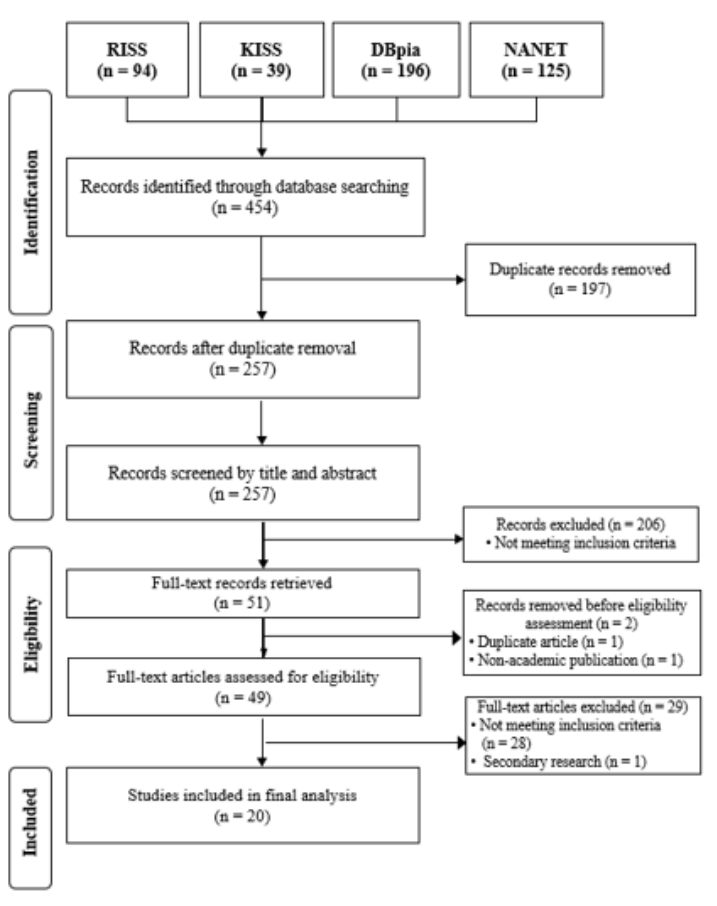
데이터베이스 검색 결과 RISS 94편, KISS 39편, DBpia 196편, NANET 125편으로 총 454편이 검색되었다. 이 중 중복 문헌 197편을 제거하여 257편의 제목과 초록을 검토하였고, 선정기준에 부합하지 않는 206편을 제외하였다. 이후 51편의 원문을 독립적으로 검토하였다. 원문 검토 과정에서 추가 중복문헌 1편과 학술논문에 해당하지 않는 권호기사 1편을 제외하여 49편의 적격성을 평가하였으며, 선정기준 미충족 28편과 이차연구 1편을 제외한 최종 20편을 분석에 포함하였다. 문헌 선정과정과 단계별 제외 편수는 <Fig. 1>에 제시하였다.
최종 분석대상은 총 20편이었다. 출판 시기별로는 2016–2020년 6편(30.0%), 2021–2023년 2편(10.0%), 2024–2026년 12편(60.0%)으로 최근 3년간 발표된 연구가 가장 많았다. 연구설계는 설문조사가 13편(65.0%)으로 가장 많았고, 실험·중재연구 4편(20.0%), 교육과정 조사 2편 (10.0%), 혼합방법연구 1편(5.0%) 순이었다. 최종 선정된 20편의 문헌은 국내 학술지 논문 14편(70.0%)과 학위논문 6편(30.0%)으로 구성되었다[3,4,6–9,11–13,18–28]. 연구대상은 치위생학생 중심 연구 5편(25.0%), 치과위생사 중심 연구 5편(25.0%), 치과위생사가 포함된 혼합 치과인력 연구 5편(25.0%), 타 직종 또는 국외 치과집단 연구 3편(15.0%), 교육과정 조사 2편(10.0%)이었다. 근거 유형별로는 역량 또는 수행을 직접 측정한 핵심근거가 7편 (35.0%), 인식·교육요구·교육효과를 다룬 확장근거가 9편(45.0%), 타 직종·국외집단·교육과정의 전이 가능한 요소를 다룬 보조근거가 4편 (20.0%)이었다<Table 2>.
보조근거는 기술 범위와 전이 가능한 요소를 지도화하는 데 활용하였으며, 치과위생사의 직접적인 역량 수준을 나타내는 근거로 해석하지 않았다. 학술지 논문 중 한국치위생학회지와 차세대융합기술학회논문지가 각각 3편(15.0%)으로 가장 많았으며, 나머지 학술지에는 각각 1편 (5.0%)이 게재되었다.
Table 2. General characteristics of the 20 included studies
| Variables | Categories | n | % | ||||||||
|---|---|---|---|---|---|---|---|---|---|---|---|
| Publication period | 2016–2020 | 6 | 30.0 | ||||||||
| 2021–2023 | 2 | 10.0 | |||||||||
| 2024–2026 | 12 | 60.0 | |||||||||
| Source | Journal article | 14 | 70.0 | ||||||||
| Thesis/dissertation | 6 | 30.0 | |||||||||
| Study design | Survey | 13 | 65.0 | ||||||||
| Experimental/intervention | 4 | 20.0 | |||||||||
| Mixed methods | 1 | 5.0 | |||||||||
| Curriculum review | 2 | 10.0 | |||||||||
| Population | Dental hygiene students | 5 | 25.0 | ||||||||
| Dental hygienists | 5 | 25.0 | |||||||||
| Mixed dental personnel | 5 | 25.0 | |||||||||
| Other profession/international dental group | 3 | 15.0 | |||||||||
| Curriculum | 2 | 10.0 | |||||||||
| Evidence use | Core evidence | 7 | 35.0 | ||||||||
| Extended evidence | 9 | 45.0 | |||||||||
| Supplementary evidence | 4 | 20.0 | |||||||||
| Core evidence: direct measurement of competency or performance; extended evidence: awareness, educational needs, or educational effects; supplementary evidence: transferable elements derived from other dental groups or curricula. Core and extended evidence were used for dental hygiene-centered interpretation, whereas supplementary evidence was used only to identify transferable elements and was not interpreted as direct evidence of dental hygienists’ competency levels. | |||||||||||
선정 문헌에서 다룬 디지털 치과기술을 다중응답으로 분류한 결과, 구강스캐너·디지털 인상 관련 연구가 15편(75.0%)으로 가장 많았고 CAD/ CAM·디지털 워크플로우 12편(60.0%), 3D 프린팅 8편(40.0%), 디지털 방사선·CBCT 7편(35.0%), 인공지능과 EMR·데이터관리 각각 4편 (20.0%), VR·AR 3편(15.0%) 순이었다. 연구목적과 측정변수를 기준으로 살펴보면 디지털 기술에 대한 인식·수용태도, 장비 사용현황, 교육경험 및 교육요구를 조사한 연구가 다수를 차지하였다. 반면 실제 수행시간, 스캔오차, 반복학습에 따른 정확성과 같은 객관적 수행성과를 측정한 연구는 일부 구강스캐너 연구에 제한되어 있었다. 교육중재 연구에서는 AR 방사선 촬영 시뮬레이터, 디지털치과학 수업 및 디지털 워크플로우 교육의 효과를 평가하였으며, 교육과정 연구에서는 디지털·3D, 인공지능, 빅데이터 및 VR 관련 교과목의 개설 현황을 분석하였다.
측정도구와 주요 변수에서 직접 평가된 항목을 역량 관련 후보영역으로 재분류한 결과, 디지털 활용능력·사용이 12편(60.0%)으로 가장 많았고, 지식·이해는 2편(10.0%)이었다. 이 범주에는 실제 장비·소프트웨어의 활용능력·숙련도뿐 아니라 사용 여부·빈도 및 사용경험이 함께 포함되었으며, 활용능력·숙련도와 사용경험은 동일한 개념으로 해석하지 않고 하위개념으로 구분하였다. 객관적 수행·숙련은 2편(10.0%)으로 스캔시간, 스캔오차 및 정확도 등의 변수가 포함되었고, 문제해결·비판적 판단은 1편(5.0%)으로 디지털 기술 활용과 관련된 문제 인식·판단·해결 변수가 포함되었다. 윤리·안전·데이터보안은 2편(10.0%)으로 디지털 치위생 윤리, 방사선 안전 및 디지털 자료의 안전한 관리 관련 변수가 포함되었으며, 소통·협업은 1편(5.0%)으로 디지털 정보를 환자 또는 치과의료인력에게 설명·전달·공유하는 능력이 포함되었다. 역량 관련 지각· 개인요인에서는 태도·수용성·자기효능이 14편(70.0%), 인식·지각이 13편(65.0%)에서 확인되었다. 교육·환경요인에서는 교육경험·교육요구· 교육과정·교육중재가 15편(75.0%), 도입·접근성·장애요인·실행환경이 8편(40.0%)에서 확인되었다<Table 3>. 지식·이해 영역에는 디지털 치과기술의 개념과 기능, 디지털 치위생 직무역량의 지식영역 및 방사선 안전지식 등이 포함되었다. 디지털 활용능력·사용 영역에는 장비 사용경험과 활용도, 장비·소프트웨어 사용능력, 디지털 리터러시 행동과 스마트기기 숙련도 등이 포함되었다. 인식· 지각 영역에는 디지털 장비와 시스템에 대한 인지도와 편의성·정확성·효과성에 대한 주관적 평가가 포함되었으며, 태도·수용성·자기효능 영역에는 기술수용 의도, 유용성·용이성, 향후 사용 선호, 혁신성, 만족도, 인공지능에 대한 태도와 자기효능감 등이 포함되었다. 이들 지각·개인요인은 객관적 지식이나 실제 수행성과와 구분하여 해석하였다.
Table 3. Digital technologies, competency-related candidate domains, perceptual/personal factors, and educational/contextual factors identified in the included studies
| Section | Category | n | % | |||||||
|---|---|---|---|---|---|---|---|---|---|---|
| Digital technology | Intraoral scanner / digital impression | 15 | 75.0 | |||||||
| CAD/CAM / digital workflow | 12 | 60.0 | ||||||||
| 3D printing | 8 | 40.0 | ||||||||
| Digital radiography / CBCT | 7 | 35.0 | ||||||||
| Artificial intelligence | 4 | 20.0 | ||||||||
| EMR / data management | 4 | 20.0 | ||||||||
| VR/AR | 3 | 15.0 | ||||||||
| Competency-related candidate domain | Knowledge / understanding | 2 | 10.0 | |||||||
| Digital skills / utilization | 12 | 60.0 | ||||||||
| Objective performance / proficiency | 2 | 10.0 | ||||||||
| Problem solving / critical judgment | 1 | 5.0 | ||||||||
| Ethics / safety / data security | 2 | 10.0 | ||||||||
| Communication / collaboration | 1 | 5.0 | ||||||||
| Competency-related perceptual/personal | Awareness / perception | 13 | 65.0 | |||||||
| factors | Attitude / acceptance / self-efficacy | 14 | 70.0 | |||||||
| Educational/contextual factors | Educational experience / needs / curriculum / intervention | 15 | 75.0 | |||||||
| Adoption / access / barriers / implementation environment | 8 | 40.0 | ||||||||
| Percentages were calculated using all 20 included studies as the denominator, including core, extended, and supplementary evidence. Multiple-response coding was applied; therefore, a single study could be classified into more than one category. These frequencies represent the distribution of constructs across the included literature and should not be interpreted as the proportion of direct competency evidence for dental hygienists. | ||||||||||
객관적 수행·숙련 영역은 구강스캐너의 스캔시간·스캔오차와 반복학습에 따른 재현성·정확성을 직접 측정한 2편에서 확인되었다[6,18]. 문제해결·비판적 판단과 소통·협업은 디지털 치위생 직무역량의 해당 하위영역을 직접 측정한 1편에서 각각 확인되었다[22]. 윤리·안전·데이터보안 영역은 디지털 치위생 관련 윤리·안전 역량과 방사선 안전지식을 평가한 2편에서 확인되었다[21,22]. 데이터보안을 독립적인 역량으로 직접 평가한 연구는 확인되지 않았다. 교육내용이나 고찰에서 윤리, 환자소통, 의사결정 또는 협업을 언급한 경우라도 실제 측정변수에 포함되지 않은 경우에는 해당 역량영역으로 코딩하지 않았다. 문헌별 연구설계, 대상자, 디지털 기술, 주요 변수와 핵심 결과는 <Table 4>에 제시하였다. 인식·지각과 태도·수용성·자기효능은 역량 후보영역 자체라기보다 기술을 받아들이고 활용하는 과정과 관련된 지각·개인요인으로 별도 분류하였다. 교육경험·교육요구·교육과정·교육중재는 역량 형성에 영향을 미치는 선행요인 또는 교육환경 변수로, 도입·접근성·장애요인·실행환경은 기술수용과 실제 활용을 설명하는 맥락적 요인으로 구분하였다. 이를 종합하면 후속 디지털 치위생 역량 측정도구의 잠정적 후보영역으로는 ① 디지털 치과기술 지식·이해, ② 장비·소프트웨어 활용기술, ③ 객관적 임상 수행, ④ 문제해결·비판적 판단, ⑤ 환자소통·직종 간 협업, ⑥ 윤리·안전·데이터보안을 고려할 수 있다. 인식·지각, 태도·수용성·자기효능, 교육경험·교육요구·교육과정, 장비 접근성 및 도입장벽은 역량 후보영역과 분리하여 관련 개인요인 또는 배경·교육환경 변수로 다루는 것이 타당하다.
본 연구는 2016년부터 2026년 7월까지 국내 데이터베이스에서 검색된 치위생 중심의 디지털 치과기술 관련 연구와 보조근거 20편을 분석하여 연구의 일반적 특성, 적용된 디지털 기술, 직접 측정된 역량 관련 후보영역, 역량 관련 지각·개인요인 및 교육·환경요인을 지도화하였다. 전체 문헌의 60.0%가 2024년 이후에 발표되었고, 구강스캐너·디지털 인상과 CAD/CAM·디지털 워크플로우가 가장 빈번하게 다루어졌다. 역량 관련 후보영역에서는 전체 포함 문헌 20편을 기준으로 디지털 활용능력·사용이 12편(60.0%)으로 가장 많았고 지식·이해는 2편(10.0%)이었다. 이 비율은 핵심·확장·보조근거를 모두 포함한 문헌 분포이며 치과위생사의 직접적인 역량 수준을 의미하지 않는다. 지각·개인요인에서는 태도· 수용성·자기효능 14편(70.0%), 인식·지각 13편(65.0%)으로 나타난 반면, 객관적 수행, 문제해결·비판적 판단, 윤리·안전·데이터보안 및 소통·협업에 관한 직접 근거는 매우 제한적이었다. 이는 국내 선행연구가 디지털 시스템에 대한 인식, 지식·태도 및 교육요구 등 기술의 도입과 수용에 관련된 자기보고식 변수에 상대적으로 집중되어 온 연구경향과 관련된 것으로 볼 수 있다[3,7,8].
본 연구에서는 측정변수를 역량 관련 후보영역, 지각·개인요인 및 교육·환경요인으로 구분하였다. 이를 통해 인식·지각과 태도·수용성·자기효능을 실제 수행역량과 구분하고, 교육경험·교육요구 등은 역량 형성에 영향을 미치는 교육·환경요인으로 해석하였다. 이러한 구분은 향후 디지털 치위생 역량 모형과 측정도구 개발을 위한 개념적 기초를 제공한다. 직접 측정된 역량 관련 후보영역 가운데 객관적 수행·숙련은 2편(10.0%), 문제해결·비판적 판단은 1편(5.0%), 소통·협업은 1편(5.0%)으로 매우 적었다. 이러한 차이는 객관적 수행평가가 장비, 수행과제 및 평가기준을 필요로 하는 연구설계상의 특성과 관련되었을 가능성이 있으나, 본 연구의 결과만으로 그 원인을 확정하기는 어렵다. 실제 임상에서 요구될 수 있는 디지털 역량은 장비를 작동하는 능력뿐 아니라 오류를 인지하고 수정하며, 결과의 신뢰성을 판단하고, 디지털 정보를 환자에게 설명하고, 치과의사 및 치과기공사와 정확하게 공유하는 능력을 포함한다. 따라서 후속 교육과 연구에서는 구강 스캔 누락·왜곡·교합 정보 오류·파일 전송 문제 등 실제 사례를 활용하여 오류 대처, 임상 의사결정, 환자 설명 및 직종 간 협업을 수행평가에 포함할 필요가 있다. 이러한 수행평가는 우선 치위생(학)과의 교내 디지털 실습 및 임상실습 전 시뮬레이션 교육에서 교수자와 임상실습 지도자를 중심으로 운영하고, 이후 임상 치과위생사를 대상으로 한 보수교육 및 계속교육 프로그램으로 확장할 수 있다. 인공지능과 자동화된 진단지원 기술의 활용이 확대되는 상황에서 윤리와 데이터보안은 향후 디지털 치위생 역량체계에서 추가적으로 검토할 필요가 있는 후보영역이다[29,30]. 다만 본 연구에서 관련 연구가 적었다는 사실 자체가 해당 영역의 중요성을 입증하는 근거로 해석되어서는 안 된다.
한편 일부 구성요소는 치과의사, 치과기공사, 혼합 치과인력, 국외 치과집단 및 교육과정 연구에서 확인된 것으로, 이러한 보조근거는 치위생 분야에 전이 가능한 구성요소와 교육적 맥락을 탐색하는 데 활용하였으며, 치과위생사의 직접적인 역량근거로 일반화하는 데에는 주의가 필요하다.
본 연구의 결과를 바탕으로 후속 디지털 치위생 역량 측정도구에서는 ① 디지털 치과기술 지식·이해, ② 장비·소프트웨어 활용능력, ③ 객관적 임상 수행, ④ 문제해결·비판적 판단, ⑤ 환자소통·직종 간 협업, ⑥ 윤리·안전·데이터보안을 잠정적 후보영역으로 검토할 수 있다. 기존 디지털 역량 프레임워크를 참고하되[5], 인식·지각과 태도·수용성·자기효능은 별도의 지각·개인요인으로 교육경험, 교육요구, 교육과정 편성, 장비 접근성 및 도입장벽은 교육·환경요인으로 측정할 필요가 있다. 향후 치위생교육 전문가, 임상 치과위생사 및 디지털 치과기술·산업 전문가가 균형 있게 참여하는 다학제 패널을 구성하여 전문가 델파이와 내용타당도 검증을 실시하고, 예비도구 개발 후 구성타당도와 내적 일관성 및 검사–재검사 신뢰도를 검증할 필요가 있다. 또한 준거타당도 검증과 함께 자기보고식 역량 점수와 실제 수행평가 간의 관련성을 확인함으로써 측정도구의 타당성을 추가적으로 검증할 필요가 있다.
본 연구는 치위생 분야의 디지털 치과기술 관련 연구를 체계적으로 지도화하고, 측정된 역량과 교육·환경요인을 구분하여 후속 측정도구 개발에 활용할 수 있는 구성요소를 도출하였다는 의의가 있다. 그러나 다음의 제한점이 있다. 첫째, 국내 4개 데이터베이스에서 검색된 문헌을 대상으로 하였으므로 해외 데이터베이스에 수록된 연구가 충분히 반영되지 않았을 수 있다. 둘째, 치위생 분야의 직접 근거가 부족한 영역을 보완하기 위해 치과의사, 치과기공사, 국외 치과집단 및 관련 교육과정 연구를 보조근거로 포함하였으므로 이 결과를 치과위생사에게 직접 일반화하는 데 주의가 필요하다. 셋째, 연구설계와 측정도구의 이질성이 크고 주제범위 문헌고찰의 목적에 따라 개별 문헌의 효과크기 통합이나 질 평가를 핵심 분석으로 시행하지 않았다. 넷째, 서로 다른 연구에서 측정된 구성개념을 6개의 상위 후보영역으로 재분류하고 다중응답 코딩하는 과정에서 연구자의 해석과 판단이 개입되었을 가능성이 있다. 이를 최소화하기 위해 실제 측정변수와 조작적 정의에 근거한 보수적 코딩기준을 적용하고 2명의 연구자가 독립적으로 검토한 후 불일치 항목을 합의하였다. 향후 국제 데이터베이스 검색과 임상·교육·디지털 치과기술 분야 전문가의 체계적인 합의과정을 통해 본 연구에서 제시한 후보영역을 추가로 검증할 필요가 있다.
Table 4. Characteristics and main findings of the 20 included primary studies
| No. | Author (year) | Study design | Participants (N) | Population category | Evidence use | Coded competency-related domain(s) | Digital technology | Main variables | Key findings |
|---|---|---|---|---|---|---|---|---|---|
| 1 | Lim (2016)[18] | Repeated-measures clinical scanning experiment | Dental hygienists without scanner experience (N=20) and four scan subjects | Dental hygienists | Core | Objective performance- proficiency | iTero, Trios, Dental Wings reference scan, STL/Geomagic 3D superimposition | Reproducibility, trueness, learning curve | Trios showed better reproducibility; iTero trueness improved with repeated scanning. |
| 2 | Moon et al. (2017)[7] | Cross-sectional self-administered survey | Dental hygiene students with clinical practice experience (N=736) | Dental hygiene students | Extended | N/A | Digital X-ray, electronic chart, intra-oral camera, CAD/CAM, oral scanner | Awareness, education experience, educational needs | Educational demand was high, with higher digital-dentistry perceptions among trained students. |
| 3 | Gu and Lee (2018)[11] | Non-equivalent control-group pretest-posttest study | Dental hygiene students in radiography practice (N=217; experimental 113, control 104) | Dental hygiene students | Extended | N/A | AR-based dental radiography simulator | Self-efficacy, learning interest, flow, satisfaction | All outcomes were higher in the AR group. |
| 4 | Lim (2018)[19] | Cross-sectional self-report survey | Active dentists in Seoul, Gyeonggi, and Incheon (N=82) | Other profession / international dental group | Supplementary | Digital skills / utilization-related measures | Intraoral/model scanners, CAD/CAM, and 3D printers | Equipment use, attitudes, education, barriers | Device ownership was limited; cost and uncertain return were major barriers. |
| 5 | Lee and Ahn (2019)[3] | Cross-sectional self-administered survey | Dental hygienists with no prior intraoral-scanner experience (N=93) | Dental hygienists | Extended | N/A | Digital intraoral scanner and digital impression | Operator difficulty, perceived benefits, attitudes | Difficulty varied by age and duty position; expectations were generally positive. |
| 6 | Lee (2020)[13] | Mixed-method educational intervention | UDMM students 98 (matched 96), lecturers 50, and dental technicians 3; total N=151 | Other profession / international dental group | Extended | Digital skills / utilization-related measures | 3D printer, Medit i500/T500 scanners, EXOCAD, temporary crown/prosthesis design | Digital ability, educational needs, confidence, satisfaction | Digital-treatment ability improved, with high satisfaction and future-use intention. |
| 7 | Kim et al. (2021)[20] | Cross-sectional occupation-specific survey | Dental professionals/staff (n=92), dental industry personnel (n=29), and dental students (n=20); N=141 | Mixed dental personnel | Extended | Digital skills / utilization-related measures | Intraoral scanner, CAD/CAM, 3D printer, digital workflow | Benefits, barriers, equipment ownership, purchase intention | Time saving was the main benefit and cost the main barrier. |
| 8 | Kim (2022)[21] | Nationwide cross-sectional self-administered survey | Dental hygienists who completed university radiography practice and currently perform dental radiography (N=386) | Dental hygienists | Core | Knowledge / understanding; Digital skills / utilization-related measures; Ethics / safety / data security | Digital radiography/sensors, digital film and scanner, panoramic, cephalometric, dental CT, portable X-ray | Radiography education, radiation safety knowledge, equipment use, clinical duties | Digital radiography and panoramic imaging were widely used, while university practice remained film-focused. |
| 9 | Kim et al. (2024)[6] | Digital-competence survey plus three repeated intraoral scans | Dental hygienists and dental hygiene students without scanner experience (N=35) | Mixed dental personnel | Core | Knowledge / understanding; Digital skills / utilization-related measures; Objective performance / proficiency | Medit i700 intraoral scanner; model scanner; 3D RMS error analysis | Digital attitude, skills, knowledge, scan time/error | Higher digital skills and knowledge were associated with shorter scan time. |
| 10 | Park (2024)[22] | Cross-sectional self-report survey | Clinical dental hygienists (N=395; 3-year graduates 205, 4-year graduates 190) | Dental hygienists | Core | Digital skills / utilization-related measures; Problem solving / critical judgment; Communication / collaboration; Ethics / safety / data security | Digital dentistry workflow including AI, VR, 3D printing, and scanners | Digital competencies, awareness, education, job satisfaction | Digital competencies and educational factors were associated with job satisfaction. |
| 11 | Shilpa (2024)[23] | International online cross-sectional survey | Licensed dentists from seven Southeast Asian countries (N=25) | Other profession / international dental group | Supplementary | Digital skills / utilization-related measures | Oral scanning, chairside CAD/CAM, CBCT, 3D planning, digital smile design, guided implant surgery, big data and teledentistry | Adoption, benefits, barriers, educational methods | Interest in digital-dentistry education was high, with preference for on-site or regional training. |
| 12 | Kim (2024)[24] | Cross-sectional face-to-face and online survey | Dental personnel: dental hygienists 218, dentists 39, dental technicians 38 (N=295) | Mixed dental personnel | Extended | Digital skills / utilization-related measures | Digital intraoral scanner and digital impression, dental CAD/CAM | Awareness, use, education experience/needs | Awareness and use were high, but university education experience was low. |
| 13 | Jung (2025)[8] | Cross-sectional survey | Dentists (n=23) and dental hygienists (n=136) in Jeonnam; N=159 | Mixed dental personnel | Extended | Digital skills / utilization-related measures | Digital intraoral scanner and digital impression | Awareness, use, educational experience/needs | Awareness and educational needs were high, while university education experience was low. |
| 14 | Kim and Kim (2025)[25] | Cross-sectional self-administered survey | Dental hygiene students with clinical-practice experience in Busan/Ulsan (N=270) | Dental hygiene students | Extended | N/A | Digital intraoral scanner | Education experience/intention, digital awareness | Education experience was greater among upper-grade and longer-practicum students. |
| 15 | Lee and Yang (2025)[26] | Cross-sectional self-administered survey | Dental hygienists with digital-device experience (N=168) | Dental hygienists | Core | Digital skills / utilization-related measures | Digital radiography/CBCT, intraoral scanner, EMR, 3D printer, CAD/CAM, AI diagnosis | Utilization, proficiency, convenience, effectiveness | Digital radiography, scanners, and EMR were most frequently used. |
| 16 | Park (2025)[4] | Cross-sectional online self-administered survey | Dental personnel in Gyeongsangbuk-do (N=250; dental hygienists 207) | Mixed dental personnel | Extended | Digital skills / utilization-related measures | Digital X-ray, intraoral scanner, CAD/CAM, 3D printer | Equipment use, education needs, barriers | Digital X-ray and intraoral scanners were widely used; patient cost was the main barrier. |
| 17 | Park (2025)[9] | Exploratory website-based curriculum review | Curricula of 87 dental hygiene departments nationwide (3-year 60; 4-year 27) | Curriculum | Supplementary | N/A | Digital/3D, AI, big data/information use, coding/computing, VR | Course availability, type, year level, major status | Digital-literacy courses were offered in 39 departments (44.8%). |
| 18 | Lee (2025)[27] | Exploratory official-website curriculum analysis | 2024 curricula of five dental technology programs in Gyeonggi Province (four 3-year, one 4-year) | Curriculum | Supplementary | N/A | CAD/CAM, 3D printing, 3Shape, EXOCAD, digital complete denture design/fabrication | Digital-course credits, theory/practice, denture courses | All programs offered digital courses, but digital complete-denture courses were limited. |
| 19 | Sim et al. (2026)[12] | Single-group pretest-posttest intervention | Dental hygiene students in one 4-year university (pretest N=63; matched N=34) | Dental hygiene students | Core | Digital skills / utilization-related measures | 15-week digital dentistry course: AI, imaging, scanner/workflow, data, ethics, communication, decision-making, PBL/project | AI attitudes, digital literacy, device use/proficiency | AI attitudes improved, while digital-literacy awareness and behavior did not significantly change. |
| 20 | Lee and Lim (2026)[28] | Cross-sectional self-administered survey | Dental hygiene students at one university (N=169; grades 1〝4) | Dental hygiene students | Core | Overall digital competency (total score) | Digital dental hygiene competency involving digital equipment and information technology | Digital competency, self-regulation, critical thinking, professional values | Digital competency was associated with critical thinking, self-regulation, professional values, and grade. |
Reference numbers correspond to the manuscript reference list. Core evidence indicates direct measurement of competency or performance; extended evidence indicates indirect competency-related information such as awareness, educational needs, use, or educational effects; supplementary evidence indicates transferable elements from other dental groups or curricula. AI, artificial intelligence; AR, augmented reality; CAD/CAM, computer-aided design/computer-aided manufacturing; CBCT, cone-beam computed tomography; EMR, electronic medical record; N/A, not applicable; PBL, problem-based learning; RMS, root mean square; STL, stereolithography; UDMM, University of Dental Medicine, Mandalay; VR, virtual reality. | |||||||||
본 연구는 2016년부터 2026년 7월까지 국내 데이터베이스에서 검색된 디지털 치과기술 관련 치위생 중심 연구와 보조근거를 분석하여 디지털 기술과 역량 관련 구성요소를 지도화하였다. 관련 연구는 2024년 이후 크게 증가하였으며, 구강스캐너·디지털 인상과 CAD/CAM·디지털 워크플로우에 집중되어 있었다. 또한 디지털 활용능력·사용과 인식·태도 관련 요인은 비교적 빈번하게 다루어진 반면, 객관적 임상 수행, 문제해결·비판적 판단, 윤리·안전, 데이터보안, 환자소통 및 직종 간 협업에 대한 직접적인 근거는 제한적이었다. 향후 디지털 치위생 역량 연구에서는 자기보고식 인식과 태도뿐 아니라 실제 수행평가와 임상적 판단을 포함하는 통합적 접근이 필요하다. 본 연구에서 도출한 지식·이해, 장비·소프트웨어 활용능력, 객관적 임상 수행, 문제해결·비판적 판단, 환자소통·직종 간 협업, 윤리·안전·데이터보안의 6개 영역은 검증된 핵심역량이 아닌 잠정적 후보영역으로, 향후 전문가 합의, 내용타당도 및 측정학적 검증을 통해 구체화할 필요가 있다. 반면 인식·지각, 태도·수용성·자기효능 및 교육·환경요인은 역량 관련 후보영역과 구분하여 평가할 필요가 있다. 이러한 결과는 치위생(학) 과의 단계적 디지털 교육과정과 임상 치과위생사의 보수교육 및 계속교육 프로그램을 설계하기 위한 기초자료로 활용될 수 있다.
Conceptualization: SJ Sim, EJ Hwang; Data collection: SJ Sim, EJ Hwang; Formal analysis: SJ Sim, EJ Hwang; Writing–original draft: EJ Hwang; Writing–review and editing: SJ Sim
The authors declared no conflicts of interest.
None.
Not applicable because this study reviewed and analyzed previously published literature.
The data supporting the findings of this study are available from the corresponding author upon reasonable request.
None.
The authors used ChatGPT (GPT-5.6 Sol; OpenAI, San Francisco, CA, USA) to assist with language editing, consistency checking, and manuscript formatting. After using this tool, the authors reviewed and edited the content as needed and take full responsibility for the content of the publication.
1. Go HB, Seo YJ, Won BY, Oh SH. Transformation of digital dentistry and the need of introducing education in dental hygiene. J Korean Soc Dent Hyg 2022;22(6):467–75.
[DOI]
2. Zitzmann NU, Matthisson L, Ohla H, Joda T. Digital undergraduate education in dentistry: a systematic review. Int J Environ Res Public Health 2020;17(9):3269.
[DOI][PubMed][PMC]
3. Lee CH, Ahn SH. Analysis of dental hygienists’ perception of knowledge and attitude toward digital oral scanner. J Korean Soc Dent Hyg 2019;19(1):33–44.
[DOI]
4. Park YN. Current status and awareness of dental digital equipment systems among dental professionals. J Next-Gener Converg Technol Assoc 2025;9(9):2231–9.
[DOI]
5. Vuorikari R, Kluzer S, Punie Y. DigComp 2.2: the digital competence framework for citizens with new examples of knowledge, skills and attitudes. Luxembourg: Publications Office of the European Union; 2022.
[DOI]
6. Kim YW, Lim DS, Lim HJ, Jung IH. Effect of digital competence on scan time and scan error in intraoral scanning. J Korean Soc Dent Hyg 2024;24(4):271–80.
[DOI]
7. Moon HJ, Kim YS, Seong MG, Lee HO. The awareness on dental digital system in dental hygiene students. J Korean Acad Dent Hyg 2017;19(1):19–30.
8. Jung EJ. A study on awareness and educational needs regarding digital intraoral scanners. J Korean Soc Dent Hyg 2025;25(6):589–600.
[DOI]
9. Park BY. Digital literacy-related courses in dental hygiene departments: an exploratory study based on website analysis. J Korean Dent Hyg Sci 2025;8(2):1–10.
[DOI]
10. Kim M. Research trends in digital and AI education and competencies among dental hygiene students in Korea: a scoping review. J Korean Dent Hyg Sci 2026;9(1):91–105.
[DOI]
11. Gu JY, Lee JG. Effects of a new clinical training simulator for dental radiography using augmented reality on self-efficacy, interest in learning, flow, and practice satisfaction. J Digit Contents Soc 2018;19(9):1811–7.
[DOI]
12. Sim SJ, Hong MH, Lee MJ, Kim JH. Effects of a digital dentistry course on attitudes towards artificial intelligence and digital literacy among dental hygiene students. Korean J Clin Dent Hyg 2026;14(2):99–109.
[DOI]
13. Lee YM. Effects of digital dentistry as an international development cooperation plan for the improvement of dental education in University of Dental Medicine, Mandalay, Myanmar [Doctoral dissertation]. Seoul: Seoul National University, 2020.
14. Dzyuba N, Jandu J, Yates J, Kushnerev E. Virtual and augmented reality in dental education: the good, the bad and the better. Eur J Dent Educ 2025;29(3):497–515.
[DOI][PubMed][PMC]
15. Arksey H, O’Malley L. Scoping studies: towards a methodological framework. Int J Soc Res Methodol 2005;8(1):19–32.
[DOI]
16. Tricco AC, Lillie E, Zarin W, O’Brien KK, Colquhoun H, Levac D, et al. PRISMA extension for scoping reviews (PRISMA-ScR): checklist and explanation. Ann Intern Med 2018;169(7):467–73.
[DOI][PubMed]
17. Peters MDJ, Godfrey C, McInerney P, Munn Z, Tricco AC, Khalil H. Chapter 11: scoping reviews. In: JBI manual for evidence synthesis. Edited by Aromataris E, Munn Z: Adelaide: JBI; 2020.
[DOI]
18. Lim JH. Comparison of digital intraoral scanner reproducibility and image trueness considering repetitive learning [Master’s thesis]. Seoul: Ewha Womans University, 2016.
19. Lim SS. Identifying current use of dental digital equipments and limiting factors influencing the adaptation of the technologies: focusing on the intraoral scanner [Master’s thesis]. Seoul: Seoul National University, 2018.
[DOI]
20. Kim JH, Lee HJ, Go SM, Kim HC. A survey on dental personnel’s perceptions of digital dentistry and dental digital equipment. J Korean Dent Assoc 2021;59(5):262–74.
[DOI]
21. Kim SG. Current status of dental radiology education and clinical usability analysis [Master’s thesis]. Busan: Dong-eui University; 2022.
22. Park SY. Job satisfaction based on digital dentistry competency and awareness of dental hygienists by degree. J Next-Gener Converg Technol Assoc 2024;8(11):2698–709.
[DOI]
23. Shilpa. Recognition of barriers and educational methodologies to digital dentistry in the Southeast Asian nations: an international survey [Master’s thesis]. Daegu: Kyungpook National University, 2024.
24. Kim HJ. Analysis of dental personnels awareness and education needs on digital oral scanners [Master’s thesis]. Cheongju: Cheongju University, 2024.
25. Kim M, Kim J. Dental hygiene students perceptions of digital oral scanners. J Korean Soc Integr Med 2025;13(1):181–9.
[DOI]
26. Lee HJ, Yang DN. Analysis of dental hygienists’ perception of toward digital dental devices. J Korean Soc Oral Health Sci 2025;13(4):1–9.
[DOI]
27. Lee Y. Current status and future perspectives on digital complete denture technology in dental technology education: a study of universities in Gyeonggi Province. J Dent Hyg Sci 2025;25(2):169–77.
[DOI]
28. Lee YS, Lim AR. Effects of personal factors on digital dental hygiene competency among dental hygiene students. J Next-Gener Converg Technol Assoc 2026;10(4):1035–42.
[DOI]
29. World Health Organization. Global strategy on digital health 2020–2025 [Internet]. WHO [cited 2026 Aug 01]. Available from: https://iris.who.int/server/api/core/bitstreams/1f4d4a08-b20d-4c36-9148-a59429ac3477/content
30. Schwendicke F, Samek W, Krois J. Artificial intelligence in dentistry: chances and challenges. J Dent Res 2020;99(7):769–74.
[DOI][PubMed][PMC]