Journal of Korean Society of Dental Hygiene Open access, Peer Reviewed
pISSN 2287-1705, eISSN 2288-2294
Weeks in Review
Weeks to Publication
Journal of Korean Society of Dental Hygiene Open access, Peer Reviewed
pISSN 2287-1705, eISSN 2288-2294
Jae-In Ryu1 , Na-Yeon Tak2
1Department of Preventive and Social Dentistry, College of Dentistry, Kyung Hee University
2Department of Dental Hygiene, Ansan University
Corresponding author: Na-Yeon Tak, Department of Dental Hygiene, Ansan University, 155 Ansan-daehak-ro, Sangnok-gu, Ansan-si, Gyeonggi-do 15328, Republic of Korea. Tel: +82-10-7133-5096, E-mail: takglory@naver.com
Volume 26, Number 5, Pages 717–29, October 2026.
J Korean Soc Dent Hyg 2026;26(5):717–29. https://doi.org/10.13065/jksdh.2026.26.5.15
Received on August 25, 2026, Revised on October 13, 2026, Accepted on October 15, 2026, Published on October 30, 2026.
Copyright © 2026 by Journal of Korean Society of Dental Hygiene.
This is an Open Access article distributed under the terms of the Creative Commons Attribution Non-Commercial License(http://creativecommons.org/licenses/by-nc/4.0/).

dental care, grounded theory, health services accessibility, occupational health, oral health, qualitative research
With advances in information and communications technology, platform work has rapidly expanded worldwide. Platform work connects workers and consumers through digital platforms to broker and exchange services [1] and has been recognized by the International Labour Organization as a major development in the labor sector over the past decade [2].
Platform-based mobile work, a major form of platform work, includes transportation, food delivery, parcel delivery, and courier services mediated through digital platforms [3]. These workers have increasingly been recognized as essential workers because their services help sustain basic societal functions, including during emergencies and disasters [4].
Despite their growing presence in the labor market and increasing social significance, the working conditions and social protections available to platform-based mobile workers remain inadequate. Kim [5] reported that these workers face threats to their physical and mental health due to long working hours, night shifts, verbal abuse, physical violence, and emotional labor. Similarly, Park [6] argued that platform-based mobile workers are exposed to various health risks in their occupational environments while receiving little protection from either government institutions or platform companies. This lack of sufficient policy support leaves them medically underserved and inadequately protected within the healthcare system.
Recent evidence suggests that platform-based mobile workers may be particularly vulnerable to poor oral health [7]. A national survey on the oral health status of platform-based mobile workers in Korea found that both the prevalence of dental caries in permanent teeth and denture treatment needs were approximately twice those observed in the general adult population. Furthermore, their oral health behaviors, such as tooth-brushing practices, were poorer, while unmet dental care needs were more prevalent than in the general adult population [8]. Oral health is a crucial determinant not only of physical and mental well-being but also of overall quality of life. Therefore, it is important to investigate the oral health status and behaviors of platform-based mobile workers, a population facing substantial barriers to healthcare access.
However, research on the oral health of platform-based mobile workers remains limited, particularly regarding potential solutions. Although previous studies have assessed their oral health status and behaviors through examinations and surveys [9], qualitative research is needed to explore unmet dental care experiences and the underlying social processes that cannot be fully captured by quantitative findings [10].
Moreover, because the theoretical foundation of this research area remains underdeveloped, it is necessary to employ grounded theory, an inductive qualitative methodology that facilitates the exploration of social processes and the development of conceptual frameworks [11]. Therefore, this study conducted one-on-one, in-depth interviews with platform-based mobile workers and applied a grounded theory approach to explore the conditions and social processes through which experiences of unmet dental care needs are formed.
This study included platform-based mobile workers aged 19 years or older who participated in the Oral Health Survey of Platform-Based Mobile Workers in Seoul. Among the 204 survey participants, 36 individuals expressed willingness to participate in in-depth interviews.
Participants were initially selected using purposive sampling [12], prioritizing individuals capable of providing rich and informative accounts of their experiences. Data collection and analysis were conducted concurrently. Subsequently, theoretical sampling was employed to refine emerging categories and concepts. Based on the ongoing analysis, participants with extensive experience as full-time platform-based mobile workers or those with diverse experiences across multiple platforms were preferentially included in follow-up interviews, with additional questions incorporated as needed.
Analysis indicated that no new concepts or categories emerged after the 12th interview, suggesting that data saturation had been reached [13]. To confirm data saturation while ensuring representation across occupational groups, three additional interviews were conducted.
The study protocol was approved by the Institutional Review Board of Kyung Hee University (KHSIRB-22-111-1(RA)), and all procedures were conducted in accordance with the approved ethical guidelines.
1) Preparation for in-depth interviews
Before conducting the interviews, a semi-structured interview guide was developed based on health survey items from the Korea National Health and Nutrition Examination Survey. It was then revised to align with the study's objectives and the characteristics of the participants.
The interview guide included questions about participants' demographic characteristics, work experiences, perceived general and oral health status, oral hygiene practices, experiences of dental trauma, and utilization of dental care services. Demographic variables encompassed age and gender, while work-related questions focused on the duration of platform-based mobile work and specific occupational categories. Questions concerning health status, oral health status, and dental care utilization were open-ended to encourage detailed descriptions and personal experiences.
A pilot interview was conducted to refine the sequence and wording of the questions, after which the final interview guide was developed. Interview locations were chosen to ensure accessibility, privacy, and minimal distractions, including counseling rooms at platform worker support centers and nearby study cafés.
2) Explanation of study participation and informed consent
In-depth interviews were conducted between August and November 2022. All interviews were carried out face-to-face on a one-on-one basis by the principal researcher.
Before each interview, participants received written and verbal information regarding the study purpose and procedures, confidentiality, audio recording, voluntary participation, and the right to withdraw at any time without penalty. Written informed consent was obtained before the interviews.
3) In-depth interviews and data transcription
Each interview lasted approximately 60 to 90 minutes. Interviews progressed from demographic characteristics and work experiences to perceived health and oral health, oral hygiene practices, and dental care experiences. Using a semi-structured guide, the researcher encouraged participants to describe their experiences freely and used probing questions when necessary.
All interviews were audio-recorded and professionally transcribed. To enhance the credibility of the data, the researcher who conducted the interviews reviewed both the audio recordings and transcripts for accuracy. Additionally, a second researcher independently reviewed the transcripts to ensure reliability.
Data were analyzed using the grounded theory methodology proposed by Strauss and Corbin [14]. The analysis comprised three stages: open coding, axial coding, and selective coding.
During open coding, interview transcripts were repeatedly reviewed to identify meaningful statements, which were then conceptualized and categorized. During axial coding, categories and subcategories were linked and reassembled to identify relationships among concepts.
Strauss and Corbin's paradigm model was applied to systematically analyze the relationships among causal conditions, contextual conditions, the central phenomenon, intervening conditions, action–interaction strategies, and consequences.
During selective coding, the categories identified through open and axial coding were integrated and refined. Relationships among these categories were organized around the central phenomenon, and a storyline was constructed to explain the process underlying the central phenomenon.
The principal researcher conducted the coding and categorization of all data, while an additional researcher independently reviewed the analytical results. Differences in interpretation were resolved through repeated examination of the original data and discussions among the researchers until a consensus was reached.
The study participants consisted of a total of 15 platform-based mobile workers, categorized as 5 designated drivers, 5 delivery drivers, and 5 couriers/messengers <Table 1>. The majority were male (14 out of 15 participants, or 93.3%), and the average age was 58.7 years, ranging from 46 to 69 years.
Table 1. Selection of study participants
| Platform-based mobile workers | Applicants (N) | Final participants (n) | Participation rate among applicants (%) | |||||||
|---|---|---|---|---|---|---|---|---|---|---|
| Designated driver | 10 | 5 | (50.0) | |||||||
| Delivery driver | 17 | 5 | (29.4) | |||||||
| Delivery courier/messenger | 9 | 5 | (55.6) | |||||||
| Total | 36 | 15 | (41.7) | |||||||
N, number of applicants; n, number of final participants; %, participation rate among applicants.
As a result of categorizing the collected data through the process of open coding, 15 categories and 47 subcategories concerning the oral health-related experiences of platform-based mobile workers were derived <Table 2>.
Table 2. Paradigm model of oral health-related experiences among platform-based mobile workers
| Paradigm | Category | Subcategory | ||||||||||||||||||||||||||||
|---|---|---|---|---|---|---|---|---|---|---|---|---|---|---|---|---|---|---|---|---|---|---|---|---|---|---|---|---|---|---|
| Causal conditions | Work environment hindering dental | • Difficulty scheduling dental appointments during work | ||||||||||||||||||||||||||||
| visits | • Insufficient time for dental visits during work | |||||||||||||||||||||||||||||
| • Difficulty accessing dental clinics during work | ||||||||||||||||||||||||||||||
| • Lack of energy to visit a dental clinic after work | ||||||||||||||||||||||||||||||
| • Discomfort with visiting a dental clinic in work attire | ||||||||||||||||||||||||||||||
| Financial burden of dental visits | • Financial burden of dental treatment | |||||||||||||||||||||||||||||
| Central phenomenon | Repeated experiences of unmet | • Failed attempts to visit a dental clinic | ||||||||||||||||||||||||||||
| dental needs | • Repeated delays in dental treatment | |||||||||||||||||||||||||||||
| • Tolerating and neglecting oral symptoms | ||||||||||||||||||||||||||||||
| Contextual conditions | Uncertainty of platform-based | • Continuous movement between locations | ||||||||||||||||||||||||||||
| mobile work | • Difficulty predicting work details (location and duration) | |||||||||||||||||||||||||||||
| • Irregular working hours | ||||||||||||||||||||||||||||||
| Poor working conditions and high | • Long hours of physically demanding work | |||||||||||||||||||||||||||||
| physical fatigue | • Continuous exposure to vibration | |||||||||||||||||||||||||||||
| • Exposure to environmental hazards (fine dust, noise, etc.) | ||||||||||||||||||||||||||||||
| • Lack of rest and maintenance spaces | ||||||||||||||||||||||||||||||
| Psychological stress and low | • Psychological pressure from the platform system | |||||||||||||||||||||||||||||
| occupational recognition | • Conflicts with customers | |||||||||||||||||||||||||||||
| • Experiences of social disrespect toward their occupation | ||||||||||||||||||||||||||||||
| Socioeconomic vulnerability and | • Limited social, cultural, and economic capital | |||||||||||||||||||||||||||||
| monetization of time | • Low pay per task in platform work | |||||||||||||||||||||||||||||
| • Perception of non-working time as income loss | ||||||||||||||||||||||||||||||
| Insufficient social and institutional | • Insufficient health screening coverage | |||||||||||||||||||||||||||||
| protection | • Insufficient income protection during illness or | |||||||||||||||||||||||||||||
| occupational injury | ||||||||||||||||||||||||||||||
| • Lack of institutional safeguards | ||||||||||||||||||||||||||||||
| Low oral health awareness | • Low awareness of the importance of oral health | |||||||||||||||||||||||||||||
| Intervening conditions | Expanded institutional support | • Oral health screening support for mobile workers | ||||||||||||||||||||||||||||
| for workers in special types of | • Inclusion of oral health screening in health examinations | |||||||||||||||||||||||||||||
| employment | for workers in special types of employment | |||||||||||||||||||||||||||||
| • Recognition of oral health screening time as working time | ||||||||||||||||||||||||||||||
| • Basic or minimum income guarantee | ||||||||||||||||||||||||||||||
| Platform-linked dental care support • Platform app-based dental clinic recommendations and | ||||||||||||||||||||||||||||||
| appointment scheduling | ||||||||||||||||||||||||||||||
| • Support through platform-affiliated dental clinics | ||||||||||||||||||||||||||||||
| • Shelter-based oral health screening and counseling | ||||||||||||||||||||||||||||||
| • Expanded evening and weekend dental services | ||||||||||||||||||||||||||||||
| Rest and recovery support | • Expansion of shelters for mobile workers | |||||||||||||||||||||||||||||
| • Expansion of platform-affiliated rest spaces | ||||||||||||||||||||||||||||||
| Action–interaction strategies | Attempts to use dental care under | • Use of evening and weekend dental services | ||||||||||||||||||||||||||||
| constrained conditions | • Participation in shelter-based oral health screening | |||||||||||||||||||||||||||||
| • Use of oral hygiene products | ||||||||||||||||||||||||||||||
| • Self-regulation of working and rest hours | ||||||||||||||||||||||||||||||
| Intention to use dental care with | • Intention to use dental care with institutional support | |||||||||||||||||||||||||||||
| available support | • Intention to use platform-based dental support systems | |||||||||||||||||||||||||||||
| • Intention to participate in shelter-based preventive | ||||||||||||||||||||||||||||||
| education and counseling | ||||||||||||||||||||||||||||||
| Consequences | Improved access to dental care | • Reduced barriers to dental care | ||||||||||||||||||||||||||||
| • Increased participation in oral health screening and | ||||||||||||||||||||||||||||||
| dental treatment | ||||||||||||||||||||||||||||||
| • Improved oral health management practices | ||||||||||||||||||||||||||||||
| • Reduced repeated experiences of unmet dental needs | ||||||||||||||||||||||||||||||
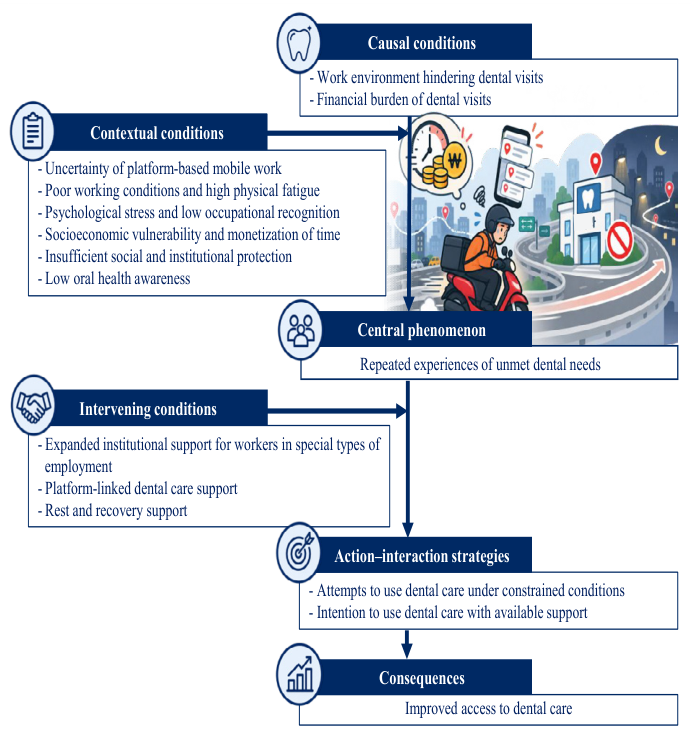
The relationships between the categories derived thereafter were connected to describe the flow of causal conditions, contextual conditions, the central phenomenon, intervening conditions, action–interaction strategies, and consequences <Fig. 1>.
1) Central phenomenon
The central phenomenon among platform-based mobile workers was ‘repeated experiences of unmet dental needs.’
Despite planning or making appointments to visit the dentist, they often failed to actually go, experienced delays or postponements in treatment due to not visiting on time even during ongoing dental care, and endured oral symptoms without seeking treatment, resulting in necessary dental care not being adequately met at the appropriate time. “I know I need to go to the dentist, but I keep putting it off. I only go when I really can’t bear it anymore.” (Participant 3) “Even when I made appointments, I often ended up not going. So, I kept missing out on treatment.” (Participant 8) “I’ve had toothaches many times, but I just endured them.” (Participant 11)
2) Causal conditions
The causal conditions were ‘work environment hindering dental visits’ and ‘financial burden of dental visits.’ Regarding ‘work environment hindering dental visits,’ participants stated that due to the nature of their work, it was ‘hard to schedule dental appointments’ and ‘not easy to secure time to visit the dentist.’ They also mentioned that during work hours, it was ‘difficult to access dental care,’ and after long working hours, they lacked ‘the leisure and energy to visit the dentist.’ Some participants perceived that ‘visiting the dentist while wearing work clothes itself was burdensome.’ “Even if I make a dental appointment, it’s hard to go at the scheduled time. So I keep postponing it.” (Participant 4) “After work, I’m so exhausted that I can’t even think about going to the dentist.” (Participant 14) “I can’t go to the dentist wearing my work clothes…” (Participant 15)
Regarding ‘financial burden of dental visits,’ participants stated that they often postponed or gave up dental visits due to the ‘burden of treatment costs.’ In particular, dental treatment was perceived as a medical service with a high cost burden, so when symptoms were not severe, they tended to delay treatment as a lower priority. “Dentist visits cost a lot of money at once, so I can’t go. I endure it until the pain gets worse.” (Participant 6) “I need to go to the dentist, but the cost of treatment right now is too burdensome.” (Participant 10) “When I think about the cost, it’s hard to go to the dentist right away. So I think I keep postponing it.” (Participant 13)
3) Contextual conditions
The causal conditions were reinforced by six contextual conditions: uncertainty of platform-based mobile work, poor working conditions and high physical fatigue, psychological stress and low occupational recognition, socioeconomic vulnerability and monetization of time, insufficient social and institutional protection, and low oral health awareness. Together, these conditions contributed to repeated experiences of unmet dental needs. Regarding ‘uncertainty of platform-based mobile work,’ participants described real-time changes in work locations, difficulty predicting the content and duration of tasks in advance, and irregular working hours. “I have to keep moving, so I can’t go to the dental clinic I usually visit.” (Participant 2) “Since I don’t know what jobs will come up today or how long they will take, I can’t even make an appointment.” (Participant 7)
Regarding ‘poor working conditions and high physical fatigue,’ participants performed long hours of high-intensity labor while being continuously exposed to various external environments such as vehicle vibrations, fine dust, exhaust fumes, and noise. At the same time, they reported high levels of fatigue due to a lack of sufficient space for rest or changing clothes. “I keep getting vibrations, so my back hurts a lot. It puts a lot of strain on my musculoskeletal system.” (Participant 11) “Working outside all day means dust sticks to my clothes and they smell. It’s a bit awkward to go to the dentist like that.” (Participant 12) “There’s nowhere to change clothes in the middle of the day… For us, standing on the street is what counts as resting.” (Participant 15)
Regarding ‘psychological stress and low occupational recognition,’ participants continuously experienced psychological pressure from the platform system, the burden of customer evaluations, and conflicts with customers. They also perceived that their occupation was not sufficiently respected by society and stated that even visiting the dentist while wearing their work uniform was burdensome. “When a call comes in, I have to pick it up quickly, so I’m constantly on edge.” (Participant 1) “They keep saying ‘delivery guy, delivery guy.’ Even among ourselves, we ignore it, so…” (Participant 6) “You have to get good ratings too. So even when you meet difficult customers, it’s not easy to speak up.” (Participant 9) “When I went to the dentist wearing my work uniform, I felt the way people looked at me was different.” (Participant 15)
Regarding ‘socioeconomic vulnerability and monetization of time,’ participants were placed in a situation of low work rates and unstable income structures due to a lack of social, cultural, and economic capital. They also perceived that since their earnings were based on the amount of work done, any time not working directly resulted in income loss. This led to viewing even dental visits as an economic loss, showing a tendency to prioritize livelihood maintenance over health care. “Break time itself is time when I can’t earn money, so going to the hospital is a burden.” (Participant 6) “If I can’t work while I’m at the dentist, my income for that day immediately decreases, so I can’t go easily.” (Participant 12) “I have debts and have to support my family, so even if my body is tired, I have no choice but to keep working.” (Participant 15)
Regarding ‘insufficient social and institutional protection,’ participants stated that unlike regular workers, they were not sufficiently guaranteed health checkups or welfare benefits, and there was no coverage for accidents or injuries. Therefore, even if an accident or illness occurred during work, it was difficult to receive institutional protection. This absence of institutional protection also served as another background factor preventing them from accessing necessary dental care at the appropriate time. “When I got into a traffic accident, my income for the next month immediately dropped to zero.” (Participant 3) “You can’t take sick leave like at a company when you’re sick, and if you take a day off, you lose that day’s income right away.” (Participant 2) “Quick service workers don’t get any support for dental care or health check-ups.” (Participant 14)
Regarding ‘low oral health awareness,’ participants did not perceive oral symptoms as serious health issues, and there was a strong perception that the dentist was a place to visit only when the pain became severe. Additionally, due to prioritizing making a living, there was a tendency to postpone oral health care or endure symptoms. “I thought the dentist was a place you go only when the pain is really unbearable.” (Participant 3) “Since making a living comes first, dental care keeps getting pushed back.” (Participant 8) “Even if my teeth felt a little uncomfortable, I just thought it was because I was tired and ignored it.” (Participant 14)
4) Intervening conditions
The intervening conditions identified were ‘expanded institutional support for workers in special types of employment,’ ‘platform-linked dental care support,’ and ‘rest and recovery support.’ Participants recognized, based on their experiences with oral health screening programs, that such support could help alleviate barriers to accessing dental care caused by time constraints and financial burdens.
Regarding ‘expanded institutional support for workers in special types of employment,’ participants perceived that institutional support tailored to the characteristics of platform-based mobile work should be established. In particular, they emphasized the need for public oral health screening programs for platform-based mobile workers and the inclusion of oral health examination items in health checkups for workers in special types of employment. They also suggested that time spent receiving health screenings or dental treatment should be recognized as working time or compensated for as income loss. Some participants further noted that social safety nets, such as a basic income or minimum income guarantee, could reduce financial pressures and allow them to seek dental care when needed. “If I could receive regular oral health screenings like office workers do, it would feel much less burdensome.” (Participant 4) “If dental examinations were included in routine health checkups, I would not need to set aside additional time for them.” (Participant 8) “If the time spent receiving health screenings were recognized as working time, I could attend much more comfortably.” (Participant 14)
Regarding ‘platform-linked dental care support,’ participants reported that the nature of platform-based mobile work makes it difficult to access dental services during regular weekday clinic hours. Therefore, they emphasized the need for expanded evening and weekend dental services as well as platform-linked dental support systems. For example, they suggested recommendation services that identify available dental clinics based on workers’ locations or travel routes, appointment systems integrated within platform applications, and partnerships with affiliated dental clinics. Participants believed that such measures would improve access to dental care. They also highlighted the importance of oral health screenings and counseling services provided through shelters for platform-based mobile workers, as well as expanded evening and weekend services tailored to their work schedules. “Because I work throughout the day, I need to be able to visit a dentist conveniently at night or on weekends.” (Participant 5) “If appointments could be made directly through the platform, it would reduce the burden of searching and making phone calls during work.” (Participant 6) “Since it is difficult to visit a local dental clinic anyway, it would be much more convenient if only clinics near my usual route were shown.” (Participant 10)
Regarding ‘rest and recovery support,’ participants reported that long working hours and inadequate rest environments made it difficult to utilize dental care services. Therefore, they emphasized the need to expand shelters for platform-based mobile workers and provide sufficient rest facilities during work. Participants viewed shelters not only as places for rest but also as potential hubs for oral health screenings and health counseling. They further perceived that ensuring adequate rest time would facilitate their ability to seek dental care. “Because we spend most of our time working outdoors, having a proper place to rest is extremely important.” (Participant 4) “If there were more shelters, it would be easier to take breaks, brush our teeth, and even change work clothes.” (Participant 15)
5) Action–interaction strategies
The action–interaction strategies identified were ‘attempts to use dental care under constrained conditions’ and ‘intention to use dental care with available support.’
Regarding ‘attempts to use dental care under constrained conditions,’ participants reported making efforts to access dental care and maintain oral health within the limitations imposed by their work environments. Because it was difficult to visit dental clinics during weekday daytime hours, they sought clinics providing evening and weekend services or prioritized dental facilities located along their work routes. Some participants took advantage of oral health screenings offered at shelters for platform-based mobile workers and perceived these services as more accessible than arranging separate dental visits. When immediate dental care was not feasible, participants attempted to minimize deterioration in oral health through daily self-care practices such as tooth brushing and the use of oral hygiene products. In addition, some reported regulating their working and resting hours or utilizing shelters to reduce physical fatigue caused by excessive workloads. “Since I work continuously during weekday daytime hours, I tend to look for clinics that provide weekend or evening services.” (Participant 10) “Because it is difficult to visit a neighborhood dental clinic, I have already identified clinics that I can access along my usual work route.” (Participant 3) “I came because I heard that oral health screenings were being offered at the shelter.” (Participant 12) “Since I cannot immediately visit the dentist, I try to pay extra attention to brushing my teeth before work and before going to bed.” (Participant 6) “I set my own work schedule and limit my hours. Otherwise, the physical strain becomes too great.” (Participant 5)
Regarding ‘intention to use dental care with available support,’ participants stated that although it is currently difficult to visit dental clinics because of their working conditions, they would be willing to seek dental care if institutional and environmental support were provided. “If the time spent receiving health screenings were officially recognized, like it is for regular employees, and some kind of protection were provided, I would definitely participate.” (Participant 3) “If information about hospitals and appointment services were connected through the platform, I think it would be much easier to use.” (Participant 14) “If shelters continued to offer screenings and counseling, I think many more people would participate.” (Participant 6)
6) Consequences
The consequence identified in the paradigm model was ‘improved access to dental care.’
Participants reported that the oral health screenings provided at shelters for platform-based mobile workers motivated them to visit dental clinics in practice. They perceived that institutional and environmental support designed to accommodate the characteristics of platform-based mobile work would reduce barriers to dental care utilization and increase participation in both oral health screenings and dental treatment. Furthermore, they believed that such support would encourage better oral health management practices and enable workers to receive necessary dental care at appropriate times. Consequently, they expected that repeated experiences of unmet dental needs would be alleviated.
This study conducted in-depth interviews with platform-based mobile workers and analyzed the data using a grounded theory approach to understand their experiences of unmet dental care needs and identify potential strategies for improvement. A total of 15 participants were included in the study. Data saturation was reached during the interview process, as no new concepts or categories emerged. This sample size was considered adequate for exploring shared experiences among platform-based mobile workers, consistent with previous research by Hagaman and Wutich [15], which found that common themes within relatively homogeneous groups can be identified with 16 or fewer interviews.
The central phenomenon identified in this study was repeated experiences of unmet dental needs, consistent with previous evidence of greater unmet dental care among platform-based mobile workers than among the general adult population [8]. The causal conditions were work environments that hindered dental visits and the financial burden of dental care, while contextual conditions—including uncertainty of platform-based mobile work, poor working conditions and high physical fatigue, psychological stress and low occupational recognition, socioeconomic vulnerability and monetization of time, insufficient social and institutional protection, and low oral health awareness—further reinforced these barriers. These findings suggest that repeated unmet dental needs reflect structural constraints arising from the interaction of occupational, economic, and social conditions rather than inadequate individual health management.
First, unpredictable work assignments and constantly changing work locations made it difficult for platform-based mobile workers to anticipate schedules [16]. Given that occupational factors influence missed healthcare appointments [17,18], the temporal and spatial uncertainty inherent in platform-based mobile work may hinder access to appointment-based dental services. In addition, continuous exposure to vibration, noise, exhaust fumes, and fine particulate matter, combined with inadequate rest facilities, may increase physical fatigue and reduce workers’ capacity for self-care [19–21]. Some workers also felt uncomfortable visiting dental clinics in work attire, reflecting broader experiences of occupational stigma and social discrimination [22,23].
Second, the platform-based work system itself contributed to physical and psychological fatigue. Continuous monitoring of mobile applications and rapid responses to job opportunities kept workers focused on platform notifications, even during rest periods [6,24]. This reflects the “nanosecond culture” described in previous research, in which constant connectivity and responsiveness blur the boundaries between work and non-work time [6]. As rest and healthcare utilization become absorbed into this continuous networked time, working hours are effectively extended, contributing to cumulative physical and psychological exhaustion [24].
Third, participants described “time as money,” perceiving non-working time as forgone income rather than an opportunity for rest [25]. Because earnings depend on completed tasks, time spent visiting a dental clinic directly translates into income loss. This monetization of time, characteristic of task-based platform work, makes both rest and healthcare utilization potential economic losses [26]. Combined with constant mobility, this made dental care not only a treatment expense but also a sacrifice of potential earnings, leading some workers to postpone treatment or continue working despite symptoms. Furthermore, many workers entered platform work because of economic necessity, including living expenses and debt repayment [26,27], making out-of-pocket dental costs an additional burden. Consequently, livelihood needs were often prioritized over dental care, resulting in delayed treatment and continued tolerance of symptoms.
To address these unmet dental needs, three intervening conditions were identified: expanded institutional support for workers in special types of employment, platform-linked dental care support, and rest and recovery support. These conditions influenced action–interaction strategies by strengthening workers’ willingness and ability to utilize dental care.
First, participants highlighted the need for regular oral health screening programs specifically designed for platform-based mobile workers, inclusion of oral health components in health examinations for workers in special types of employment, recognition of dental visits and oral health screenings as working time, and financial compensation for income loss associated with health examinations. Participants believed that institutional support for oral health services would reduce both the financial burden and psychological barriers associated with dental visits. Although recent efforts have expanded social protection and occupational health support for platform workers and other workers in special types of employment, preventive health services, including oral healthcare, remain insufficiently addressed [9].
Second, platform-linked dental care support represents a strategy that leverages the strengths of platform systems themselves. Participants reported that access to real-time information regarding nearby dental clinics, evening and weekend services, and appointment availability through platform applications would greatly facilitate dental care utilization. They also suggested partnerships between platform companies and dental providers that could offer appointment scheduling services, screening reminders, and other supportive resources. Because platform companies already manage workers’ locations and routes in real time, integrating oral health support into existing systems may represent a practical strategy for improving healthcare accessibility.
Third, there is a need to expand environments that support rest and recovery among platform-based mobile workers. Previous studies have reported that these workers often lack access to rest areas and restroom facilities during work and therefore rely on informal strategies such as exchanging information with colleagues [7]. This finding suggests that platform-based mobile workers frequently lack spaces not only for rest but also for basic health management [16]. Participants identified the expansion of shelters and rest facilities as a priority support measure. While local governments have recently increased the number of shelters for platform workers, limitations related to accessibility and regional disparities remain. Therefore, collaboration among platform companies, restaurants, convenience stores, and other businesses frequently visited by workers could supplement public efforts by utilizing existing community resources [7]. Such spaces could serve not merely as rest facilities but also as venues for preventive oral health services, including oral hygiene management, oral health education, and regular oral health screenings. From a dental hygiene perspective, community-based oral health programs could also be developed through collaboration with local dental clinics and dental hygiene educational institutions, enabling dental hygienists to provide oral health assessments, oral hygiene education, counseling, and referral services within these settings.
This study has several limitations. Participants were recruited in Seoul from workers who had visited shelters and participated in oral health screenings, which may limit representativeness and introduce selection bias. Most participants were also male. Although women account for less than 10% of platform workers in Seoul [28], they may experience disproportionately unfavorable working conditions and discrimination [29]; future studies should therefore include more female workers and geographically diverse samples. Despite these limitations, this grounded theory study provides a worker-centered framework for understanding unmet dental needs in relation to labor conditions and social protection and offers a foundation for developing oral health policies and preventive programs for platform-based mobile workers.
This study found that repeated experiences of unmet dental needs among platform-based mobile workers result from the combined effects of irregular working hours, continuous mobility, income loss associated with dental visits, the financial burden of dental treatment, and inadequate social and institutional protection. Participants perceived that institutional support and platform-linked interventions tailored to the characteristics of platform-based mobile work could help alleviate barriers to dental care utilization. The findings suggest that unmet dental care needs among platform-based mobile workers should be understood not merely as an issue of individual health behavior but as a consequence of broader labor and social protection conditions. This study provides foundational evidence for the development of future oral health policies and preventive health management systems aimed at improving oral health outcomes among platform-based mobile workers.
Conceptualization: NY Tak, JI Ryu; Data collection: NY Tak; Formal analysis: NY Tak; Writing-original draft: NY Tak, JI Ryu; Writing-review and editing: NY Tak, JI Ryu.
The authors declared no conflicts of interest.
None.
This study was approved by the Institutional Review Board of Kyung Hee University (KHSIRB-22-111-1(RA)).
The qualitative data generated in this study are not publicly available to protect participant confidentiality and minimize the risk of identification.
This article is based on a part of the corresponding author's doctoral dissertation (Kyung Hee University, 2024).
The authors used ChatGPT (OpenAI, San Francisco, CA, USA) to generate the illustrative graphical elements in Fig. 1. The authors reviewed and edited the figure as needed and take full responsibility for its content.
1. Jang SH, Baek K. Factors associated with work-related injuries among male platform delivery and transportation workers. Health Soc Sci 2025;69:27–48.
[DOI]
2. Silva V. The ILO and the future of work: the politics of global labour policy. Glob Soc Policy 2022;22(2):341–58.
[DOI]
3. Wallis M, Bojadžijev M, Altenried M. Platform mobilities: migration and digital labor. In: The SAGE Handbook of Digital Labour. Edited by Bulut E, Chen JY, Grohmann R, Jarrett K: London: SAGE Publications; 2025:147–56.
[DOI]
4. Lee SY, Baek SH. COVID-19 pandemic and essential workers: conceptual framework of essential workers and support policies. Citiz World 2022;(40):53–95.
[DOI]
5. Kim SG. Occupational safety and health status of workers in special types of employment 1: parcel delivery workers: platform labor and occupational health. Wolgan Saneop Bogeon 2019;374:13–26.
6. Park SM. Culture of immediacy and shadow work in platform delivery economy. Econ Soc 2021;(130):208–36.
[DOI]
7. Ryu JI, Tak NY. A qualitative study on the oral health of mobile platform workers: focus on tooth brushing experience. J Korean Acad Oral Health 2024;48(2):40–8.
[DOI]
8. Dobong-gu Workers’ Support Center. Oral health status and health promotion measures for mobile workers. Seoul: Dobong-gu Workers’ Support Center. 2022.
9. Ryu JI, Cha EG. Related factors for the denture needs among platform workers in Seoul. J Korean Acad Oral Health 2023;47(2):73–9.
[DOI]
10. Pyo J, Lee W, Choi EY, Jang SG, Ock M. Qualitative research in healthcare: necessity and characteristics. J Prev Med Public Health 2023;56(1):12–20.
[DOI][PubMed][PMC]
11. Mohajan D, Mohajan HK. Exploration of coding in qualitative data analysis: grounded theory perspective. Res Adv Educ 2022;1(6):50–60.
[DOI]
12. Ahmad M, Wilkins S. Purposive sampling in qualitative research: a framework for the entire journey. Qual Quant 2025;59(2):1461–79.
[DOI]
13. Alordiah CO, Oji J. Theoretical sampling strategies in qualitative interviews: enhancing data richness and theoretical saturation. NIU J Soc Sci 2024;10(2):181–91.
[DOI]
14. Strauss A, Corbin J. Basics of qualitative research: techniques and procedures for developing grounded theory. 2nd ed. Thousand Oaks: SAGE Publications; 1998.
15. Hagaman AK, Wutich A. How many interviews are enough to identify metathemes in multisited and cross-cultural research? Another perspective on Guest, Bunce, and Johnson’s (2006) landmark study. Field Methods 2017;29(1):23–41.
[DOI]
16. Kim S, Kang M. Platform workers’ experiences of time and space. Korea Soc Policy Rev 2022;29(1):3–47.
[DOI]
17. Paust A, Lau SR, Bro F, Prior A, Mygind A. Temporal capital and unaligned times as inequality mechanisms: a case study of chronic care in general practice. Soc Sci Med 2023;338:116337.
[DOI][PubMed]
18. Alabdulkarim Y, Almukaynizi M, Alameer A, Makanati B, Althumairy R, Almaslukh A. Predicting no-shows for dental appointments. PeerJ Comput Sci 2022;8:e1147.
[DOI][PubMed][PMC]
19. Lee GH, Kim SW. Exposure assessment of particulate matter among door-to-door deliverers using GPS devices. J Korean Soc Occup Environ Hyg 2017;27(1):13–22.
[DOI]
20. Schor JB, Tirrell C, Vallas SP. Consent and contestation: how platform workers reckon with the risks of gig labor. Work Employ Soc 2024;38(5):1423–44.
[DOI]
21. Choi Y, Kim I, Song J. Association between long working hours and unmet dental needs in wage workers. BMC Oral Health 2023;23:570.
[DOI][PubMed][PMC]
22. Muldoon J, Pigatto G. Racial discrimination in the platform economy: comparative experiences from food delivery riders in London and São Paulo. Digit Geogr Soc 2026;10:100165.
[DOI]
23. Long H, Yang Y, Chen L, Luo S, Lai H. Occupational and psychosocial risk factors for depression among uninsured middle-aged food delivery riders. BMC Psychol 2026;14:129.
[DOI][PubMed][PMC]
24. Yu D, Lee SSY, Ko T. Overwork without an employer: fictitious autonomy and algorithmic control in South Korea’s platform economy. J Asian Public Policy 2026:1–16.
[DOI]
25. Küçük D. Concept of working time in platform work. Selçuk Üniv Huk Fak Derg 2023;31(4):1689–727.
[DOI]
26. Joung S. Precariat on the street: life and sense of practice of delivery app workers. OUGHTOPIA 2020;35(2):81–130.
[DOI]
27. Kang M, Kim S. Why do delivery app drivers continue to work on delivery? Drawing on Bourdieu’s forms of capital. Korean J Soc Welf 2021;73(1):65–94.
28. Kim JJ, Kim YW, Kim YH, Kim YY, Kim JH, Noh SC, et al. A study on the current status and policy tasks of digital platform labor in Seoul. Seoul: Korea Labour & Society Institute. 2020.
29. Gerber C. Gender and precarity in platform work: old inequalities in the new world of work. New Technol Work Employ 2022;37(2):206–30.
[DOI]
목적: 본 연구는 플랫폼 이동노동자의 미충족 치과의료 경험을 탐색하고, 근거이론적 접근을 통해 치과의료 이용에 영향을 미치는 요인과 과정을 규명하고자 하였다. 방법: 서울 지역 플랫폼 이동노동자 15명을 대상으로 심층면담을 실시하였다. 연구 참여자는 대리운전기사, 배달기사 및 퀵서비스 종사자로 구성되었다. 목적표집을 통해 연구 참여자를 선정하였으며, Strauss와 Corbin의 근거이론 방법론에 따라 개방코딩, 축코딩 및 선택코딩을 통해 자료를 분석하였다. 결과: 중심현상은 ‘반복되는 미충족 치과의료 경험’으로 나타났다. 인과적 조건은 ‘치과 방문을 저해하는 근무환경’과 ‘치과 방문의 경제적 부담’이었다. 맥락적 조건은 ‘플랫폼 이동노동의 불확실성’, ‘열악한 근무환경과 높은 신체적 피로’, ‘심리적 스트레스와 낮은 직업적 인식’, ‘사회경제적 취약성과 시간의 금액화’, ‘불충분한 사회적·제도적 보호’, ‘낮은 구강건강 인식’으로 나타났다. 중재적 조건은 ‘특수형태근로종사자에 대한 제도적 지원 확대’, ‘플랫폼 연계 치과의료 지원’, ‘휴식 및 회복 지원’이었다. 작용·상호작용 전략은 ‘제약된 조건에서의 치과의료 이용 시도’와 ‘지원 활용을 통한 치과의료 이용 의향’으로 나타났다. 그 결과, 참여자들은 이러한 지원이 치과의료 접근성 향상에 도움이 될 수 있다고 인식하였다. 결론: 플랫폼 이동노동자의 미충족 치과의료는 예측하기 어려운 근무환경, 경제적 부담 및 불충분한 사회적 보호와 관련된 구조적 제약을 반영하였다. 이러한 결과는 구강건강 정책과 치과의료 접근성 향상을 위한 제도·플랫폼·쉼터 연계 전략을 개발하는 데 기초자료로 활용될 수 있다. 주요어: 치과의료, 근거이론, 보건의료서비스 접근성, 직업건강, 구강건강, 질적연구